
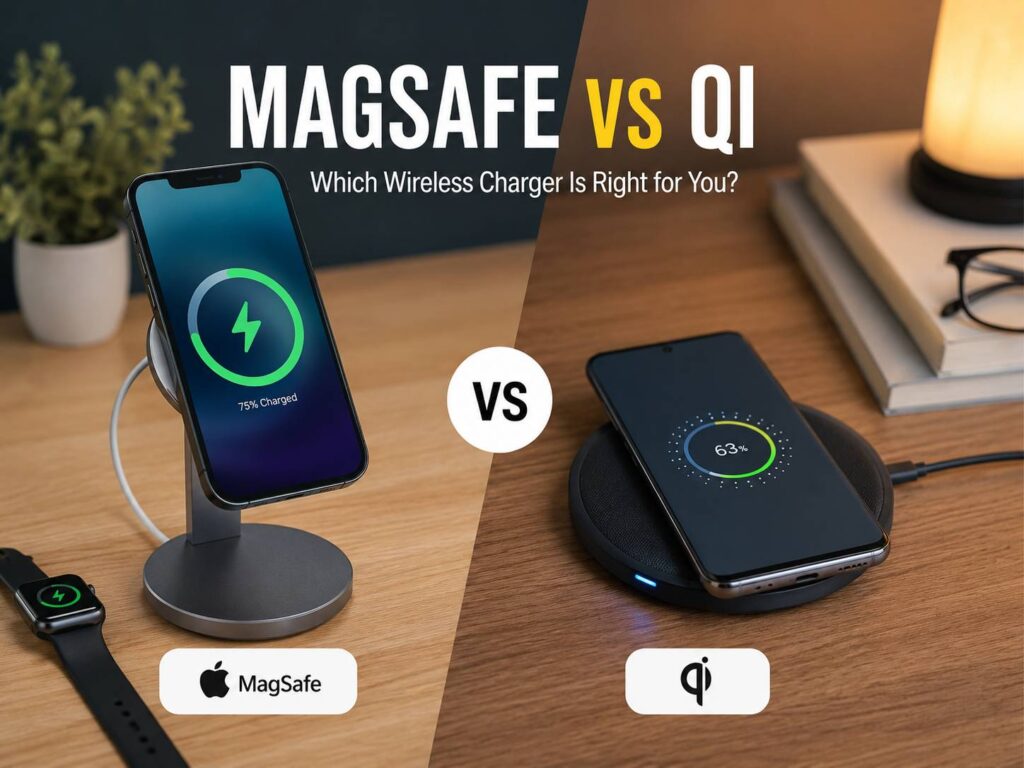
Wireless charging has changed a lot in the past few years. At first, most phones used basic Qi charging pads. Then Apple introduced MagSafe with the iPhone 12 series. More recently, Qi2 brought magnetic charging to a wider range of phones and accessories.
That makes the MagSafe vs Qi question a little more complex than it used to be.
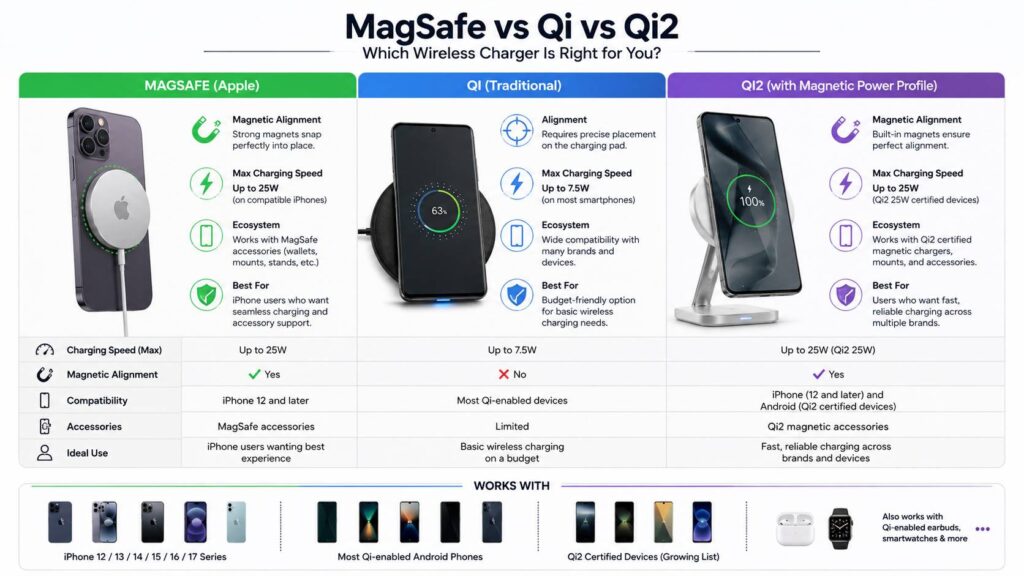
Traditional Qi is still common and cheap. MagSafe offers strong magnetic alignment and a large iPhone accessory range. Qi2 sits between them and brings many of MagSafe’s best ideas to a wider group of devices.
So, which one makes more sense in 2026?
For most people buying a new wireless charger, Qi2 is now the best place to start. Still, MagSafe remains a great fit for iPhone users, and old Qi chargers are far from useless.
This guide explains the real differences in charging speed, heat, phone cases, battery use, car charging, power banks, and day-to-day use.
What Is Qi Wireless Charging?
Qi is a wireless charging standard used by many phone makers.
Instead of plugging a cable into the phone, you place the device on a charging pad or stand. Power then moves from the charger to a coil inside the phone.
The main benefit is simple. Qi works with a huge range of devices.
You can find Qi chargers built into:
- Charging pads
- Desk stands
- Cars
- Power banks
- Alarm clocks
- Furniture
- Hotel rooms
- Airport charging areas
- Multi-device docks
Yet old Qi charging has one clear weak point. Placement matters.
The charging coil inside the phone needs to sit close to the coil inside the charger. If the phone moves too far from the right spot, charging can slow down or stop.
That problem is easy to notice on a flat charging pad. You place the phone down at night, see the charging icon, and go to sleep. In the morning, you may find that the phone moved slightly and never finished charging.
This is one of the main reasons magnetic charging became so popular.
What Is MagSafe?
MagSafe is Apple’s magnetic charging and accessory system for iPhone.
Apple added a ring of magnets around the wireless charging coil inside compatible iPhones. A MagSafe charger uses matching magnets, so it snaps into the right position.
As a result, you do not need to carefully line up the phone with the charger.
That sounds like a small upgrade, but it makes wireless charging much easier.
You bring the charger close to the phone, and it attaches itself. The magnets then hold the charger in place.
MagSafe can also support much more than charging.
Common MagSafe accessories include:
- Wallets
- Car mounts
- Desk stands
- Power banks
- Tripods
- Charging docks
- Ring grips
- Phone holders
For me, this is the real strength of MagSafe. The charging speed is useful, but the magnetic system makes wireless charging easier to trust.
A charger that stays lined up is often more useful than one with a slightly higher number printed on the box.
What Is Qi2?
Qi2 is the newer version of the Qi wireless charging standard.
The big change is magnetic alignment.
With Qi2, the phone and charger can lock together in a similar way to MagSafe. This keeps the charging coils lined up and reduces the need to move the phone around until charging starts.
Early Qi2 chargers supported up to 15W.
Newer Qi2 25W chargers can reach up to 25W with phones that support that speed.
So, the gap between MagSafe and Qi2 is now much smaller.
Qi2 also has another major benefit. It is not tied to Apple.
That means phone makers can add magnetic Qi2 charging without creating their own separate system.
For buyers, that can make chargers more useful for longer. A good Qi2 charger can work across more than one phone brand, depending on device support.
If you want to see how this newer charging type works in a real product, the KUXIU D5 Qi2.2 charger is a useful example of the newer generation of magnetic wireless chargers.
MagSafe vs Qi Charging Speed
Charging speed is one of the biggest differences between old Qi and newer magnetic chargers.
Traditional Qi charging on many iPhones is limited to lower speeds. In many cases, that means up to 7.5W.
MagSafe can go much faster on supported iPhones.
Newer MagSafe hardware can reach up to 25W with the right iPhone and a strong enough USB-C power adapter.
Qi2 has followed a similar path.
The first Qi2 products commonly topped out at 15W. Qi2 25W raised that limit to 25W on supported phones and chargers.
Still, one detail matters a lot.
A 25W charger does not mean every phone will charge at 25W.
Your phone decides how much power it can accept. So, a phone with a 15W wireless charging limit will still charge at up to 15W on a 25W charger.
The wall adapter matters too.
For example, a 25W wireless charger connected to a weak USB power adapter will not reach its full speed.
For the best results, all three parts need to support the right power level:
- The phone
- The wireless charger
- The USB-C wall adapter
If one part is slower, the whole setup slows down.
MagSafe vs Qi2: What Is the Real Difference?
MagSafe and Qi2 now feel very similar during normal use.
Both can offer:
- Magnetic alignment
- Magnetic stands
- Magnetic car mounts
- Wireless charging
- Magnetic power banks
- Easy one-handed attachment
Still, they are not the same system.
MagSafe is Apple’s own system. Qi2 is a wider wireless charging standard.
For an iPhone-only home, that difference may not matter much.
For a mixed home with iPhones and Android phones, Qi2 makes more sense.
It gives you magnetic charging without tying every charger to one brand.
That is why I would now look at Qi2 first when buying a new general-purpose wireless charger.
Is MagSafe More Reliable Than Qi?
In daily use, magnetic charging is often more reliable than old Qi.
The reason is alignment.
With a basic Qi pad, you need to place the phone in roughly the right position. With MagSafe or Qi2, the magnets guide it into place.
That helps on a nightstand. It also helps much more in a car.
A phone can slide around on a normal charging tray during braking or cornering. Once it moves away from the charging coil, charging may stop.
A magnetic car mount keeps the phone fixed in one place.
The same benefit applies to charging stands and power banks.
So, if you often find that your phone did not charge properly overnight, moving to MagSafe or Qi2 can solve a very real problem.
Does MagSafe Get Hotter Than Qi?
Wireless charging creates some heat.
That is normal.
Part of the power is lost during wireless transfer, and some of that lost energy becomes heat.
Faster charging can create more heat too.
Several things can make the phone warmer:
- Fast wireless charging
- A thick case
- Poor coil alignment
- Gaming during charging
- Navigation
- High screen brightness
- Hot weather
- Direct sunlight
- Charging inside a hot car
Magnetic alignment can help here since the coils stay in the correct position.
Yet a 25W magnetic charger can still make a phone feel warmer than a slow 7.5W Qi pad.
This becomes easy to notice in a car.
GPS, mobile data, music, Bluetooth, and a bright screen all create heat. Add wireless charging on a hot summer day, and the phone may slow its charging rate.
For long trips, I still prefer wired USB-C charging when speed matters.
Is MagSafe Bad for Battery Health?
MagSafe does not automatically ruin your battery.
Heat is the bigger issue.
Phone batteries age over time, and high temperatures can speed up that process.
So, the goal is not to avoid MagSafe. The goal is to avoid letting the phone get very hot again and again.
A slightly warm phone during charging is normal.
A phone that becomes uncomfortably hot every day is different.
You can reduce heat by:
- Keeping the charger out of direct sun
- Removing very thick cases
- Using a good power adapter
- Avoiding games during fast charging
- Keeping car chargers near airflow
- Using certified charging gear
For most people, normal MagSafe or Qi2 use is fine.
I would pay more attention to heat than to the fact that the charger uses magnets.
Do Cases Affect MagSafe and Qi Charging?
Yes, cases can make a noticeable difference.
A normal thin case often works with standard Qi charging.
Magnetic charging is more demanding.
A thick non-magnetic case can weaken the connection between the phone and charger. The charger may still work, but it can slide off more easily.
That is why magnetic cases include their own ring of magnets.
They help the charger attach firmly through the case.
If you use MagSafe or Qi2 every day, a proper magnetic case is worth buying.
Metal is a different story.
Metal plates, metal cases, some wallet inserts, and large metal rings can block or disturb wireless charging.
So, avoid placing metal objects between the phone and charger.
Cards should stay out of the way too. Bank cards, key cards, and some access cards can contain magnetic or radio parts that do not belong between a phone and a magnetic charger.
Why Is My MagSafe or Qi Charger So Slow?
A slow wireless charger does not always mean the charger is faulty.
The power adapter is a common cause.
For example, you can buy a fast 25W wireless charger and then connect it to an old low-power USB plug. In that case, the charger cannot reach its rated speed.
Other common causes include:
- A weak wall adapter
- A USB-A plug
- A thick phone case
- Heat
- Poor phone placement
- Heavy phone use
- A low wireless charging limit on the phone
- A cheap charging cable
- Metal accessories near the coil
Battery level matters too.
Phones do not charge at full speed from 0% to 100%.
Charging speed usually falls as the battery gets closer to full. This helps control heat and battery stress.
So, do not judge a charger only by how fast it moves from 80% to 100%.
MagSafe vs Qi for Car Charging
Magnetic charging makes a lot of sense in a car.
A normal Qi pad can work, but the phone often moves around.
MagSafe and Qi2 mounts solve that problem.
The phone stays in place, and you can keep the screen visible for maps.
That makes magnetic charging a better choice for most drivers.
Still, heat can become a problem.
A phone running Google Maps or Apple Maps already works hard. Add 5G, Bluetooth, music, and a bright screen, and the phone starts warming up.
Then wireless charging adds more heat.
For short drives, that is rarely a big issue.
For a long trip in summer, a wired USB-C charger may charge faster and stay cooler.
MagSafe vs Qi for Overnight Charging
You do not need extreme charging speed overnight.
If your phone sits on a charger for seven hours, even a slower Qi pad has plenty of time to refill the battery in many cases.
That makes basic Qi chargers useful for bedrooms.
Still, I prefer magnetic charging beside the bed.
The reason is simple. It is harder to miss the charging spot.
You can attach the phone in the dark and know that the coils are lined up.
For overnight use, reliability matters more than raw speed.
MagSafe vs Qi for Power Banks
Magnetic power banks are one of the best uses of MagSafe and Qi2.
A normal wireless power bank can be awkward. You need to keep the phone lined up with the charging coil.
That is hard when walking around or putting the phone in a bag.
A magnetic power bank stays attached.
This makes it great for:
- Travel
- Festivals
- Long days away from home
- Photography
- Commuting
- Airports
- Train trips
There is a downside.
Wireless charging wastes more power than a cable.
So, a magnetic power bank may deliver less usable energy to your phone than you expect from the battery size printed on the box.
It can also create more heat.
For pure battery life, a cable is still better.
For ease of use, magnetic power banks are far nicer.
Should You Replace an Old Qi Charger?
Not always.
If your old Qi charger still works, there is no urgent reason to replace it.
Keep it if:
- You charge mainly overnight
- Speed does not matter
- Your phone always charges properly
- You use older devices
- You do not care about magnetic stands or mounts
A new charger makes more sense if:
- Your phone often misses the charging spot
- You want faster wireless charging
- You want a magnetic car mount
- You use a magnetic power bank
- You want a cleaner desk setup
- You are buying a charger for a new phone
For a new purchase, I would choose Qi2 over old Qi in most cases.
Should iPhone Owners Buy MagSafe or Qi2?
For an iPhone owner, both can be good choices.
Apple’s MagSafe system works very well with iPhone, and the accessory range is huge.
Qi2 is more flexible.
That makes Qi2 a smart choice if you expect to use the charger with different phones later.
Price can make the final decision.
A well-made Qi2 charger from a trusted brand can cost less than some MagSafe-branded products while giving you the same basic magnetic charging experience.
So, check three things before buying:
- Charging wattage
- Qi2 certification
- Phone compatibility
Do not buy based only on terms such as “MagSafe compatible” or “magnetic charger.”
Those phrases do not always tell you the real charging speed.
Which Wireless Charging Type Is Best?
Traditional Qi still works well for cheap and simple charging.
MagSafe remains one of the best choices for iPhone users who want magnetic accessories.
Qi2 is now the most useful choice for many new buyers.
It offers magnetic alignment, broader device support, and faster charging on newer hardware.
Qi2 25W makes the choice even more interesting. It can match the higher charging speeds offered by newer magnetic systems, as long as your phone supports that rate.
My preference for a new purchase is Qi2.
It gives you the feature that made MagSafe so useful, the phone snaps into the right place, but it does so through a wider charging standard.
Still, I would not throw away a working Qi charger just to upgrade.
Old Qi is slower and less convenient, but it still does the job.
The best choice depends on how you actually charge your phone.
For a bedside charger, old Qi is often enough.
For a car, I would pick MagSafe or Qi2.
For a power bank, magnetic charging is much easier to use.
For a charger you plan to keep through several phone upgrades, Qi2 makes the most sense.
MagSafe vs Qi FAQ
Is MagSafe faster than Qi?
Yes, on supported iPhones. Traditional Qi charging can run at lower speeds, while newer MagSafe setups can reach up to 25W on compatible hardware.
Is Qi2 the same as MagSafe?
No. Qi2 is a wider wireless charging standard. MagSafe is Apple’s own magnetic charging and accessory system. They now offer a very similar charging experience.
Is Qi2 better than old Qi?
For most new purchases, yes. Qi2 adds magnetic alignment and can support faster charging on compatible phones.
Does Qi2 work with iPhone?
Yes, supported iPhones can use Qi2 charging. Maximum speed depends on the exact iPhone model and charger.
Is MagSafe worth buying?
For iPhone users who charge wirelessly every day, it can be. The magnetic alignment makes charging easier, and the same system works with stands, mounts, wallets, and power banks.
Is wireless charging slower than USB-C?
Often, yes. Wired USB-C charging can deliver more power with less energy loss. Wireless charging wins on ease of use.
Can I use a normal case with MagSafe?
Sometimes, but the magnetic hold may be weak. A MagSafe or Qi2-ready case with its own magnetic ring works better.
Does MagSafe damage the battery?
Normal use does not mean automatic battery damage. Heat matters more. Keep the phone away from very hot places and avoid covering the charger during use.
Is Qi2 25W worth it?
It makes sense if your phone can accept 25W wireless charging. If your phone is limited to 15W, you will not get a 25W charging rate.