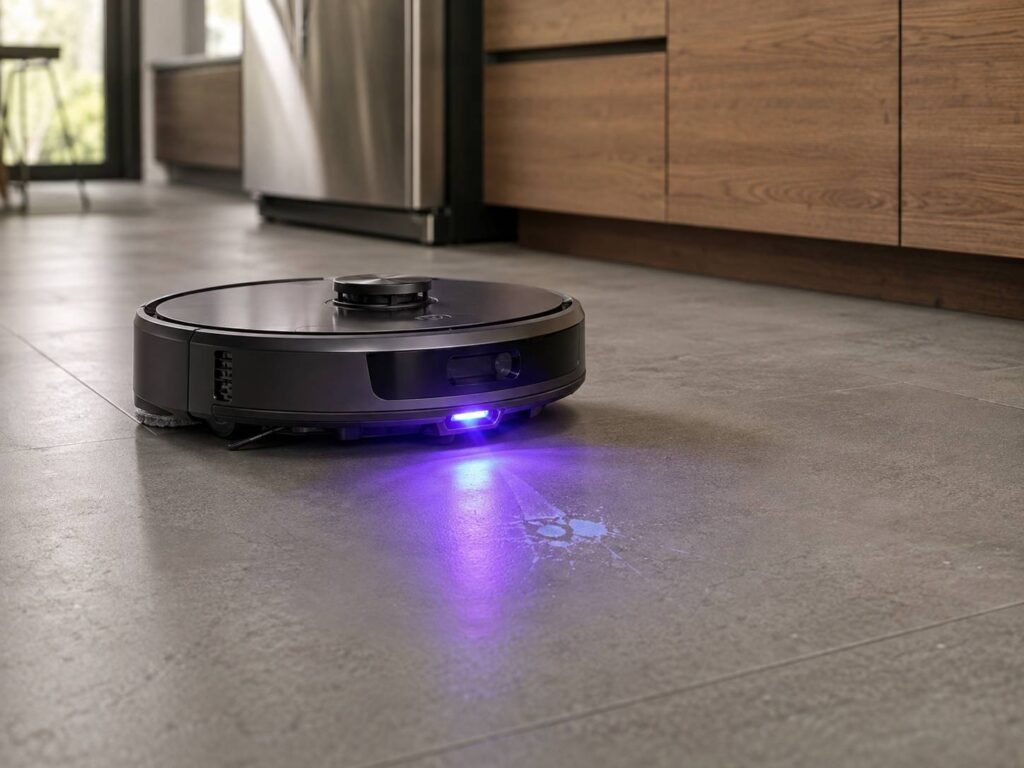
Robot vacuums have become much better at mapping rooms, avoiding furniture, and collecting everyday dirt. Mopping is a little more complicated. Most robots still clean the entire floor in roughly the same way, even if one small section needs far more attention.
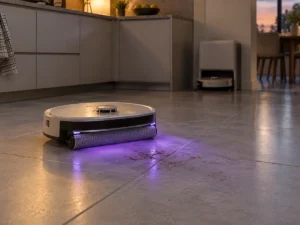
UV stain detection tries to solve that problem. It helps a robot spot dried spills and faint residue that may be hard to see under normal lighting. Once it finds something suspicious, the robot can return to the area, scrub it more thoroughly, and check the result.
It sounds impressive, and in the right home, it can be genuinely useful. Still, UV detection has limits. It cannot reveal every type of stain, and it does not guarantee that the robot can remove whatever it finds.
What Is UV Stain Detection?
UV stain detection uses ultraviolet illumination, cameras, and image-processing software to find marks on the floor. These may include dried drinks, food splashes, sticky residue, sweat, ground-in dirt, and traces left by pet accidents.
Some substances behave differently under ultraviolet light than they do under normal room lighting. A stain may fluoresce, which means it absorbs UV energy and releases some of it as visible light. Other residues may simply reflect or absorb UV light differently from the surrounding floor.
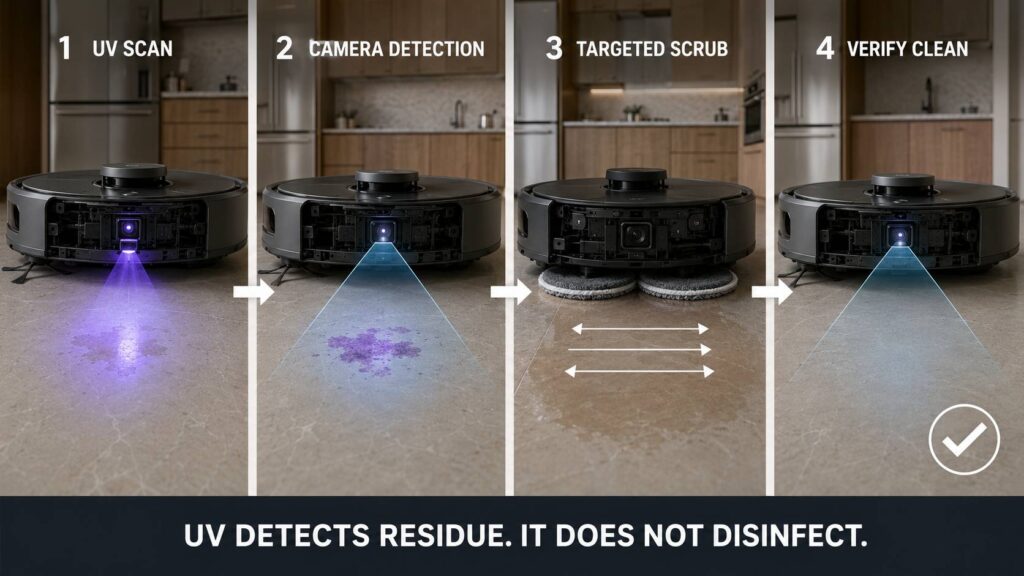
A camera records that change. The robot’s software then compares the suspicious patch with the clean surface around it. If the pattern resembles a stain, the robot remembers its position and schedules extra cleaning.
The UV light does not actually remove anything. It simply helps the robot find areas that may need more attention. The mop design, pressure, water flow, cleaning solution, and scrubbing action still do the real work.
How Does UV Stain Detection Work?
Manufacturers do not reveal every technical detail about their UV systems. Wavelengths, recognition thresholds, and image-processing methods may remain undisclosed. Even so, most systems follow the same basic process.
The robot illuminates the floor
A small UV light shines onto the area directly ahead of or underneath the robot. Because the light sits close to the floor, the camera receives a more consistent image. Normal changes in room lighting should have less influence at such a short distance.
Under UV illumination, certain residues stand out more clearly. For example, a dried splash that blends into a dark floor during the day may appear much brighter or darker to the robot’s camera.
Still, not every mark reacts in the same way. The result depends on the substance, its age, its concentration, and the type of flooring underneath it.
A camera examines the area
Current UV stain-detection systems combine ultraviolet light with RGB cameras or other optical sensors. The robot does not automatically treat every glowing spot as dirt.
Instead, its software can examine several details, including:
- The color and brightness of the area
- The size and shape of the suspected stain
- Differences between the stain and surrounding floor
- The surface texture
- The stain’s location within the room
- Information gathered during earlier cleaning passes
This analysis helps reduce false detections. That matters because floor polish, detergent residue, grout, repair products, and protective coatings can also look unusual under UV light.
The robot marks the stain’s location
If the software decides that a mark needs cleaning, the robot saves its position on the internal map. Some models may deal with it immediately. Others finish their main cleaning pass, return to the dock to wash the mop, and then come back.
A fresh mop can make a real difference here. Otherwise, the robot risks spreading dirty water or old residue while trying to clean the newly detected spot.
Targeted scrubbing begins
Once the robot returns, it changes its cleaning pattern. The exact response depends on the model, but it may:
- Move repeatedly across the stain
- Use a tighter back-and-forth motion
- Increase mop vibration or movement
- Apply more water or cleaning solution
- Approach the stain from several angles
- Wash the mop before trying again
Some robots also scan the area after cleaning. If the mark remains visible, the machine may perform another pass within its programmed limits.
That verification step is one of the feature’s most useful parts. A traditional robot follows its route and assumes the job is finished. A stain-aware robot can at least check its work.
UV Detection Is Different From Regular Dirt Detection
Manufacturers use several types of sensors to identify dirt. Their names often sound similar, but they do not all detect the same things.
Traditional dirt sensors usually respond to loose particles. For instance, a robot may detect debris passing through its intake or notice changes around the brush. It can then increase suction or repeat that section of flooring.
Visible-light cameras look for objects, spills, and marks that contrast with the floor. They can spot a dark splash on a light tile, but they may struggle with clear or faded residue.
Infrared sensors can help recognize wet areas. Because liquid reflects infrared light differently from a dry surface, a robot may detect a fresh spill and avoid vacuuming through it.
UV stain detection focuses on residue that becomes easier to distinguish under ultraviolet illumination. As a result, it can reveal dried marks that normal cameras and particle sensors may overlook.
The best approach combines several sensor types. UV should support the robot’s existing camera, mapping, and dirt-detection systems rather than replace them.
What Kinds of Stains Can UV Light Reveal?
Manufacturers promote UV detection for common household messes such as:
- Dried food and drink splashes
- Sticky patches
- Sweat residue
- Ground-in dirt
- Some pet-related accidents
- Faint marks on dark or patterned floors
Pet urine is one of the most discussed examples. Some dried urine residue becomes more visible under UV light, but detection is not guaranteed. Previous cleaning, flooring material, concentration, and the age of the stain can all affect the result.
The robot may also detect something without knowing exactly what it is. A bright patch could come from juice, detergent, floor polish, food, or a pet accident. UV detection identifies unusual optical patterns, not their precise chemical composition.
Does UV Light Sanitize the Floor?
No. UV stain detection and UV disinfection are not the same thing.
The UV light in a stain-detection system acts as an optical tool. It helps the camera see residue. It does not prove that bacteria, viruses, allergens, or odor-causing compounds have been removed.
Germicidal systems normally use specific forms of UVC light at controlled intensities and exposure times. A stain scanner has a different job.
Some premium robot docks advertise sanitizing features, but these usually rely on heated water, hot-air drying, or controlled mop-washing cycles. Those functions operate separately from the robot’s stain-detection light.
A floor can look clean while still carrying microorganisms. The opposite can happen too. A harmless trace of cleaning product may remain visible under UV even after the surface has been properly disinfected.
So, think of UV detection as a way to locate residue, not as a hygiene test.
Where Is UV Stain Detection Most Useful?
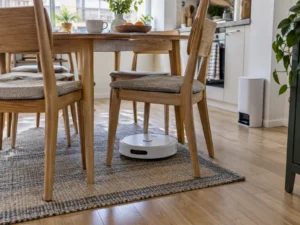
The feature makes the most sense in homes with plenty of sealed hard flooring. Kitchens, dining rooms, hallways, and pet feeding areas tend to collect dried splashes and sticky marks.
Families with young children may also find it useful. A few drops of juice or milk can dry quickly, especially on patterned tiles where the spill is difficult to notice.
Targeted cleaning may also save the robot from scrubbing the entire floor at maximum intensity. Instead, it can spend more time on smaller problem areas. Still, repeated scanning and extra cleaning passes may make the overall cycle longer.
UV detection has less value if most of your home is carpeted. It also will not improve pet-hair collection, deep carpet cleaning, or basic dust pickup. Those jobs depend on suction, brush design, airflow, and navigation.
The Main Limitations
UV stain detection is clever, but it is far from perfect.
Some stains will remain invisible
Not every substance produces a useful response under UV light. Grease, dye, paint, or deeply absorbed marks may show little contrast. In some cases, a normal RGB camera may detect the stain more easily.
Clean materials can cause false detections
Detergent, floor polish, grout, protective coatings, and repaired scratches may look suspicious under UV light. The robot could repeatedly scrub a permanent feature that will never disappear.
Finding a stain does not mean removing it
The robot may correctly locate a mark but lack the pressure or cleaning solution needed to remove it. Old grease, adhesive, paint, and residue trapped in textured flooring may still need manual treatment.
It mainly benefits hard floors
Targeted wet scrubbing only makes sense on compatible surfaces. The robot must avoid carpets while mopping, and owners should follow the floor manufacturer’s cleaning advice.
Repeated wet passes may not be suitable for unsealed wood or moisture-sensitive flooring. More scrubbing is not always better.
Dirty sensors can affect accuracy
Dust, hair, and smears around the UV light or camera may reduce detection quality. These components need occasional cleaning, just like cliff sensors and navigation cameras.
Extra passes use more time and energy
A robot that repeatedly checks stains may consume more battery power, water, and cleaning solution. It may also return to its dock more often.
A Good Mop Still Matters More Than the Sensor
A UV scanner cannot rescue a weak mopping system.
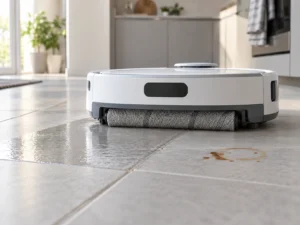
The robot still needs firm contact with the floor, steady water delivery, and enough mechanical movement to loosen dried residue. A roller mop, vibrating pad, or strong scrubbing pattern can matter more than the detection method itself.
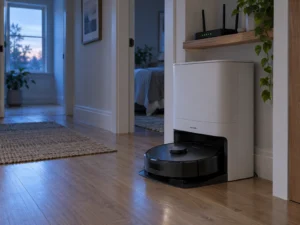
The dock matters as well. A robot should wash its mop properly between cleaning stages. Otherwise, it may drag dirty residue across a larger area.
Navigation also plays a part. Detecting a stain is not very helpful if the robot cannot return to the correct position. Accurate mapping, edge coverage, obstacle avoidance, and floor recognition all influence the final result.
For that reason, do not buy a robot based only on the words “UV stain detection.” Look at the entire cleaning system.
What Changed in 2026?
UV stain detection became far more visible in the robot-vacuum market during 2026.
Shark released the PowerDetect UV Reveal, which combines UV illumination with an RGB camera. The robot identifies hidden residue, returns for targeted scrubbing, and checks the area afterward.
In September 2026, Dyson announced the R3 Nurovi Spot+Scrub UV. Its AI stain scanner uses UV light to reveal and verify stains. The model was still listed as coming soon at the time of its announcement, so real-world comparisons remain limited.
These launches suggest that stain verification may become more common in premium robot mops. For now, though, the technology remains relatively new. Buyers should treat bold manufacturer claims carefully until more independent tests cover different floors, lighting conditions, and stain types.
What Should You Check Before Buying?
A useful UV stain-detection system should do more than make hidden marks visible. It should also respond in a practical way.
Before buying, check for:
- Strong targeted scrubbing
- Post-cleaning stain verification
- Reliable hard-floor and carpet detection
- Automatic mop washing
- Accurate room mapping
- Easy access to the camera and sensors for cleaning
- Adjustable stain-detection settings
- Limits on repeated cleaning attempts
- Clear support for your type of flooring
Privacy deserves attention too. These robots rely on cameras, which may capture parts of your home during navigation and stain detection.
Check whether the robot processes images locally, stores them, or sends them to cloud servers. Also look for controls that let you disable camera-based features or restrict remote access.
Is UV Stain Detection Worth Paying For?
UV stain detection is not just a flashy light. When paired with accurate software, strong mopping, and a verification pass, it can help a robot find dried residue that a conventional model might ignore.
Still, it serves a fairly specific purpose. It cannot reveal every stain, identify every substance, disinfect the floor, or guarantee complete removal.
The feature makes the most sense for homes with pets, children, frequent spills, and large areas of hard flooring. It may also appeal to anyone who regularly finds sticky patches after a robot has supposedly finished cleaning.
If you mostly need carpet vacuuming or basic daily dust collection, a more affordable model with good navigation and strong suction may offer better value. UV detection is a useful bonus, but the quality of the overall cleaning system still matters far more.