Keychron lets you move the click point on its new G6 HE mouse through 11 steps, on a button whose whole travel it lists as 0.65 mm. Keychron is taking pre-orders, and on October 11 its US store had the swappable-battery version at $89.99. That version ships with a second battery and a dock that charges it while working as the 8,000 Hz receiver. Of the two headline features, the battery system will change more about daily use, because each actuation step can move the click point by a few hundredths of a millimeter at most.
What the MagOptic switch does
The MagOptic switch, which Keychron bills as a first for a gaming mouse, reads each main button with both an optical and a magnetic sensor and still gives a physical click. The magnetic side measures how far the button has moved, so the actuation point can be set in software. Rapid Trigger, a setting borrowed from Hall effect keyboards, re-arms the button as soon as it starts to rise, which Keychron pitches for faster repeated inputs.
Both live in Keychron Launcher, a web app that runs in Chrome, Edge or Opera with the mouse connected by cable or through its receiver. Settings are saved to the mouse, so they travel with it to another computer.
Logitech reached the same two settings by a different route. The Logitech G PRO X2 SUPERSTRIKE has no switch under its main buttons. It senses how far you press and produces the click electronically with haptics. The G6 HE keeps a mechanical click, which takes away the question of whether a simulated one feels right in your hand.
How small the 11 steps are
Keychron has not published the range its 11 actuation steps cover. They have to fit inside the click’s travel, which Keychron lists with a tolerance of 0.07 mm either way. Spread evenly across that whole travel, 11 points leave 10 gaps of 0.065 mm each, and any narrower range makes the steps smaller still.
That puts the gap between two neighboring settings below the variation Keychron allows in the travel itself. The setting is a fine trim on a short click rather than a way to turn a light trigger into a heavy one.
The 11-step lift-off distance on the same spec sheet is a different setting. It decides how high you can lift the mouse before the sensor stops tracking.
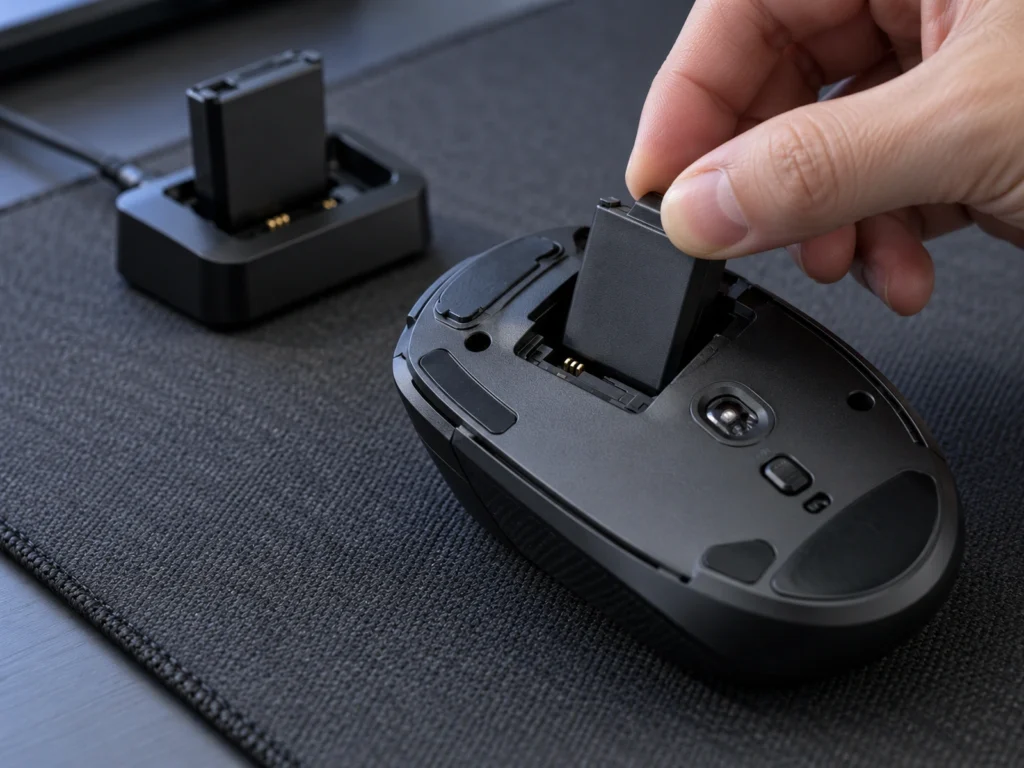
A second battery and a dock that charges it
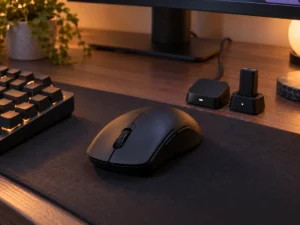
The swappable-battery version comes with two batteries, one installed and one spare, and the TurboLink 8K, a small dock that is the receiver and the charger for the spare at once. Keychron says a swap takes about 3 seconds. The dock also carries four buttons you can set for shortcuts, macros or launching apps.
Keychron rates the battery for up to 33 hours at 8,000 Hz. At four hours of play a day that is about eight days per battery, with the spare waiting in the dock. At 1,000 Hz the rating rises to 191 hours, almost seven weeks at the same pace, and Bluetooth 5.3 is rated at 271 hours. The SteelSeries Sensei Pro works the same way, with two batteries rated at 16 hours each at the same polling rate.
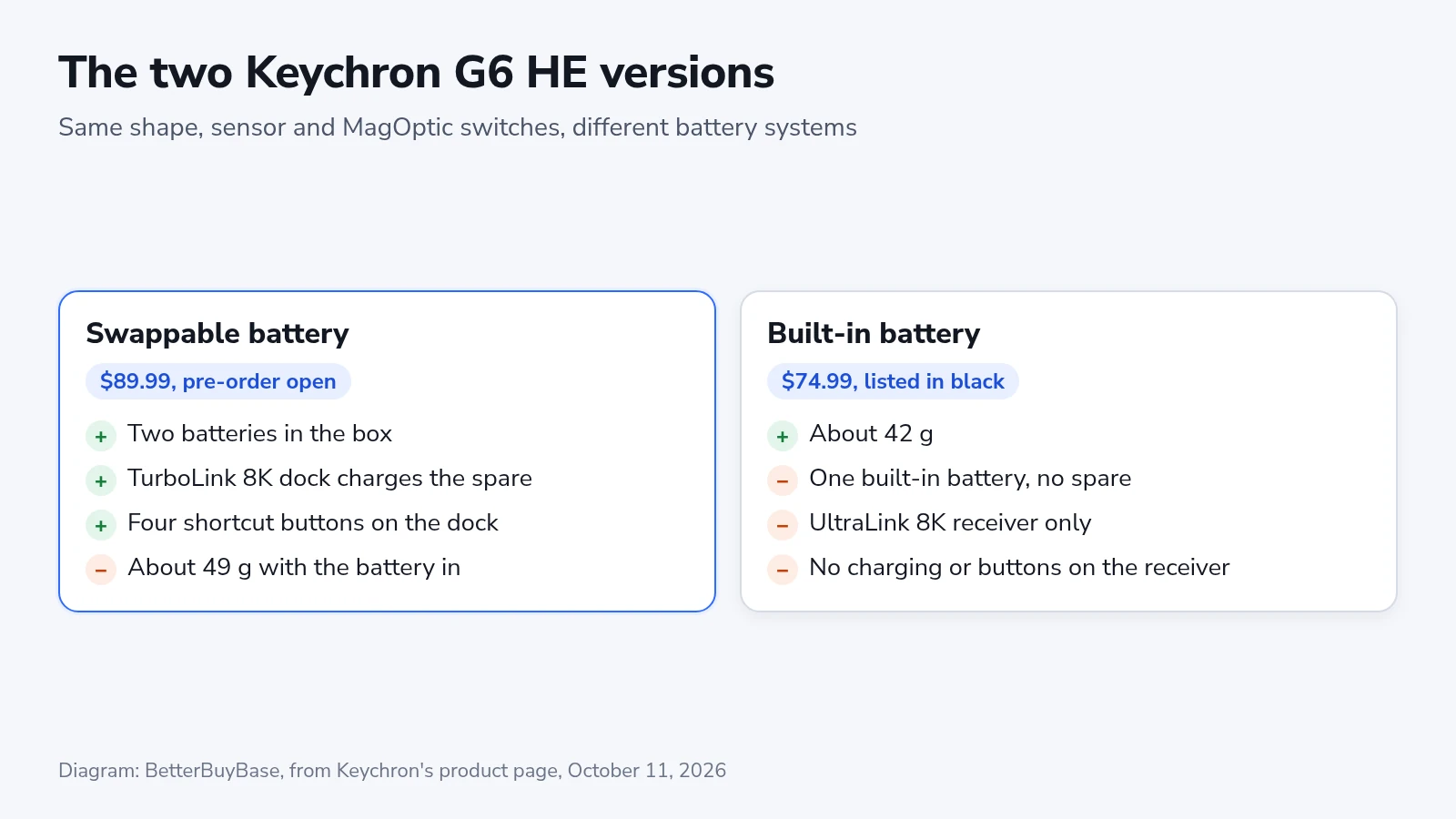
The battery sets the weight. Keychron gives about 49 g with the battery in for wireless play, about 41 g wired with the battery out, and 56 g or 66 g with the optional 15 g and 25 g weight blocks, which are not in the box.
The cheaper version, $74.99 with a built-in battery, weighs about 42 g and comes with a plain UltraLink 8K receiver that neither charges anything nor has buttons. Keychron’s store lists it only in black, and on October 18 it could not yet be ordered there.
Sensor, shape and firmware
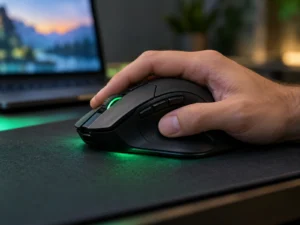
Under the shell sit PixArt’s PAW3955 sensor, rated by Keychron at 40,000 DPI, 750 IPS and 60 G, and a Nordic 54LM20A controller. The symmetrical body is 123.7 mm long and shaped for palm and claw grips, and the scroll wheel reads its 24 steps optically. Keychron says it measured 0.382 ms of click latency over 8K wireless and 0.188 ms wired.
The firmware is ZGM, built on the Zephyr operating system, and Keychron plans to publish its source code on GitHub in the first quarter of 2027. Until it does, the Launcher settings are what owners can change.
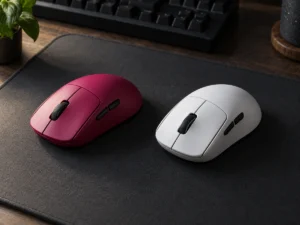
The first black and white mice are due to ship in mid-November, with a second batch in late November, when the five Frosted colors are also expected.