
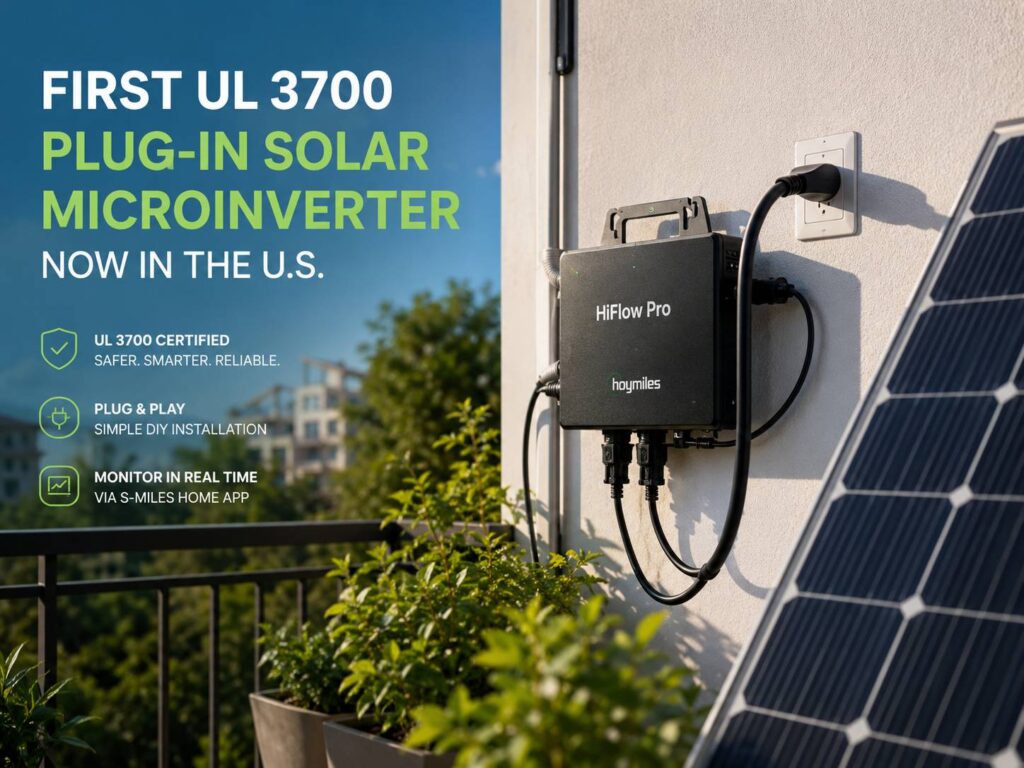
Plug-in solar has moved one step closer to the mainstream U.S. market. Hoymiles has introduced the HiFlow Pro, which the company calls the first plug-in solar microinverter in the United States certified to UL 3700.
The product launched on July 15, 2026. It targets smaller residential solar setups on balconies, patios, terraces, fences, and garden structures. More importantly, it gives renters and homeowners another way to generate solar power without installing a full rooftop system.
For years, balcony solar has remained far more common in Europe than in the United States. European households often use one or two panels connected to a compact microinverter. The inverter then feeds electricity into the home through a compatible outlet. Now, a similar product category is starting to take shape in the U.S.
Still, buyers need to understand what the launch means. UL 3700 certification covers key safety requirements, but it does not make every installation legal in every state. Local electrical codes, utility rules, landlord policies, homeowner association restrictions, and permit requirements still matter.
So, the HiFlow Pro represents a major technical milestone rather than a universal green light for plug-in solar.
Why the Hoymiles HiFlow Pro Matters
Traditional rooftop solar often involves permits, utility paperwork, roof access, professional labor, and a large upfront payment. Plug-in solar serves a different purpose. It produces a smaller amount of electricity and reduces part of a home’s daytime grid use.
For example, a compact solar system can help power appliances that remain active during daylight hours. These often include refrigerators, internet routers, computers, air conditioners, televisions, and home office equipment.
That makes plug-in solar attractive for several groups:
- Apartment residents with a sunny balcony
- Renters who cannot modify a roof
- Homeowners with limited installation space
- People who want to test solar before buying a larger system
- Households looking to reduce daytime electricity use
At the same time, plug-in solar will not replace a full rooftop installation for most homes. Its value comes from accessibility, lower cost, and simpler installation.
The growing interest in compact energy products goes beyond homes. Solar technology is appearing in portable batteries, outdoor equipment, and mobility products such as the Phosgo GO5 solar e-bike. The common idea is simple. Smaller solar systems can reduce dependence on traditional charging and grid power in practical, everyday situations.
What UL 3700 Certification Means
A normal wall outlet sends electricity from the electrical panel to a household device. A plug-in solar system reverses part of that flow. Electricity moves from the solar panels, through the microinverter, and into the home’s electrical circuit.
That change creates safety questions that older solar standards did not fully address.
For this reason, UL introduced a testing and certification framework for plug-in photovoltaic equipment in January 2026. UL 3700 covers the construction, performance, protection systems, labeling, and intended use of plug-in solar equipment.
In practice, the standard looks at risks such as:
- Contact with live electrical parts
- Unsafe voltage after disconnection
- Electrical overload
- Incorrect current flow
- Improper installation
- Grid power feeding back during an outage
The certification gives manufacturers a shared safety target. It gives utilities and local authorities a clearer way to review plug-in solar products. It gives consumers a more reliable signal than a general claim that a device is safe.
Yet certification details still matter. Buyers should check whether UL 3700 applies only to the microinverter or to the full kit. A complete system includes the panels, connectors, power cable, plug, mounting hardware, and other electrical parts.
That difference matters. A certified microinverter paired with unsuitable cables or panels does not automatically create a certified solar kit.
How the HiFlow Pro Works
The HiFlow Pro connects between a solar panel and a household outlet. The panel produces direct current electricity. The microinverter then converts that electricity into 120-volt alternating current for home use.
Hoymiles offers models with power ratings from 360 watts to 500 watts. The company says users can combine up to four units in one setup. Total output can reach 1,200 watts in areas where local rules permit that system size.
Next, the microinverter uses maximum power point tracking to manage panel output as sunlight, shade, and temperature change. Hoymiles lists 99.8% static MPPT performance and 99.5% tracking performance.
The unit supports Bluetooth and Wi-Fi connections through the S-Miles Home app. Through the app, users can check power generation, view system status, and manage supported settings.
The HiFlow Pro measures 182 × 164 × 30 millimeters and weighs 1.8 kilograms. Its small size allows it to sit close to the solar panel without taking up much room.
Meanwhile, its IP67 and NEMA Type 6 enclosure protects it from dust and water exposure. Hoymiles rates the operating temperature from -40°C to 65°C. The standard warranty lasts 12 years.
Safety Features Designed for Plug-In Solar
The product’s safety systems form the most important part of the launch.
First, Hoymiles says the AC plug drops to a safe voltage within one second after disconnection. The company states that the microinverter stops producing power within 135 milliseconds after losing its grid connection.
This fast shutdown reduces the risk of dangerous voltage remaining on an unplugged connector.
Next, the HiFlow Pro includes anti-islanding protection. The system stops sending electricity during a grid outage. This protects utility workers and prevents the device from feeding power into electrical lines that should remain inactive.
That means the microinverter does not provide backup power during a blackout. A separate battery or backup power system remains necessary for outage use.
The HiFlow Pro supports bidirectional GFCI operation and includes protection against breaker masking. These features matter since plug-in solar changes how current moves through a household branch circuit.
For safe use, Hoymiles tells buyers to connect the microinverter directly to a properly installed outlet. The company warns against power strips, daisy-chained extension cords, and cables running through doors or windows.
This guidance makes sense. A plug-in solar microinverter handles far more power than a phone charger. The outlet, wiring, breaker, plug, cable, and mounting system all need proper installation.
U.S. Availability and Current Stock
Hoymiles directs U.S. customers to Bright Saver for HiFlow Pro kits. Bright Saver lists systems with 180-watt and 360-watt output options, standard outlet connections, and do-it-yourself installation.
Pricing starts at about $285 for members. The listed retail price for non-members is $499. Shipping is available within the continental United States.
Still, immediate stock remains limited. As of July 21, 2026, Bright Saver lists the current inventory as sold out. The seller accepts preorders and expects new stock in late August.
The complete kit is not available in Maine, New York, or Vermont at this stage. These states apply certification requirements that cover the whole system rather than only one component.
So, the HiFlow Pro has officially reached the U.S. sales market, but the rollout remains limited. Wider access will depend on inventory, full-system certification, state laws, and utility acceptance.
What Buyers Should Check Before Ordering
Plug-in solar looks simple, but buyers should not treat it like an ordinary household appliance.
Before ordering, check these points:
- State rules for plug-in solar systems
- Local permit requirements
- Utility interconnection policies
- Export limits for excess electricity
- Meter compatibility
- Landlord or lease restrictions
- Homeowner association rules
- Outlet condition and GFCI protection
- Panel mounting safety
- Wind and weather exposure
- Certification coverage for the full kit
For renters, written permission from the landlord can prevent later disputes. For condominium owners, balcony and exterior mounting rules often apply. For homeowners, a licensed electrician can inspect the intended circuit and outlet.
The solar panels need secure mounting too. A poorly attached panel can become dangerous during strong wind, heavy rain, or storms.
How Much Money Can Plug-In Solar Save?
A small plug-in solar system works best when a home uses electricity during the day. Power generated and consumed inside the home reduces the amount purchased from the grid.
For example, suppose a system produces 500 kilowatt-hours per year. At an electricity price of $0.18 per kilowatt-hour, the annual saving reaches about $90.
500 kWh × $0.18 = $90 per year
Now suppose the complete kit costs $500.
$500 ÷ $90 = 5.56 years
In this example, the system takes about five and a half years to recover its purchase cost.
Actual results change based on:
- Local sunlight
- Panel direction
- Panel angle
- Shade
- Weather
- Electricity prices
- Daytime energy use
- Installation costs
- Export compensation
For this reason, buyers should not rely on the highest savings number shown in marketing material. A realistic estimate uses local sunlight data and the household’s current electricity rate.
Hoymiles presents a shorter payback estimate based on 5.6 peak sun hours per day and an electricity price of $0.38 per kilowatt-hour. That rate is much higher than the price paid in many parts of the country. Homes with cheaper electricity will recover the purchase cost more slowly.
Who Will Benefit Most From the HiFlow Pro?
The HiFlow Pro makes the most sense for people with a sunny outdoor space and steady daytime electricity use.
A renter with a south-facing balcony can use a small system to reduce power drawn by a refrigerator, router, computer, or portable air conditioner. A homeowner can place a panel on a patio, fence, shed, or garden mount. A remote worker can offset part of the electricity used by a home office.
In contrast, the system offers less value in heavily shaded locations. It also makes less financial sense for homes that use most of their electricity at night.
My view is that the HiFlow Pro matters more for access than for total energy output. A 360-watt or 500-watt microinverter will not transform the electricity use of a large house. Yet it gives more people a practical way to start generating solar power.
That is the real appeal. Buyers can start small, learn how much solar energy their location produces, and decide later whether a larger system makes sense.
A Turning Point for U.S. Balcony Solar
The Hoymiles HiFlow Pro marks an important stage for plug-in solar in the United States. The category now has a dedicated UL safety framework and its first certified microinverter.
Still, the market remains young. State laws vary, utilities use different interconnection rules, and complete system certification remains a major issue in some locations.
For now, the HiFlow Pro offers a promising option for renters, apartment residents, and homeowners who want a smaller solar setup. Its fast shutdown, anti-islanding protection, weather resistance, app monitoring, and compact size make it well suited to this role.
The launch does not make plug-in solar legal everywhere. It does show that safer, tested plug-in solar hardware is entering the U.S. market.
As stock improves and local rules become clearer, balcony solar could become a practical choice for many households that cannot install a traditional rooftop array.