
Electric vehicle batteries often cause more worry than the motor, brakes, or charging system. Many buyers fear that the battery will fail after a few years and leave them with a huge repair bill. In reality, modern EV batteries usually last far longer than people expect.
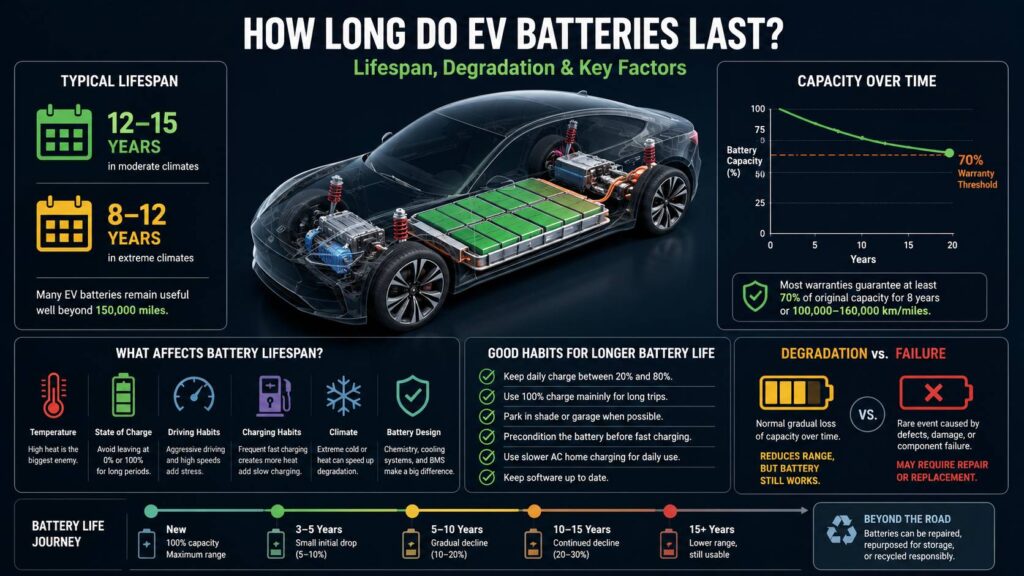
So, how long do EV batteries last? Most modern packs can remain useful for 12 to 15 years in moderate climates. In harsher climates, the expected lifespan can fall closer to 8 to 12 years. Even then, the battery does not normally stop working overnight. Instead, it slowly loses some of its ability to store energy.
For many drivers, the battery will last longer than they plan to own the car. In fact, an EV can still work well after 150,000 or even 200,000 miles. Its range may be lower by that point, but it can still handle daily commutes, shopping trips, and family travel.
What Does EV Battery Lifespan Really Mean?
EV battery lifespan does not describe the moment a car loses a few miles of range. Instead, it refers to the period during which the pack remains safe and useful.
All lithium-ion batteries lose capacity with age. For example, a new electric car may travel 300 miles on a full charge. Several years later, the same car may offer 270 miles under similar conditions. Later, that figure may fall again.
Still, lower capacity does not mean the battery has failed. A pack with 80% of its original capacity can remain useful for many years. A car that once offered 300 miles could still travel about 240 miles under similar conditions.
For most daily trips, that range remains more than enough. At the same time, long-distance drivers may notice the loss more clearly. They may need one extra charging stop on a longer journey.
How Many Years Does an Electric Car Battery Last?
A realistic estimate for many modern EV batteries is 12 to 15 years. Yet battery age is only one part of the story. Mileage, temperature, charging habits, battery chemistry, and vehicle design all play a role.
For instance, a high-mileage electric car driven in mild weather may have a healthier battery than a low-mileage EV stored in intense heat. In the same way, a car charged carefully may age better than one left at 100% for long periods.
Modern electric cars use battery management systems to control temperature, charging speed, and power delivery. These systems protect the cells from excessive heat and deep discharge.
Also, many manufacturers include hidden capacity at the top and bottom of the battery. For this reason, a dashboard reading of 0% does not mean every cell is completely empty. In the same way, a displayed 100% may not use the battery’s full physical capacity.
Battery Degradation Is Not the Same as Battery Failure
Drivers often mix up battery degradation and battery failure. Yet these are two different problems.
Battery degradation means the pack stores less energy than it did when new. Battery failure means the pack or one of its main parts no longer works correctly.
In most cases, gradual degradation is normal. Total battery failure is far less common, especially in newer electric cars. Early EVs had smaller packs, simpler cooling systems, and less advanced software. Newer models benefit from years of real-world data and better temperature control.
Still, failures can happen. A damaged module, cooling leak, faulty sensor, software fault, crash, or manufacturing defect can lead to repairs. Even so, many faults do not require a complete battery replacement.
How Fast Do EV Batteries Lose Range?
There is no single degradation rate for every electric car. Some batteries age slowly, and others lose capacity faster.
For example, many newer EVs lose only a small part of their original capacity during the first several years. After that, degradation often continues at a gradual pace. Yet the exact rate changes from one model to another.
Weather can affect the dashboard range too. In winter, cabin heating and cold battery cells can reduce the displayed figure. Then, part of that range returns during warmer weather.
Likewise, high speed, headwinds, low tire pressure, hills, and heavy loads can reduce estimated range. For this reason, a lower number on the dashboard does not prove that the battery has lost the same percentage of capacity.
A proper battery health report gives a clearer picture. It can show the pack’s current usable capacity and compare it with the original figure.
What Causes EV Battery Degradation?
Heat is one of the biggest causes of battery ageing. High temperatures speed up chemical reactions inside lithium-ion cells. Over time, this can reduce the amount of energy the battery stores.
Cold weather creates a different problem. It reduces short-term performance and slows charging. Yet much of that lost range returns once the battery warms up.
Charging habits matter too. For example, leaving the vehicle at 100% for several days can place extra stress on some battery types. In the same way, leaving it close to 0% for a long period can cause problems.
The following habits can speed up battery wear:
- Leaving the battery at 100% for long periods
- Frequently running the charge close to 0%
- Storing the car with a nearly empty battery
- Parking in extreme heat for long periods
- Repeatedly using rapid charging when slower charging is available
- Driving hard when the battery is already very hot
- Ignoring battery cooling or charging warnings
Still, drivers do not need to treat the battery like a fragile object. Modern EVs manage much of the charging and temperature control automatically.
Is Fast Charging Bad for an EV Battery?
Fast charging does not automatically ruin an EV battery. The vehicle controls the power level based on battery temperature, charge percentage, and pack condition.
At first, a rapid charger may deliver high power. Then, the charging speed drops as the battery fills. This protects the cells and reduces heat.
Even so, regular rapid charging can create more heat than slower home charging. For that reason, AC charging at home works well for daily use. Rapid charging remains a practical choice during road trips or busy days.
The same confusion appears with smaller electrical loads in normal cars. For a related explanation, read our guide on whether charging your phone in the car wastes fuel or drains the battery.
Should You Charge an EV to 80% or 100%?
For many electric cars, an 80% daily limit offers a good balance between range and battery care. Then, drivers can charge to 100% before a long trip.
Yet battery chemistry matters. Some vehicles use lithium iron phosphate batteries, often called LFP batteries. These packs may come with different charging advice. In some cases, the manufacturer recommends regular full charging to keep the range estimate accurate.
For this reason, the owner’s manual should guide your charging routine. Advice written for one EV may not suit another.
Timing matters too. Charging to 100% in the morning and leaving soon after is different from keeping the battery full for two weeks. In fact, time spent at a very high charge level can matter more than an occasional full charge.
How Long Are EV Batteries Covered by Warranty?
Many electric vehicles include an eight-year battery warranty. Mileage limits often sit near 100,000 miles in the United States or 160,000 kilometres in Europe.
Still, warranty details differ between brands. Some plans cover manufacturing defects and complete failure. Others include a capacity guarantee.
A common capacity threshold is 70%. This means the manufacturer may repair or replace the battery once its usable capacity falls below 70% during the warranty period.
Yet normal degradation above that limit may not qualify. For example, a battery at 75% health could still fall within the warranty terms.
Before buying an EV, check these details:
- Battery warranty length
- Mileage or kilometre limit
- Minimum capacity guarantee
- Transfer rules for second owners
- Maintenance requirements
- Exclusions linked to damage or misuse
- Battery testing rules
- Coverage for parts and labour
A clear capacity guarantee gives buyers more protection than a warranty that covers defects alone.
Does a Damaged EV Need a Full Battery Replacement?
Not every battery fault requires a full pack replacement. An EV battery contains cells, modules, cooling parts, sensors, wiring, and electronic controls.
For instance, a charging fault may come from a sensor or connector rather than the cells. In another case, a cooling system problem may cause warning messages or limited charging speed.
Some battery packs allow module repairs. Other packs use designs that make local repairs harder. Then, the manufacturer may replace a larger part of the assembly.
A complete replacement can cost a lot outside warranty. Yet there is no reliable single price for every vehicle. Pack size, model, labour, taxes, new parts, and refurbished parts all change the final bill.
Before approving a costly repair, ask for:
- A written diagnostic report
- The measured battery health
- The exact failed part
- Warranty eligibility
- A repair quote
- A full replacement quote
- Refurbished battery options
- Confirmation that software updates are complete
How to Check Battery Health on a Used EV
Battery condition matters more than mileage alone. So, buyers should ask for proof rather than trust the dashboard range.
Start with a battery health report from the manufacturer, dealer, or qualified EV workshop. Next, check the remaining warranty and service history.
Then, test the vehicle at a high charge level. Compare the displayed range with the car’s original rating, but treat this only as a rough guide.
During the test drive, watch the energy use. Sudden drops in charge percentage can point to a problem. At the same time, high consumption may come from cold weather, heating, speed, or low tire pressure.
Check these points before buying:
- Battery state of health
- Remaining warranty
- Charging speed
- Open recalls
- Warning lights
- Real energy consumption
- Range in warm and cold weather
- Service records
- Signs of underbody damage
- Battery cooling performance
My view is simple. A used EV with a verified battery report can be a safer purchase than a newer car with no clear history. The report gives real data. A seller’s claim that the range feels normal does not.
How Can You Make an EV Battery Last Longer?
A few habits can reduce unnecessary battery stress.
First, follow the daily charge limit shown by the vehicle. Next, avoid leaving the battery near 0% or 100% for long periods. Then, park in a garage or shaded area during very hot weather where possible.
Preconditioning can help before rapid charging. It warms or cools the battery to a better working temperature. As a result, charging can start faster and place less strain on the pack. [Need avoid banned “As a result”.]
Slower home charging remains a good choice for routine use. Still, there is no need to avoid rapid chargers completely. They exist for road trips, long commutes, and drivers without home charging.
Software updates matter too. They can change charging curves, temperature control, range estimates, and fault detection.
Most of all, use the car normally. Battery care should not turn every journey into a maths exercise.
What Happens to Old EV Batteries?
An EV battery can remain useful after it no longer meets a driver’s range needs. For example, some packs can move into stationary energy storage.
Other batteries can be repaired or remanufactured. Later, recycling facilities can recover materials such as lithium, nickel, cobalt, graphite, copper, aluminium, and iron.
Still, high-voltage batteries need trained handling. Owners should not open or dismantle a pack at home. A dealership, approved workshop, dismantler, or licensed recycling centre should handle it.
So, How Long Do EV Batteries Really Last?
Most modern electric car batteries can last around 12 to 15 years in moderate climates. In harsher conditions, 8 to 12 years may be more realistic.
Even then, most packs lose capacity slowly rather than fail without warning. A battery at 80% health can still offer plenty of range for daily driving.
For this reason, buyers should focus on battery health, thermal management, warranty terms, and service history. A good EV battery does not need to remain perfect. It only needs to offer enough range for the way the car is used.