
Charging a phone in the car feels almost free. You connect the cable, open Google Maps, play some music, and arrive with a fuller battery. Still, the electricity has to come from somewhere.
In a petrol or diesel car, the alternator produces electricity once the engine starts. The engine powers the alternator, so every electrical device adds a small load. This includes the headlights, climate controls, infotainment screen, heated seats, USB ports, and phone chargers.
So, does charging your phone in the car use more fuel? Technically, yes. Still, the amount is so small that most drivers will never notice it at the fuel pump.
The situation changes after the engine stops. At that point, an active USB port or 12-volt socket can draw power from the car battery. One short phone charge rarely causes trouble. Yet leaving several devices connected for hours can raise the risk, mainly in an older car or one with a weak battery.
Does Charging Your Phone in the Car Use More Fuel?
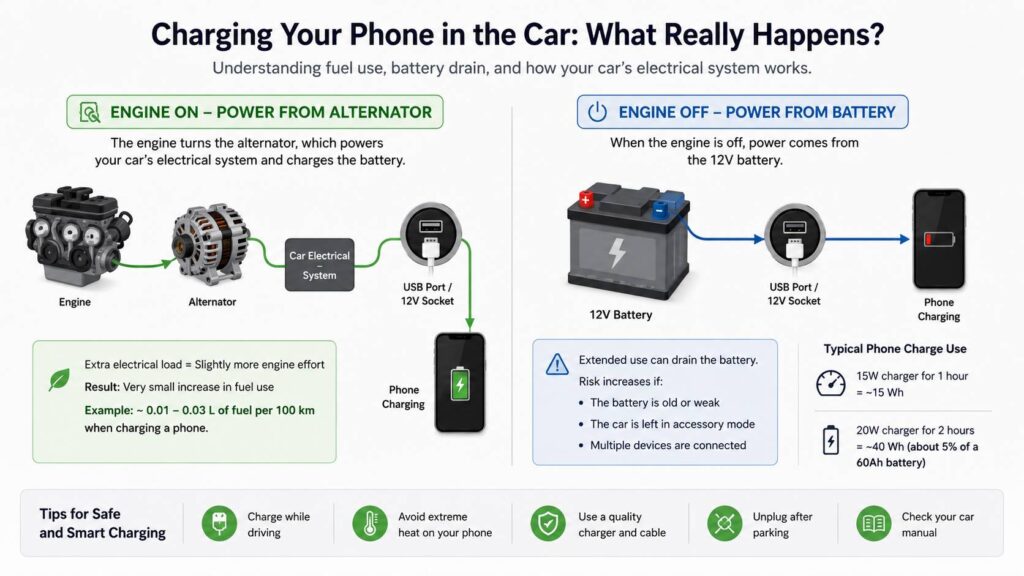
A combustion car uses an alternator to power its electrical equipment and recharge the 12-volt battery. The engine turns the alternator through a belt. As the electrical demand rises, the alternator works harder. Then, the engine must provide a little more power.
A phone charger adds to that demand, but its impact remains tiny. Many current phones charge at rates between 15 and 45 watts. By comparison, a vehicle’s lights, fans, window heaters, audio system, and control modules can use hundreds of watts together.
Also, phones do not draw their maximum charging rate for the whole trip. Fast charging usually peaks at a lower battery level. Then, the phone reduces power as the battery fills. Heat, cable quality, navigation use, screen brightness, and battery temperature can reduce the rate even more.
For that reason, a charger labelled as 45 watts does not constantly pull 45 watts during every journey.
How Much Extra Fuel Does Car Phone Charging Use?
A simple calculation helps show how small the cost is.
Suppose a phone draws 20 watts for one hour. That equals:
20 watts × 1 hour = 20 watt-hours
Now suppose the charger and electrical system lose some energy during conversion. The alternator may need to produce around 25 to 30 watt-hours to deliver 20 watt-hours to the phone.
Petrol contains far more energy than that. The engine also wastes much of the fuel’s energy as heat, so the exact figure changes from one car to another. Even so, the extra fuel needed for one phone charge remains very small.
A rough estimate often places it at only a few millilitres of fuel for a normal charging session. That amount costs far less than one cent in many cases.
For example, tyre pressure has a much larger effect on fuel use. Rapid acceleration, high motorway speeds, roof boxes, short trips, and heavy air-conditioning use matter far more too.
So, there is no practical reason to avoid phone charging during a normal drive just to save petrol or diesel.
Can Charging a Phone Drain the Car Battery?
Yes, but mainly after the engine stops.
With the engine running, the alternator supplies most of the car’s electrical power. It also sends energy back into the 12-volt battery. In that situation, a phone charger poses little risk to a healthy battery.
Once the engine is off, the battery becomes the power source. Some cars shut down their USB ports and 12-volt sockets soon after locking. Other models keep certain outlets active for a long time.
A typical car battery may have a capacity of around 60 amp-hours. At 12 volts, that gives a nominal capacity of roughly:
12 volts × 60 amp-hours = 720 watt-hours
A 20-watt phone charger running for two hours would use:
20 watts × 2 hours = 40 watt-hours
That equals about 5.6% of the battery’s nominal capacity.
Still, a starter battery cannot safely deliver every watt-hour shown on its label. The car needs a strong burst of power to turn the starter motor. Cold weather, battery age, alarm systems, keyless entry, interior lights, and other electronics can reduce the available reserve.
For this reason, a phone alone rarely causes a flat battery. The bigger problem often comes from leaving the ignition in accessory mode. That setting can keep the dashboard, infotainment system, speakers, fans, and control modules awake.
Can a Phone Charger Kill a Car Battery Overnight?
A single phone charger will rarely flatten a strong and fully charged battery overnight. Still, the risk is not zero.
Problems become more likely in these situations:
- The battery is old or already weak.
- The car has not been driven for several days.
- The weather is very cold.
- The ignition remains in accessory mode.
- The infotainment screen stays active.
- Several devices charge at the same time.
- A dash camera or cooler uses the same outlet.
- The car keeps its USB ports powered after locking.
- A low-quality adapter draws unnecessary standby power.
Also, short city journeys may not give the alternator enough time to replace the energy used during engine starting. A weak battery can then lose charge slowly over several days.
My practical view is simple. Charging during a drive is perfectly reasonable. Charging for ten or twenty minutes with the engine off is rarely a problem. Leaving several accessories powered all night is not a good habit.
Does the Charger Keep Drawing Power After the Phone Reaches 100%?
Modern phones control the charging process. As the battery fills, the phone reduces its power intake. Once it reaches the selected charge limit, it usually pauses charging and only takes small amounts of power later.
Still, the charger itself can consume a small amount of standby electricity. The exact amount changes by model and build quality.
A good USB charger uses very little power with no phone attached. A cheap adapter may waste more energy or remain warm. In some cases, it can create radio interference or fit poorly in the socket.
So, unplugging the adapter after parking is a sensible habit. It removes a small parasitic load and reduces the chance of a low-quality charger heating up when nobody is in the car.
Is Wired or Wireless Car Charging Better?
Wired charging usually wastes less energy. The cable sends power directly from the charger to the phone. Wireless charging uses coils, and some energy turns into heat during the transfer.
Poor phone alignment can make the loss worse. Thick cases, metal rings, direct sunlight, and a hot dashboard can add even more heat.
Still, the fuel difference between wired and wireless charging remains tiny. Phone temperature matters much more.
A wireless charging pad can become very warm during navigation. The screen stays on, GPS runs continuously, mobile data remains active, and the phone may sit in direct sunlight. At that point, the device can slow or pause charging to protect the battery.
For long trips, a wired charger often provides steadier charging and less heat. Wireless charging remains convenient for shorter drives and frequent stops.
Drivers interested in modern magnetic car charging can also read our guide to the Kuxiu D5 Qi2 2 charger, which covers its design, charging setup, and everyday use.
Does Charging a Phone Reduce Electric Car Range?
Yes, but the effect is extremely small.
An electric car supplies accessory power through its high-voltage battery and electrical conversion system. A phone that draws 20 watts for two hours uses:
20 watts × 2 hours = 40 watt-hours
That equals:
40 watt-hours = 0.04 kilowatt-hours
Now compare that with a 60-kilowatt-hour electric car battery:
0.04 ÷ 60 × 100 = 0.067%
That is less than one tenth of one percent of the battery capacity.
Real-world charging losses raise the figure slightly. Even then, the effect remains too small to notice on the range display.
Cabin heating has a far larger effect. Air conditioning, battery temperature control, high speed, strong wind, low tyre pressure, and cold weather matter more too.
So, charging a phone should not influence an electric car owner’s trip planning.
What About Hybrid Cars?
Hybrid cars use both an engine and an electric system. They still have a 12-volt electrical network for accessories, lights, control modules, and USB ports.
The vehicle manages power automatically. At times, the combustion engine supplies energy. At other times, the hybrid battery and power converter handle the load.
Again, a phone charger uses very little energy compared with the rest of the car. Climate control and battery temperature management create much larger demands.
Charging a phone in a hybrid car is safe during regular use. The same rule applies after parking. Avoid leaving the car in accessory mode for long periods.
Can a High-Wattage Car Charger Damage Your Phone?
A good charger does not force its full rated output into the phone.
USB-C Power Delivery chargers communicate with the connected device. The phone then requests a supported voltage and current. For example, a 100-watt car charger can safely charge a phone that accepts only 25 watts. The phone draws only what it supports.
Still, charger quality matters. A poorly made adapter can overheat, disconnect on rough roads, produce unstable voltage, or fail early.
Look for these features:
- USB-C Power Delivery support
- PPS support for compatible Samsung and Android phones
- Overcurrent protection
- Overvoltage protection
- Temperature protection
- Clear wattage ratings for each port
- A firm fit inside the 12-volt socket
- A cable rated for the required power
Also, check how the charger shares power across several ports. A charger advertised at 100 watts may provide that figure only through one port. Once two or three devices connect, the output can drop.
Is It Bad to Charge Your Phone During Short Trips?
No, but short trips can create a different issue for the car battery.
Starting the engine uses a noticeable amount of battery power. The alternator then needs time to restore that energy. A five-minute trip may not fully replace the charge used during startup, mainly in winter.
The phone charger adds only a small load. Still, repeated short trips, heated windows, headlights, cabin fans, heated seats, and an ageing battery can slowly create a charging deficit.
So, the phone is not usually the main cause. It is simply one small part of the total electrical demand.
A longer drive from time to time can help restore the battery. A smart battery charger also makes sense for cars that sit unused or only travel short distances.
Should You Idle the Engine Just to Charge a Phone?
No. Running the engine only to charge a phone wastes much more fuel than the phone needs.
An idling engine powers many systems at once. It also creates heat, noise, emissions, and mechanical wear. A basic power bank can charge a phone without running the car.
So, use the car charger during a journey. Once parked, switch to a power bank or wall charger instead of leaving the engine running.
How to Charge Your Phone Safely in the Car
A few simple habits can protect both the phone and the vehicle battery:
- Charge the phone during normal driving.
- Use a reputable USB-C or Qi2 charger.
- Choose a cable rated for the charger’s power.
- Keep the phone away from direct sunlight.
- Use an air vent mount during navigation.
- Remove thick cases if the phone gets too hot.
- Unplug accessories after parking.
- Avoid long sessions in accessory mode.
- Check whether the car’s sockets remain powered after locking.
- Replace an adapter that becomes unusually hot or smells burnt.
Also, check the vehicle owner’s manual. USB port behaviour differs between makes and models. Some ports switch off immediately, and others remain active for several minutes or longer.
Does Charging Your Phone in the Car Use More Fuel? The Final Answer
Charging a phone in a petrol or diesel car does use a tiny amount of extra fuel. The alternator places a small additional load on the engine. Still, the cost is too low for most drivers to notice.
Charging with the engine off draws power from the 12-volt battery. A short session rarely causes trouble. The risk rises with an old battery, cold weather, accessory mode, or several connected devices.
In an electric or hybrid car, one phone charge has an almost unnoticeable effect on energy use and driving range.
So, charge your phone during the journey without worrying about fuel costs. Use a good adapter, keep the phone cool, and unplug accessories once the car is parked.