
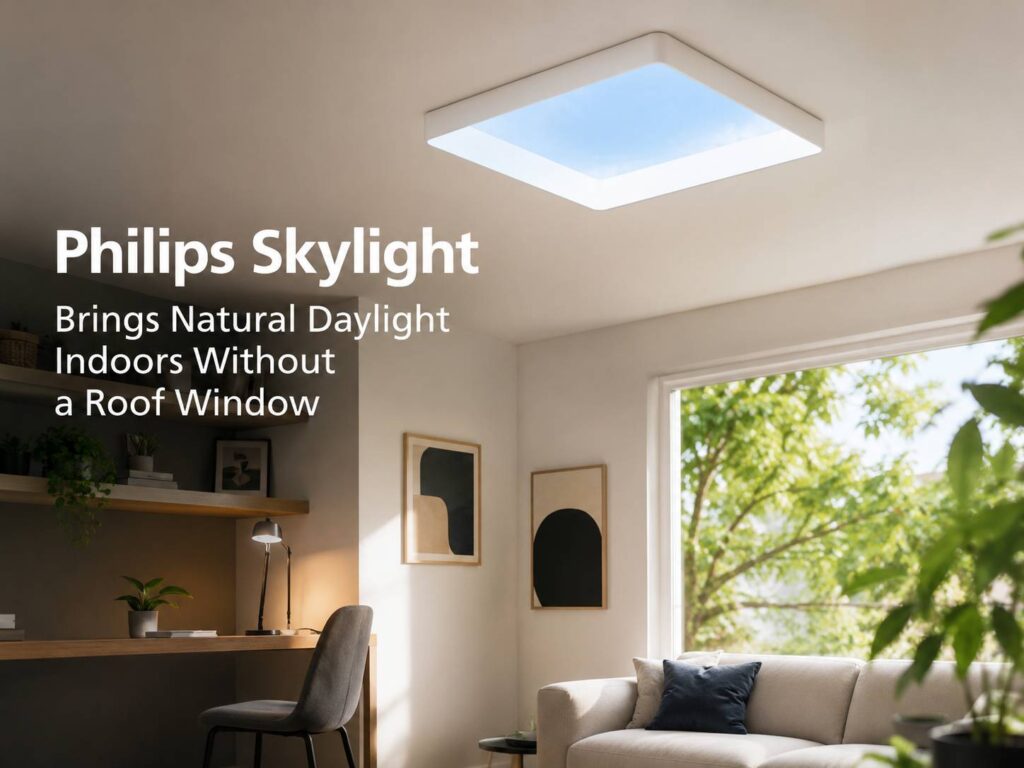
Philips Skylight takes a common home problem and gives it a smart answer. Many rooms need better daylight, but not every room can have a real skylight. Basements, hallways, bathrooms, home offices, and inner rooms often feel dull under normal ceiling lights. They may look fine during the day, yet they rarely feel open or fresh.
Philips Skylight aims to change that. It uses ceiling-mounted LED technology to recreate the feeling of natural daylight inside the home. The idea is simple: make a dark room feel brighter, calmer, and more connected to the daylight cycle outside.
This is not just a flat LED panel with a cold white glow. Instead, Philips Skylight uses NatureConnect LED technology to create the look of a bright sky above you. It brings together blue-white light, a sky-like panel, window-style reflections, and side lighting that mimics directed sunlight.
For that reason, it feels more like a home upgrade than a basic light fixture.
A Ceiling Light That Looks More Like Daylight
The main appeal of Philips Skylight comes from the way it changes the feel of a room. A normal ceiling light can make a space brighter, but the room may still feel closed in. Philips Skylight tries to solve that by adding depth and direction to the light.
For example, a windowless bathroom can feel harsh under a standard LED bulb. A hallway can look flat, even with strong ceiling lights. A basement can feel boxed in during the day. In those rooms, a daylight-style ceiling panel can make the space feel more natural.
The product does not require roof work. That matters. A real skylight can be expensive, messy, and impossible in many homes or apartments. Philips Skylight gives people another option. It brings a daylight effect into rooms where a real window or roof opening makes no sense.
Search interest around artificial skylights, daylight ceiling lights, and windowless room lighting has grown for a clear reason. People want homes that feel brighter without major construction. Philips Skylight fits that need well.
Auto Day Rhythm Makes the Light Change During the Day
One of the most useful features is Auto Day Rhythm. This setting changes the light during a 24-hour cycle. In the morning and daytime, the light becomes brighter and cooler. Later in the day, it shifts toward warmer tones.
That matters more than many people think. Most homes use the same light at 8 a.m., 3 p.m., and 10 p.m. So, the room stays bright, but the light does not match the time of day.
Philips Skylight takes a different path. It tries to follow the feeling of natural daylight. During work hours, the brighter light can make a home office feel more alert. Then, in the evening, warmer light can make a bedroom or living room feel softer.
This kind of lighting works especially well in rooms used across the whole day. A kitchen, office, therapy room, or reading corner can feel more balanced with light that changes over time.
The system also includes five preset daylight scenes. That gives users quick control without making the light hard to use. For daily life, that matters. People want better lighting, but they do not want to spend five minutes changing settings every time they enter a room.
VitaUp Adds Indoor Vitamin D Support
The Philips Skylight range includes VitaUp models with a UV-B module. Philips says this version supports the body’s natural vitamin D production indoors. That feature will get attention from buyers who search for vitamin D lights, UV-B lamps for home, and indoor sunlight lamps.
Still, the feature needs realistic expectations. VitaUp is not a medical device, and it does not replace time outdoors. It works as a wellness lighting feature, not as a treatment.
Even so, the idea makes sense for people who live in places with long winters, limited sun exposure, or darker homes. Many people spend most of the day indoors. So, a ceiling light that combines daylight-style lighting with vitamin D support will feel useful to the right buyer.
Safety matters here too. Philips includes an eight-hour auto-off function for VitaUp, and users can control the feature through the remote. That keeps the UV-B part from feeling like a risky add-on.
My honest view: VitaUp is the most interesting version of Philips Skylight, but not everyone needs it. Some buyers will want the daylight effect only. Others will see extra value in the vitamin D support. That split makes the four-model lineup easy to understand.
Four Versions for Different Rooms
Philips Skylight comes in four versions:
- Philips Skylight Medium
- Philips Skylight Large
- Philips Skylight VitaUp Medium
- Philips Skylight VitaUp Large
This lineup keeps the buying choice fairly simple. Medium makes sense for smaller rooms, compact home offices, bathrooms, hallways, and utility areas. Large fits better in bigger kitchens, living rooms, basement rooms, and open work areas.
The VitaUp versions suit buyers who want the daylight effect plus vitamin D support. The standard versions suit people who want a brighter, more natural-looking room without UV-B.
Each version uses a slim surface-mounted design. That helps in homes where recessed lights are not practical. Installation works more like a standard ceiling light, so it does not need the type of structural work linked to a real skylight.
For renters, that point may matter a lot. For homeowners, it can still save time and money.
Where Philips Skylight Makes the Most Sense
Philips Skylight works best in rooms that feel closed, dark, or grey. It will not turn a windowless room into an outdoor space, but it can make that room feel more pleasant.
Good places for it include:
- Home offices with limited daylight
- Windowless bathrooms
- Dark kitchens
- Basement rooms
- Hallways
- Laundry rooms
- Reading corners
- Therapy or hobby spaces
- Small bedrooms with poor natural light
The IP44 rating makes the product suitable for bathrooms and damp areas. That gives it a strong use case. Many bathrooms have poor light, no windows, or a single harsh bulb. A daylight-style panel can make the room feel cleaner and more relaxing, especially in the morning.
Basements may benefit even more. A basement rarely needs another plain LED light. It needs a better feeling of space. Philips Skylight seems built for that problem.
For indoor comfort, lighting can work together with air quality too. A bright room feels better, but fresh air and clean airflow matter as well. For a related home comfort guide, see this comparison of an air purifier vs fan.
How It Differs From a Standard LED Panel
A standard LED panel spreads light across a room. Philips Skylight tries to create a daylight scene.
That difference shapes the full product. It uses NatureConnect LED technology, BioUp LEDs, Auto Day Rhythm, preset scenes, and remote control. So, it targets mood, comfort, and daily rhythm, not only brightness.
The remote control is a practical choice. Some people like app-based lighting, but not every ceiling light needs a phone. A remote works for guests, family members, and shared rooms. It also makes the product easier for people who want better lighting without a full smart home setup.
For that reason, Philips Skylight feels more friendly than many high-end connected lighting products. It has advanced technology, but the daily use still sounds simple.
My Honest Opinion on Philips Skylight
Philips Skylight feels like one of the more useful home lighting ideas of 2026. It solves a real problem that many homes have. Dark rooms are common, and roof work is not always possible.
The strongest part is the visual concept. A fake skylight only works if it feels believable. Philips already uses NatureConnect technology in professional spaces, so bringing it into homes feels like a logical next step.
The VitaUp version gives the range a stronger identity. It adds a wellness angle that many people will search for. Still, the standard version may be the better buy for most homes if the price difference is high.
Price will decide a lot. Advanced ceiling lights often cost much more than normal fixtures. For a home office, basement, or bathroom used every day, the cost may feel easier to justify. For a small storage room, a cheaper LED light will probably do the job.
Why Philips Skylight Could Become a Popular Home Upgrade
Philips Skylight arrives at the right time. More people work from home. Many spend long hours indoors. At the same time, homes still have dark corners, windowless rooms, and basement spaces that feel underused.
A product that brings daylight-style light into those rooms has a clear purpose. It does not need to promise too much. It just needs to make indoor spaces feel brighter, more open, and easier to live in.
That is where Philips Skylight looks promising. It gives homeowners a way to improve a room without cutting into the roof, changing windows, or planning a major remodel.
For anyone searching for an artificial skylight, daylight ceiling light, natural daylight lamp, or windowless room lighting idea, Philips Skylight is worth watching closely. It may not replace the sun, but it can make a dark room feel much less dull.