
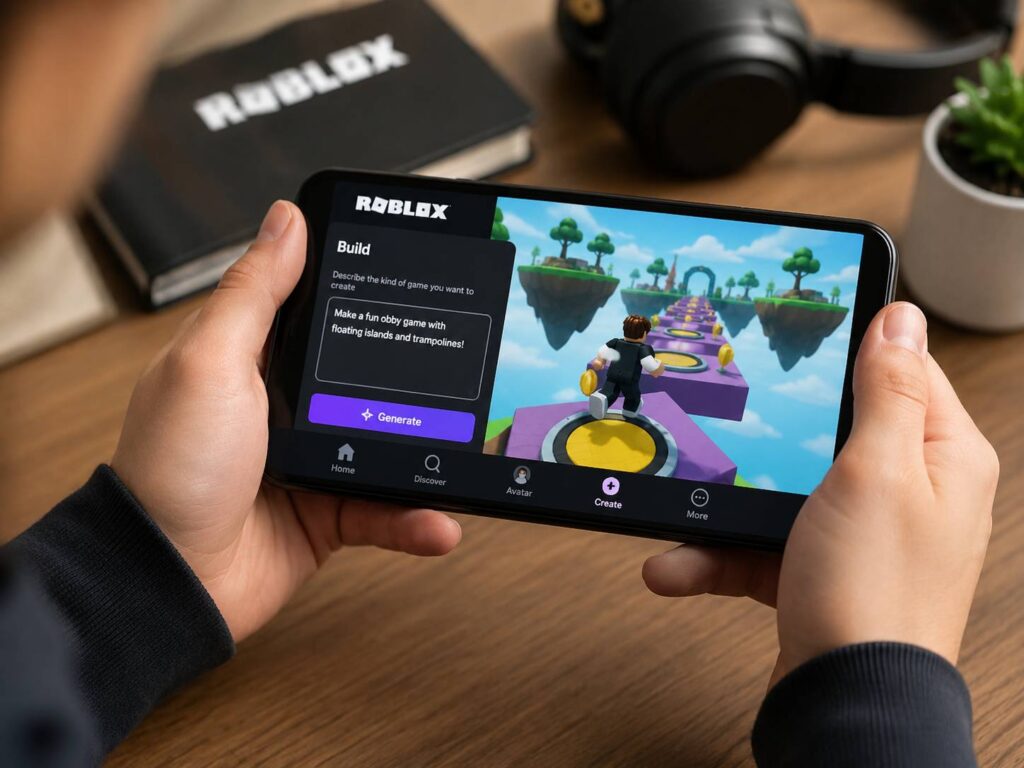
Roblox is preparing one of its biggest changes to game creation. Its new Build feature will let users create basic games inside the Roblox mobile app by typing simple AI prompts.
Instead of opening Roblox Studio on a computer, creators can describe an idea in plain language. Build can then generate a playable starting point with a setting, game rules, characters, sounds, and interactive objects. After that, users can test the result, refine the prompt, share the game with friends, or publish it.
For new creators, this removes one of the biggest barriers. They no longer have to begin with an empty map, a code editor, and a long list of tutorials.
Still, Build is not meant to replace Roblox Studio. It acts as a quicker starting point for people who have creative ideas but little coding experience. It can also help users who do not have access to a desktop computer.
That distinction matters. Roblox is not claiming that one short prompt will produce the next major hit. Instead, the company is giving users a simpler way to turn an idea into something they can play.
Roblox Build Brings Game Creation to Mobile Devices
Roblox game development has long depended on Roblox Studio. The desktop software lets creators build worlds, write Luau scripts, manage assets, test gameplay, and publish complete experiences.
Studio offers a lot of control. At the same time, its large range of tools can feel overwhelming to a beginner.
Build takes a much simpler route. The feature appears as a creation tab inside the Roblox app. A user can type a request such as, “Make a cozy forest adventure with hidden objects and a short obstacle course.”
Then, the system creates a basic game that the user can play and edit.
In practice, this means creators will no longer need to start from scratch. They can begin with a rough game and shape it through more prompts, manual changes, and repeated testing.
For younger users, casual players, and phone-only households, this opens access to a part of Roblox that once felt difficult to reach.
How Roblox Build Turns AI Prompts Into Games
Build uses a mix of Roblox models and open-source AI systems. Together, these tools can work across several parts of game development.
They can help create:
- Basic gameplay mechanics
- 3D environments
- Characters
- Visual themes
- Sound effects
- Interactive objects
- Simple level layouts
Even so, the first result will not be a finished commercial game. It will be closer to an early prototype.
A creator will still need to test the controls, fix weak sections, improve the pace, and check whether the game stays fun after the first few minutes. Friends and early players can help identify problems that AI may miss.
That human input still matters. AI can place objects and create simple rules, but it cannot reliably judge whether a level feels fair, exciting, funny, or rewarding.
From my point of view, the editing process will decide whether Build becomes genuinely useful. Creating a rough game in seconds sounds impressive. Turning that rough result into something people want to replay is the harder part.
Build and Roblox Studio Will Work Together
Roblox designed Build as an extension of Studio rather than a separate platform. Both systems share a back end, AI models, and chat history.
As a result, a creator can begin a simple project on a phone and continue working on it from a computer. Once the project moves into Studio, the user can add advanced scripts, custom assets, detailed lighting, monetization systems, menus, and deeper gameplay.
Creators can start certain tasks in Studio and check their progress from a mobile device too. This connection gives Build more value than a closed mobile editor.
For example, a user may create a simple racing game during a bus journey. Later, the same user can open the project in Studio, improve the vehicle controls, add checkpoints, and create a larger map.
In turn, mobile creation can attract new users, and Studio can give serious developers the tools needed to build more polished experiences.
Who Gets Access to Roblox Build First
Roblox plans to begin public alpha testing on July 28, 2026. The first rollout will cover age-checked users in New Zealand who are at least 9 years old.
Publishing will have tighter restrictions during the alpha period. Games that pass Roblox safety checks will become available worldwide to age-checked users who are 16 or older. Age rules and availability can vary by region.
For now, the company plans to expand Build gradually over the following months. The early release will help Roblox test creation tools, moderation systems, publishing rules, server demand, and the quality of AI-generated content.
A limited rollout makes sense. Mobile AI tools can produce a large number of games in a short time. Roblox needs to watch for copied content, broken projects, misleading thumbnails, moderation problems, and low-quality uploads.
Roblox Build Will Include a Free Version
Roblox says the base version of Build will be free for creators. Paid options are planned for people who need more advanced tools.
The company has not confirmed full pricing, generation limits, prompt caps, or the exact features included in each plan. I cannot confirm those details until Roblox publishes them.
A free entry tier fits the way Roblox attracts new creators. Users can test their ideas without buying software or learning an entire development system on day one.
Later, paid plans may offer more generations, stronger AI models, faster processing, or support for larger projects. Roblox has not confirmed that feature split yet.
The free version will need enough room for real experimentation. A tool with very strict limits could feel more like a short demo. By comparison, a practical free tier could bring a new generation of creators into the platform.
AI Games Will Still Compete for Player Attention
AI creation brings one clear concern. Roblox could fill with rushed games made from short prompts.
Roblox says Build projects will enter the same candidate pool as other experiences. Its discovery system will rank them using player retention and engagement signals.
So, a game will not gain strong visibility just for being created with AI. Players still need to click it, understand it, and keep playing.
That said, discovery systems cannot solve every quality problem. Weak games can still spread through search pages, social posts, direct links, and eye-catching thumbnails.
In my view, Roblox should keep creation simple but make publishing more demanding. Clear titles, honest images, tested controls, working menus, and accurate age ratings should remain basic publishing standards.
Fast creation should help people experiment. It should not reward careless uploads.
New AI Agents Are Coming to Roblox Studio
Build is only one part of Roblox’s wider AI plan. The company is preparing several new agents for both Build and Studio.
Planned tools include:
- A playtesting agent that searches for bugs
- An analytics agent that answers questions about game data
- An experiment agent that suggests tests for retention and monetization
These agents target tasks that often pull creators away from game design. Bug testing, dashboard analysis, and experiment planning can take many hours.
For example, a playtesting agent may repeat the same level many times and flag areas where characters get stuck. An analytics agent may help a creator understand why players leave after the first few minutes.
Still, every result needs human review. Automated tests can miss strange player behavior. Data summaries can leave out context. Retention experiments can push creators toward repetitive reward systems rather than better games.
Used carefully, these tools can reduce repetitive work. Used carelessly, they can help creators produce mistakes at a faster rate.
Roblox Is Expanding Its 3D AI Tools
Roblox is building Build on top of a growing set of 3D generation systems.
Procedural Models can create adjustable 3D assets from text or images. Users can then change specific settings to reshape the object without rebuilding it from the beginning.
Roblox’s Cube foundation model can turn prompts into game-ready objects, including vehicles and interactive items. A future scene-generation model is expected to create full editable 3D scenes from a single request.
This work reflects a wider shift in how digital objects are designed and produced. Similar changes are happening outside gaming, where systems such as the HP MJF 1200 bring industrial 3D printing to smaller workspaces.
For Roblox, the goal is to connect art, code, physics, sound, and interaction inside one project.
Yet, every generated part still needs to work with the others. A detailed vehicle has little value if the controls feel poor. A large environment will frustrate players if the frame rate drops or the level design creates dead ends.
What Roblox Build Means for New Creators
Roblox Build can change who gets to call themselves a game creator. A phone user with no coding background can begin with an idea rather than a blank screen.
At first, many Build games will probably stay simple. Obstacle courses, racing games, social spaces, collection games, survival maps, and short adventures fit prompt-based creation well.
Over time, skilled users will learn how to write clearer prompts, combine generated parts, collect player feedback, and move promising projects into Studio.
Build will not remove the need for skill. Instead, it will change where that skill begins.
Prompt writing, taste, editing, testing, and player feedback will matter from the first stage. Coding and advanced design will still matter for larger projects.
For this reason, Build’s strongest feature is not instant game creation. Its real value is the chance to give more people a practical first step into game development.