
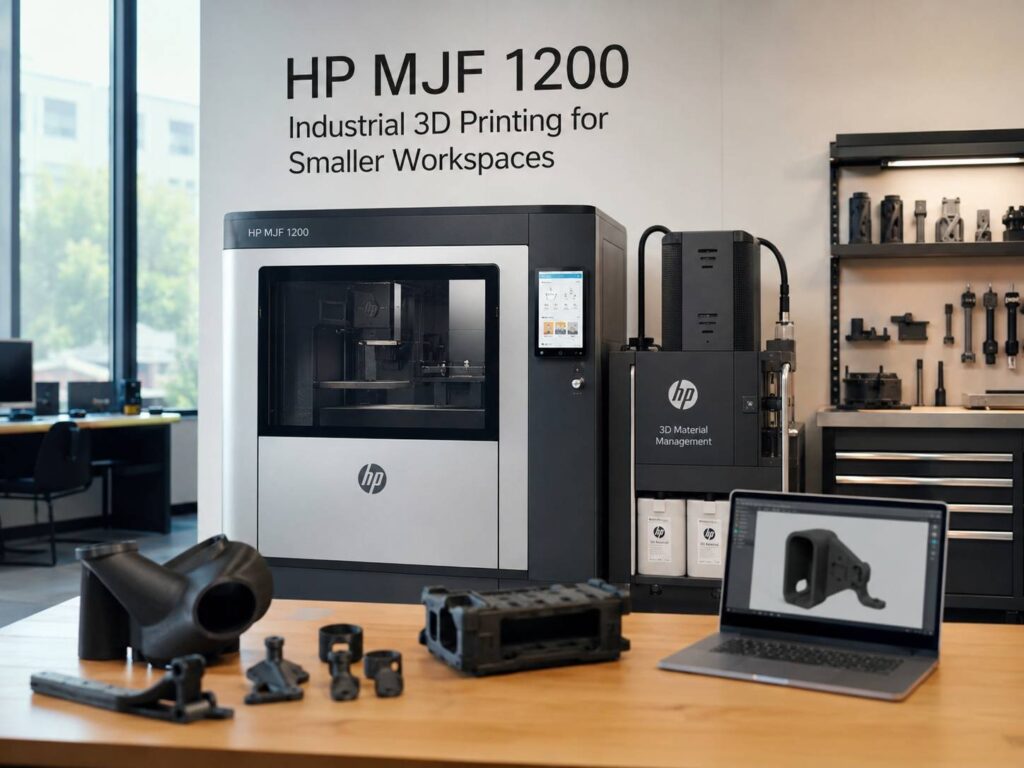
HP is making industrial 3D printing feel more realistic for smaller teams. The new HP Multi Jet Fusion 1200 gives product designers, engineers, labs, and small manufacturers a way to print strong polymer parts without building a full factory-style setup.
That is the main reason this launch matters. Many companies already see the value of 3D printing, but the machines, space, and workflow can feel too heavy for a small office or workshop. The HP MJF 1200 aims to close that gap with a compact system, guided software, PA 12 material support, and a build volume suited for real functional parts.
It is not a desktop printer for hobby use. It is a professional machine for teams that need stronger prototypes, test parts, jigs, fixtures, short-run parts, and small production batches.
Why the HP MJF 1200 gets attention
The HP MJF 1200 targets a clear need in the market. Smaller teams want better parts, but they do not always need a huge production system. They need a printer that fits into a practical workspace and gives them more control over testing, design changes, and production timing.
For example, a product team can print a bracket, test the fit, adjust the design, and print the next version without waiting for an outside supplier. That saves time, and it keeps private designs inside the company.
This matters for startups, research labs, repair shops, engineering teams, dental labs, and universities. Many of these groups need real plastic parts, not just display models. So a compact industrial printer makes sense when the work requires strength, accuracy, and repeatable results.
What makes Multi Jet Fusion different
HP’s Multi Jet Fusion process uses a powder bed and fusing agents to build parts layer by layer. The process can create strong polymer parts with clean detail and good surface consistency. It also allows users to pack many parts into one build, which helps when a team needs several prototypes or small batches at once.
The HP MJF 1200 launches with HP 3D High Reusability PA 12 enabled by Evonik. PA 12 is a popular engineering material for functional parts. It works well for housings, clips, mounts, ducts, lightweight structures, and parts that need more durability than common desktop prints.
That gives the MJF 1200 a clear place in the 3D printing market. It sits above basic FDM and resin printers, but below large industrial systems made for bigger production floors.
A smaller footprint with real industrial use
The HP MJF 1200 has a 12 L build volume and build dimensions of 320 x 165 x 230 mm. That gives teams enough room for many small parts or a few medium-sized components in one job.
The printer is not built for massive output. Instead, it focuses on practical daily use. That makes it interesting for teams that print often but do not need a large production cell.
HP says the system can produce functional parts in under 12 hours in standard PA 12 mode across the full build height. That timing works well for overnight printing. A team can start a job near the end of the day, then review parts the next morning.
In my view, that is one of the strongest points. Small teams do not only need lower cost. They need fast feedback. A machine that shortens the design loop can change how quickly a product moves from idea to tested part.
Cleaner powder handling helps smaller teams
Powder-based 3D printing can look difficult at first. The printer itself is only one part of the process. Teams also need to handle material loading, cooling, unpacking, cleaning, powder recovery, and part finishing.
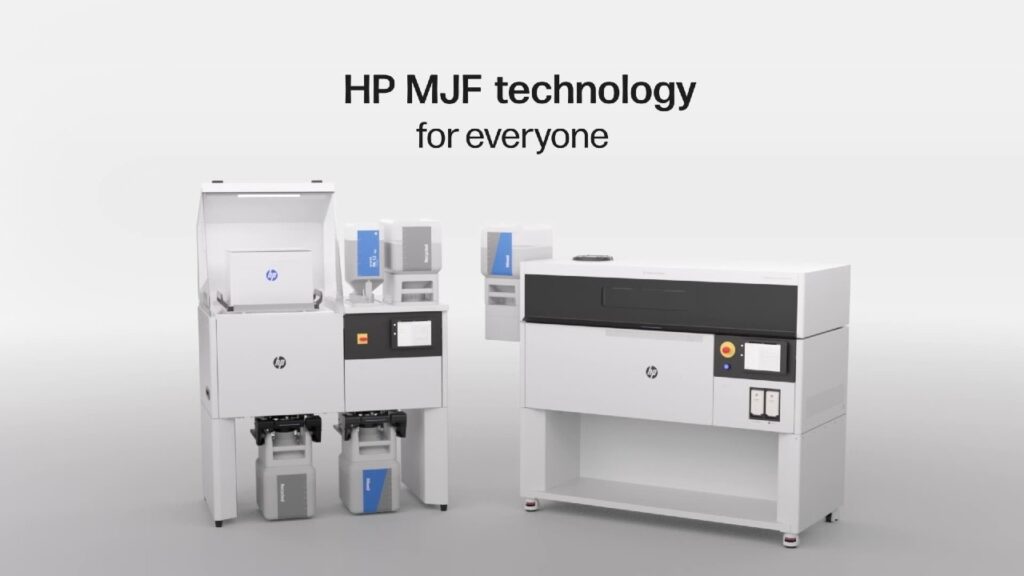
HP tries to make that workflow easier with a full system. The setup includes the printer, a Material Management System, and a Natural Cooling Unit. After printing, the build moves into the cooling unit. Then the printer can start another job.
Once the parts cool, the cooling unit connects to the material system. The system helps unpack parts, clean them with vibration, and recover unused powder. That matters in a small workspace, since powder mess can slow the whole process and make daily use frustrating.
This does not remove all manual work. Parts still need inspection, and some jobs need extra finishing. Still, the guided workflow makes the system much easier to picture in a lab or small production room.
Practical uses for the HP MJF 1200
The HP MJF 1200 makes the most sense for teams that need functional plastic parts on a regular basis. It is not the best choice for someone who prints only a few basic models each month.
Good use cases include:
- Functional prototypes
- Jigs and fixtures
- Clips, mounts, and brackets
- Small housings and covers
- Airflow parts and ducts
- Drone parts and lightweight structures
- Medical models and orthotic test parts
- Short-run production parts
- Replacement parts for internal use
- Design validation before tooling
A small manufacturer can use it to test new part shapes before ordering molds. A design team can use it to check ergonomics and fit. A repair shop can print low-volume replacement parts for internal jobs. Each use case has one thing in common: the printed part needs to work, not just look right.
Readers who follow HP’s wider hardware push can also check this related article on the HP Ferrari AI laptop, since it shows how HP is expanding across both workstations and advanced production tools.
How it compares with desktop 3D printers
Desktop 3D printers still have a place. They cost less, take less room, and work well for simple prototypes, visual models, and early design checks. They are useful tools for many offices and creators.
Still, the HP MJF 1200 serves a different user. It targets teams that need stronger parts, better repeatability, and a more controlled workflow. That makes it better suited for professional prototyping and small-batch part production.
The price also shows the difference. HP has positioned the MJF 1200 with a starting price below $60,000 in the US and EU. That is not cheap, but it is more reachable than many large industrial 3D printing systems.
So the real comparison is not against a $500 desktop printer. The better comparison is against outsourced industrial printing, larger additive systems, and the cost of long prototype cycles.
Software plays a key role
The MJF 1200 system includes Magics Print for HP by Materialise and HP 3D Center. These tools help teams prepare builds, arrange parts, monitor jobs, and manage printer activity.
Good software matters in industrial printing. Poor build preparation can waste space, material, and time. A better workflow helps teams place more parts in one build and reduce trial-and-error work.
For a small team, this can make the printer easier to adopt. A machine with strong hardware still needs a clear software process. Otherwise, the daily workflow becomes too slow.
The real value for small workspaces
The HP MJF 1200 is most interesting because it brings industrial polymer printing closer to teams that were stuck between two choices. One choice was a desktop printer that could not always produce the right part quality. The other choice was a large industrial system that needed more space, more money, and more planning.
This new printer creates a middle path. It gives teams access to MJF parts without forcing them into a full production-floor setup. That alone makes it a strong fit for many small professional spaces.
The strongest buyers will be teams that print every week, test many designs, or need to protect private product files. For them, owning the machine can reduce delays and make development work feel more direct.
What buyers should check first
Before buying the HP MJF 1200, teams should look at the full cost and workflow, not only the printer price.
Key points to check include:
- Local availability
- Final price with taxes
- Service and support costs
- PA 12 material pricing
- Powder reuse rules
- Room layout
- Power needs
- Cooling and unpacking space
- Operator training
- Post-processing needs
- Monthly print volume
A team that prints only a few parts each month may still save money with an outside print service. A team that prints often has a stronger reason to bring the work in-house.
Final thoughts
The HP Multi Jet Fusion 1200 brings a more practical version of industrial 3D printing to smaller workspaces. It offers a compact build size, PA 12 support, cleaner powder handling, guided software, and a price point that sits below many larger systems.
It will not replace every printer, and it will not fit every budget. Still, it solves a real problem for teams that need strong polymer parts without a large production setup.
For small manufacturers, product labs, and engineering teams, the HP MJF 1200 looks like one of the most useful industrial 3D printing launches to watch. It gives teams more control, faster testing, and a clearer path from design file to functional part.