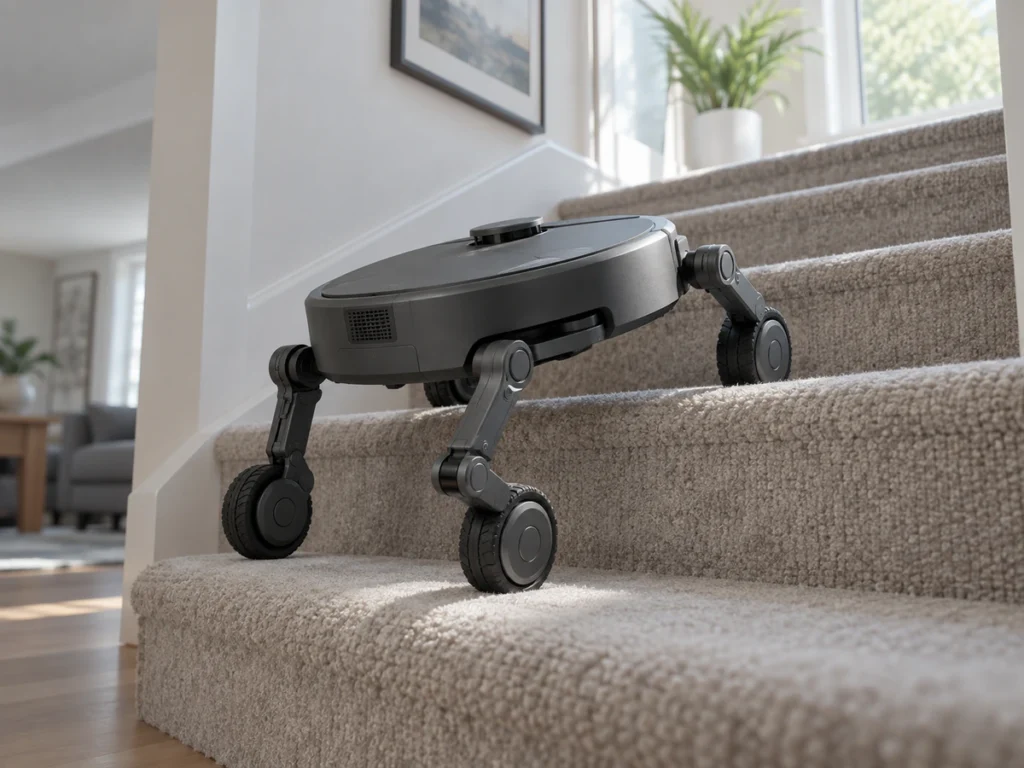
Roborock brought a robot vacuum with legs to IFA 2026 in Berlin, held from September 4 to 8, and it climbed stairs in front of the crowd. The Saros Rover replaces the usual fixed wheels under a round chassis with a wheel-leg design, and Roborock describes it as the first robot vacuum built that way. The company showed the same machine at CES 2026 in January, so Berlin was its European debut. No price exists and no release date exists. That combination makes it worth separating what a stair-climbing robot vacuum fixes from what remains an open question.
What Roborock has said
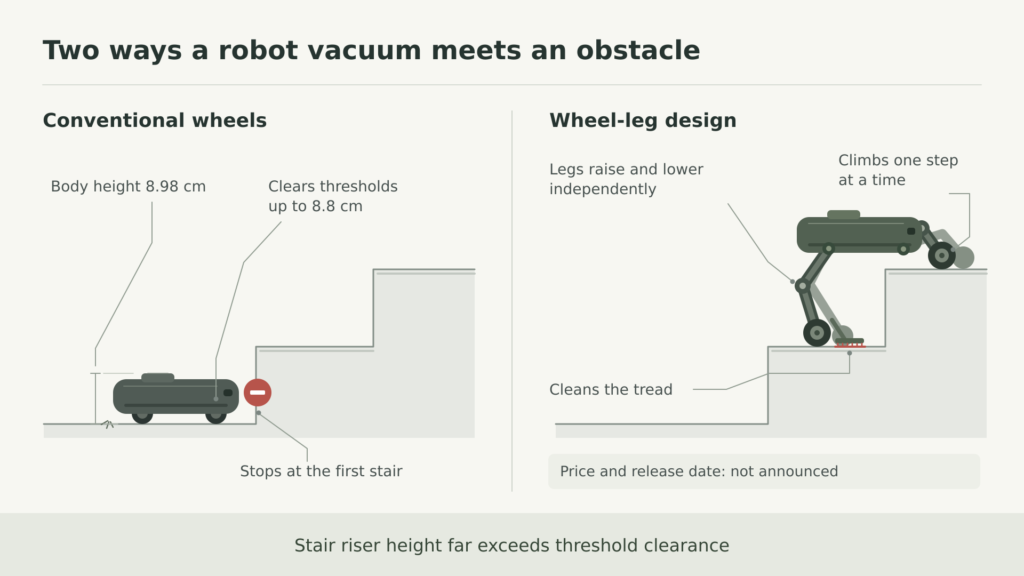
The Rover’s legs raise and lower independently. That lets the machine change its own height, work across slopes, deal with obstacles and perform small jumps. Roborock says it can climb a staircase and clean the individual steps as it goes, which is a different claim from crossing between floors.
Navigation leans on motion sensors combined with 3D spatial data, a step beyond a flat two-dimensional floor map. A robot that changes its body height and steps onto a raised surface needs to understand the space vertically, so the sensing change follows from the mechanical one.
Everything else is unstated. Roborock has not published a maximum step height, a stair width requirement, a weight, a battery figure for stair work, or how the machine docks when it lives on two floors. It has not announced pricing or availability in any market.
The problem legs are meant to solve
Multi-floor homes have always been the weak spot for robot vacuums. A standard robot maps and cleans one level, then stops at the top or bottom of the staircase. Owners deal with that in one of two ways. Either they carry the robot upstairs and let it rebuild or reload a second map, or they buy a second robot and a second dock.
Both answers cost something. Carrying the machine defeats much of the point of automation, since the robot only runs when somebody remembers to move it. Buying two units doubles the hardware spend and the maintenance, and it still leaves the stairs themselves uncleaned. Stairs collect a lot of dust and pet hair, and no mainstream robot vacuum touches them today.
So the target is real. A machine that moves between levels on its own and cleans the steps in between would remove the single largest gap in robot vacuum coverage.
How much a shipping robot already handles
Legs are not the only route over an obstacle, and current hardware has quietly improved. Roborock’s Saros 20 Flow Complete, a conventional wheeled flagship, stands 8.98 cm tall, claims 36,000 Pa of suction and uses a retractable LiDAR turret so the body can slide under low furniture. Its chassis lifts the robot over double-layer thresholds up to 8.8 cm high. Roborock has said that model arrives in late September or early October 2026.
That is a useful benchmark. Nearly nine centimeters of climb covers most door saddles, transition strips and thick rug edges found in a home. A typical indoor stair riser is far taller than that, which is exactly where the wheeled approach runs out and a legged one starts to make sense.
This is also not the first time Roborock has bolted a limb onto a cleaning robot. The company put a mechanical arm on an earlier flagship to move small objects out of the robot’s path, and our breakdown of the Roborock Saros Z70 shows how much that machine’s price and score turn on climbing and clearance, with raw suction a smaller factor. The Rover pushes the same idea further.
The questions that decide whether it matters
Several unknowns will determine whether a legged robot becomes a product or stays a trade show demonstration.
Safety. A machine that climbs can also fall. A robot tumbling down a flight of stairs threatens the robot, the staircase and anyone standing at the bottom. Roborock has not described its fall protection.
Stair types. Open-riser stairs, spiral stairs, narrow treads and thickly carpeted steps all behave differently under wheels or feet. Roborock’s CES release names traditional staircases, curved staircases and carpeted staircases with bullnose fronts, and says nothing about open risers or narrow treads.
Cleaning quality on a step. Cleaning a stair tread well means reaching the back corner where the tread meets the riser. Round robots struggle with corners on flat floors already, so a step can only be harder.
Time and noise. Climbing one step at a time is slow by nature. A staircase cleaned overnight is fine. A staircase that takes an hour during the day is a different proposition.
Price. Roborock’s conventional flagships already sit near the top of the market. A machine with independently actuated legs, richer sensing and more motors will not undercut them.
Should you wait for one?
No, for any purchase you need to make now. A product with no announced price, no release date and no published specification sheet cannot be planned around, and Roborock has shown this machine twice across eight months without committing to either.
The sensible read is that legged cleaning robots are moving from concept toward product, but slowly. If stairs and multiple floors are your actual problem, the practical fixes today remain a second robot on the upper level, or a cordless stick vacuum kept near the staircase. Watch the Rover for what it signals about the next few years rather than as something to hold out for this season.