
Tesla Solar Roof appears to have reached the end of its run as a product for new customers. In August 2026, Tesla stopped supplying Solar Roof tiles to third-party installers. Around the same time, the company changed its website so the old Solar Roof product page now directs visitors to its conventional Solar Panels page.
Tesla has not published a separate announcement that formally says, “Solar Roof is discontinued.” Still, the company’s recent actions make its direction fairly clear. Tesla now appears focused on traditional rooftop solar panels, Powerwall battery storage, and the rest of its home energy products.
Existing Solar Roof owners should not panic, though. Tesla still maintains Solar Roof support information and warranty documentation. So, while new installations appear to be ending, current systems have not suddenly lost their support.
Is Tesla Solar Roof Really Discontinued?
For anyone hoping to order a new system, the answer is effectively yes.
Tesla reportedly told certified third-party installers that they could no longer order Solar Roof tiles. The company instead directed installers toward its standard solar panels.
The website tells a similar story. Tesla removed Solar Roof from its main residential energy lineup, while the old product address now redirects shoppers to Tesla Solar Panels.
At this point, Tesla’s residential solar business centers mostly on:
- Tesla Solar Panels
- Powerwall home batteries
- Tesla Solar Inverter
- Energy monitoring through the Tesla app
Tesla still keeps several Solar Roof support pages online. That is expected because existing customers may need repairs, warranty service, troubleshooting, or documentation for many years.
So, the end of new Solar Roof sales does not mean Tesla has abandoned every Solar Roof already installed.
Why Did Tesla Stop Selling Solar Roof?
Tesla has not released a detailed public explanation covering every reason behind the decision.
Still, Solar Roof faced one major problem from the beginning. It was much harder to install and scale than ordinary solar panels.
The idea itself was clever. Instead of mounting large photovoltaic panels above an existing roof, Tesla built solar generation directly into specially designed roof tiles.
That approach produced a cleaner appearance, but it also turned each installation into a much bigger construction project.
A Solar Roof could involve:
- Removing the existing roof
- Installing solar and non-solar roofing tiles
- Electrical work
- Waterproofing
- Solar system design
- Local permits and inspections
- Inverter installation
- Optional Powerwall integration
Traditional solar panels skip much of that work. Installers can usually place standardized modules over an existing roof without rebuilding the entire roofing system.
That difference matters because nearly every house has its own complications. Chimneys, vents, valleys, dormers, roof pitches, shading, and unusual layouts can all make a Solar Roof installation harder and more expensive.
As a result, Tesla had a product that looked impressive but proved difficult to turn into a high-volume residential energy business.
Tesla Solar Roof Never Reached the Scale Tesla Envisioned
Tesla first showed the Solar Roof concept in 2016. The company had big ambitions for it.
By 2019 and 2020, Tesla discussed reaching roughly 1,000 Solar Roof installations per week. Actual deployment stayed far below that target.
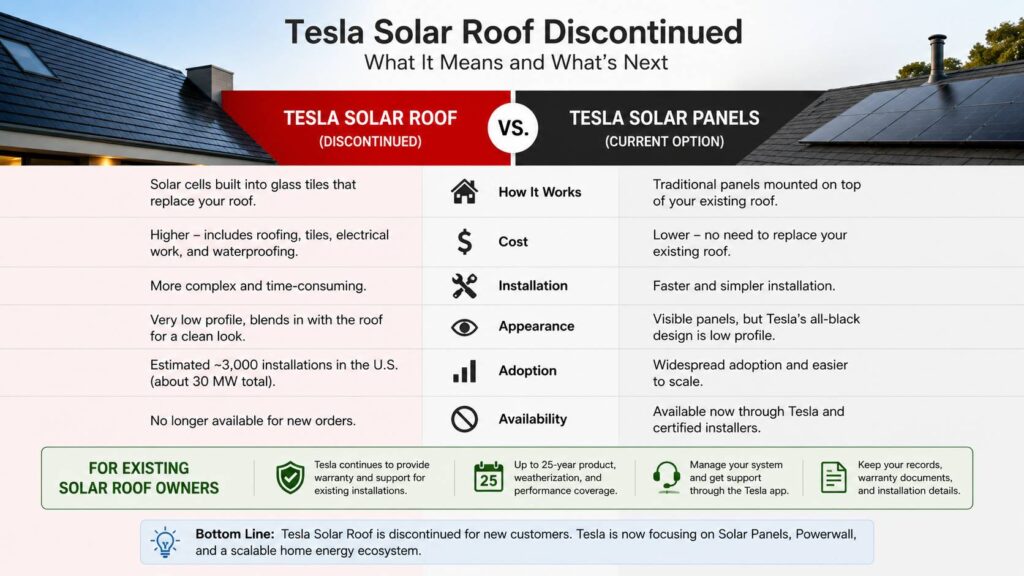
An industry analysis released in 2023 estimated that Tesla had installed around 3,000 Solar Roof systems in the United States since launch, with nearly 30 MW of combined capacity.
That gap helps explain the underlying problem.
Tesla did not simply need to manufacture more tiles. It also needed enough trained crews to install them quickly, consistently, and at prices homeowners considered reasonable.
Solar Roof required roofing expertise and solar expertise at the same time. That made expansion much more difficult than adding conventional panels to an existing roof.
Solar Roof vs Tesla Solar Panels
Tesla Solar Roof and Tesla Solar Panels both generate electricity from sunlight. Beyond that, the installation process is very different.
Solar Roof replaces the roofing surface itself. Tesla combined electricity-producing glass tiles with matching non-solar tiles to create a more uniform appearance.
Tesla Solar Panels sit above an existing roof.
That simple difference can have a major effect on cost and practicality.
If your current roof still has 15 or 20 years of useful life remaining, tearing it off to install solar shingles rarely makes financial sense. Standard solar panels let you keep the roof and add solar generation on top.
Solar Roof made more sense for homeowners who already needed a complete roof replacement. Even in that situation, buyers still had to compare the higher installation complexity with the cleaner appearance.
This trade-off was always central to the product.
Tesla Is Shifting Toward Conventional Solar Panels
Tesla’s decision becomes easier to understand when you look at its current residential energy lineup.
The company introduced an updated conventional rooftop solar panel system in 2026. Tesla lists the panel at 420 watts and uses an all-black design with low-profile mounting hardware.
The company also designed the system to hide more of the electrical hardware from view. So, while it cannot completely replicate the appearance of an integrated solar roof, it addresses one of the biggest complaints people have about traditional panels.
Tesla says its current panels use multiple power zones intended to reduce losses when dirt or partial shade affects only part of a module.
Tesla engineers the panels in California and assembles them at Gigafactory New York in Buffalo. The company also lists a 25-year product and performance warranty for its current solar panels.
For Tesla, this approach is much easier to scale. The company can sell standardized panels without becoming responsible for replacing an entire roof on every project.
Interest in solar-powered technology also extends well beyond houses. Products such as the Phosgo GO5 solar e-bike show how manufacturers continue experimenting with ways to use solar energy in everyday products, even as Tesla steps away from solar roof tiles.
What Happens If You Already Own a Tesla Solar Roof?
If you already have Solar Roof, the product’s disappearance from new sales does not automatically change your warranty.
Tesla continues to maintain support information for current owners. Its published U.S. Solar Roof warranty documentation includes long-term coverage for qualifying systems.
Depending on the installation and contract, coverage may include:
- A 25-year product warranty
- A 25-year weatherization warranty
- Long-term solar module performance coverage
Tesla’s published performance terms state that Solar Roof power capacity should remain at least 95% of rated peak power after five years. From that point, Tesla allows a maximum annual decline of 0.5% during the following 20 years.
Still, owners should check the warranty agreement they received with their installation. Tesla has changed its products and agreements over time, so an individual contract matters more than a general support page.
Owners can also continue using Tesla’s app and support channels for solar system management.
What If You Already Have a Solar Roof Order?
This is where things become less clear.
Tesla has not published a broad public policy explaining exactly what will happen to every unfinished Solar Roof project.
One customer may already have permits and an approved design. Another may have only paid a deposit. Some projects could have equipment allocated, while others may still sit in an early planning stage.
Because those situations differ so much, Tesla or the installer may handle each project separately.
If you have an active Solar Roof order, check your Tesla Account and contact the company or installer directly. Ask them to confirm in writing whether they will:
- Complete the Solar Roof project
- Replace it with a standard solar panel proposal
- Modify the contract
- Cancel the project and issue any applicable refund
It is better to get a clear answer before arranging unrelated roofing work or making other expensive changes to the property.
Will Tesla Keep Repairing Existing Solar Roof Systems?
Tesla’s continued support and warranty pages indicate that the company still intends to support qualifying existing systems under their agreements.
Still, product discontinuation creates a practical concern that owners should keep in mind. Specialized replacement parts may become harder to source over a very long period.
Solar Roof tiles are not ordinary solar panels. If one tile fails, a contractor cannot simply replace it with any standard photovoltaic module from another brand.
For that reason, owners should keep good records.
Store copies of your:
- Purchase agreement
- Warranty paperwork
- Original system design
- Installation records
- Building permits
- Electrical documentation
- Installer contact information
- Tesla account records
These documents may also help if you sell the property later.
Can You Still Use Powerwall Without Solar Roof?
Yes. Powerwall works independently of Solar Roof.
Tesla continues to sell Powerwall alongside its conventional solar panels. The battery can store electricity produced by solar panels during the day and make that energy available later.
Depending on local rules and the way your system is configured, Powerwall can also provide backup power during an outage.
So, homeowners interested in a Tesla home energy setup can still build one without Solar Roof.
For most buyers, Tesla Solar Panels paired with Powerwall now represent the most direct replacement for the original Solar Roof ecosystem.
What Are the Best Tesla Solar Roof Alternatives?
People who liked Solar Roof mainly for its integrated appearance still have options.
The first route is another solar shingle or building-integrated photovoltaic system. Several manufacturers continue developing roofing materials that can generate electricity while functioning as part of the roof itself.
The second option is far more conventional. Install a normal roof and place standard solar panels above it.
For many homes, conventional panels have several practical advantages.
They are easier to replace, and homeowners can choose from a larger range of manufacturers. Solar contractors also have much more experience working with traditional modules.
Roofers benefit too. They can work with familiar materials rather than dealing with a specialized solar roofing system.
Your roof’s current condition should play a major role in the decision.
If you already need a complete roof replacement, comparing solar shingles with a new roof plus solar panels makes sense. If your roof is still relatively new, conventional panels will usually avoid a large amount of unnecessary construction work.
Why the End of Tesla Solar Roof Matters
Solar Roof was one of Tesla’s most ambitious home energy products.
Instead of treating solar panels as equipment mounted on top of a house, Tesla tried to make electricity generation part of the roof itself. It was an appealing concept, especially for homeowners who disliked the appearance of conventional panels.
The challenge was turning that idea into something Tesla could install quickly and profitably at large scale.
Manufacturing the tiles was only one piece of the project. Tesla also had to deal with roofing crews, electricians, custom designs, waterproofing, permits, inspections, replacement parts, and long-term service.
Meanwhile, standard solar panels continued improving. They became more powerful, visually cleaner, and much easier for installers to deploy.
That made Tesla’s shift toward conventional panels increasingly logical.
For new customers, the situation is now fairly simple. Tesla Solar Roof no longer appears to be available as a normal new residential installation option. Tesla Solar Panels have effectively taken its place.
Current owners face a different situation. Their systems remain operational, Tesla still publishes support information, and existing warranty agreements continue to matter.
Solar Roof may be disappearing from Tesla’s product catalog, but the idea behind it is not necessarily dead. Solar shingles and integrated photovoltaic roofing remain active areas of development. Tesla simply appears to have decided that conventional panels offer a more practical way to grow its residential solar business.