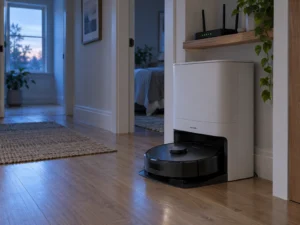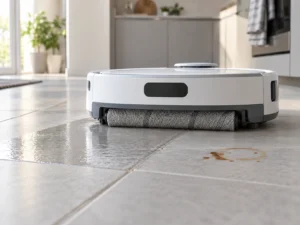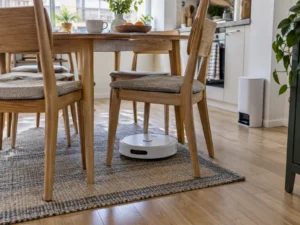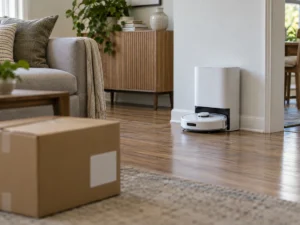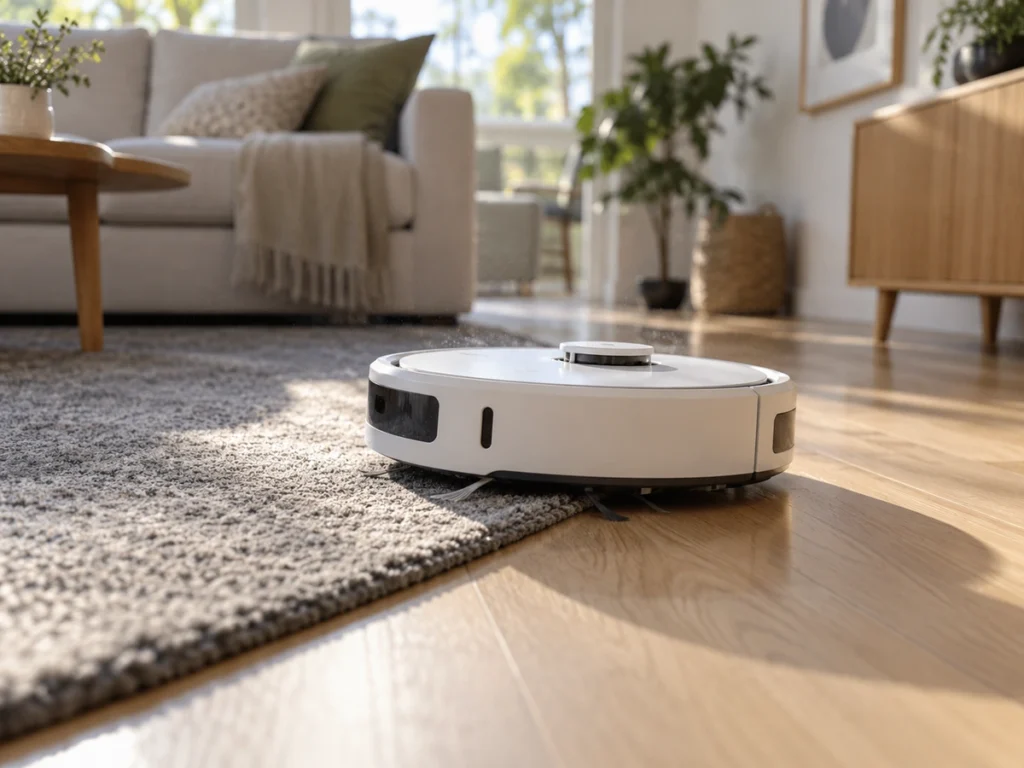
Anker’s eufy brand announced the Robot Vacuum Omni E35 on September 3, 2026, ahead of IFA 2026 in Berlin, and put two health marks at the top of the announcement, ahead of any suction figure. One of them is asthma and allergy friendly certification. That mark is not a marketing slogan invented by the manufacturer, and it is not the same thing as a HEPA claim. It comes from a testing program with published pass thresholds, so it is possible to say exactly what a certified vacuum has proved and what it has not.
Who runs the mark and what it applies to
The Asthma and Allergy Friendly Certification Program is operated by Allergy Standards Limited in partnership with the Asthma and Allergy Foundation of America. Allergy Standards writes the test standards and the foundation adopts them. More than fifty standards sit under the program, covering appliances, bedding, air filters, flooring, paint, insulation and cleaning services.
Each product category gets its own standard, so a certified mattress cover and a certified vacuum have almost nothing in common beyond the badge. Robot vacuums have a standard of their own, separate from the general vacuum standard, and it is built around a single practical worry. Vacuuming disturbs settled dust, so a bad machine can raise the allergen level in the air while it cleans.
The four things a certified vacuum has to prove
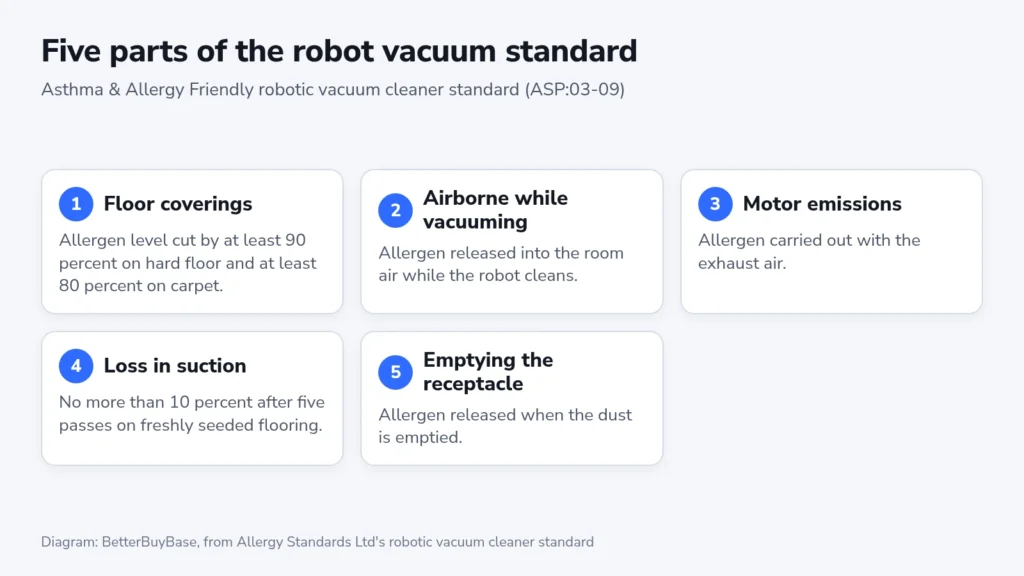
Testing happens in a controlled environmental chamber. A piece of floor covering is seeded with test dust containing dust mite allergen and cat allergen, and the machine is measured against four criteria.
Allergen pick-up comes first. A robot must cut the allergen level by at least 90 percent on hard floor and by at least 80 percent on carpet. The general vacuum standard adds a crevice test, but the robot standard’s five parts leave it out.
Airborne particles come second. Allergen levels and particle counts have to stay below the program’s limits both during cleaning and while the dust receptacle is emptied. Seal integrity is third. Every bit of air moving through the machine must pass through the filter, with none leaking around it.
Loaded performance is the fourth test, and it is the most interesting one for anyone comparing spec sheets. Suction is measured again as the dust receptacle fills over repeated passes on freshly seeded flooring, and the robot must lose no more than 10 percent of its suction to pass.
Why the loaded suction test matters more than the headline number
Manufacturers quote peak suction in pascals, and that figure is measured under ideal conditions with an empty bin and a clean filter. Real cleaning does not happen that way. Dust loads the filter within minutes, and a machine that relies on a fine filter to hit its headline number will quietly shed performance across a single run.
The 10 percent limit turns that into a pass or fail. So a certified machine has shown it still works when it is dirty, which is the state your vacuum spends most of its life in. Compare that against a specification sheet for a machine already on sale, such as the eufy X10 Pro Omni, and you can see the gap. Published specifications stop at the peak.
What the certification does not tell you
The mark is narrow on purpose. It says nothing about how well a robot navigates, whether it climbs onto rugs, how it mops, how loud it is, or how well the dock cleans itself. It does not rank one certified machine above another either, because certification is a pass-or-fail threshold.
It is also not a HEPA rating. A HEPA filter describes one component and says nothing about whether the air goes through it. The seal test exists precisely because a good filter in a leaky body does very little. Words like hypoallergenic sit in a different category again, since they carry no defined test behind them at all.
Robot vacuums and the public directory
The program’s public directory of certified vacuums is organized into commercial, cordless, water-based filtration, canister and upright groups, plus replacement parts. As of October 2026 the directory also has a Robot Vacuum Cleaners category, and it lists the Robot Vacuum Omni E35 by eufy as certified on August 5, 2026.
The directory is the place to check before you pay a premium for the badge, because it is the only public record that a specific model passed.
The second mark on the same machine
eufy also cites a TÜV SÜD Maternal and Infant Cleaning Robot certification for the E35. Coverage of the announcement describes that assessment as covering bacterial reduction, noise, dust mite treatment and the base station’s self-cleaning. Those criteria are not published in the same open form as the allergy standard, so the thresholds behind them are not public. Treat the two marks differently for now. One has numbers you can look up and one does not.
Dates and availability
The Omni E35 went on sale in the EU and the UK on September 4, 2026. US pre-orders opened the same day, with a launch set for September 25, 2026. eufy has published an early-bird price for the pre-order window and a higher standard price after it, so the launch date matters if the badge is what you are paying for.
What to check if allergies are the reason you are buying
Start with the emptying step, because that is where most exposure happens in a home. A self-emptying dock moves the dust into a sealed bag and takes the worst moment away from you. Then look at filter replacement cost and cadence, since a sealed machine with a neglected filter drifts back toward an ordinary one.
Run frequency matters as much as the machine. A certified robot running daily on a schedule removes far more allergen over a week than a stronger vacuum used once. Finally, check whether the model you are buying carries the mark. Certification applies to a specific model, not to a brand or a product family, and the cheaper variant in the same range usually has not been tested.