
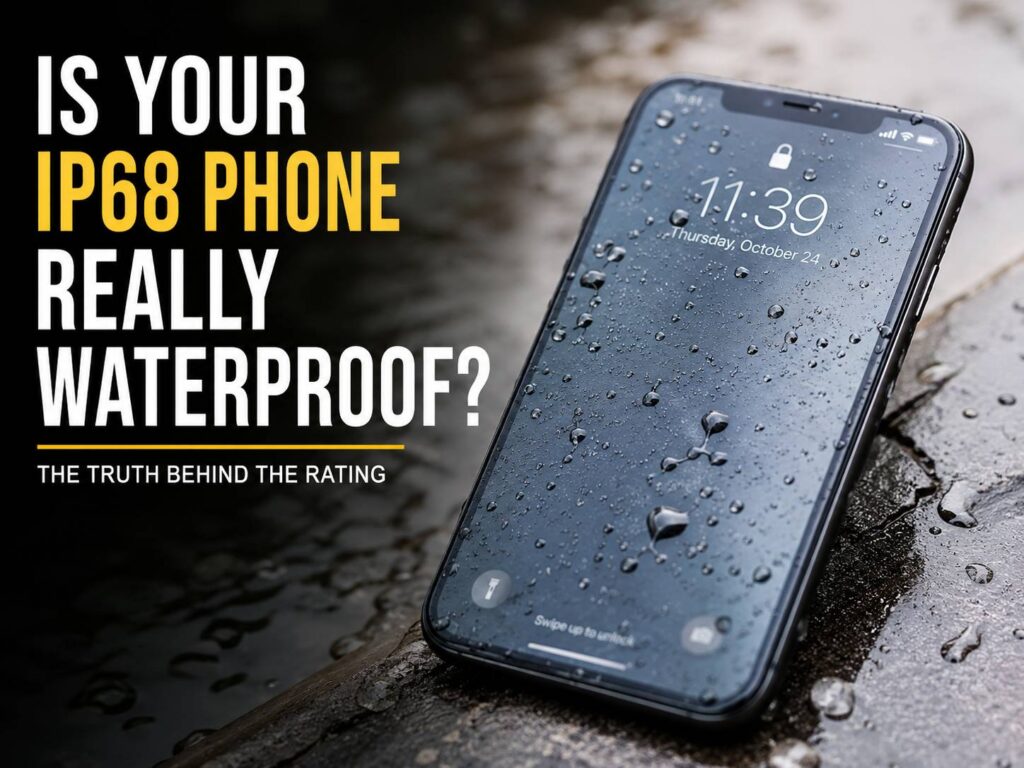
A phone with an IP68 rating can handle some contact with water. Still, that does not make it fully waterproof. The rating only shows how a new device performed during a controlled laboratory test.
That difference matters more than many buyers realize. For example, a phone can survive a short drop in clean water but still fail after exposure to salt water, steam, soap, or strong water pressure. So, IP68 offers useful protection, but it does not protect a phone in every situation.
Many brands use the words “water-resistant” rather than “waterproof.” There is a good reason for that. Water resistance has limits, and those limits can change as the phone gets older.
What Does IP68 Actually Mean?
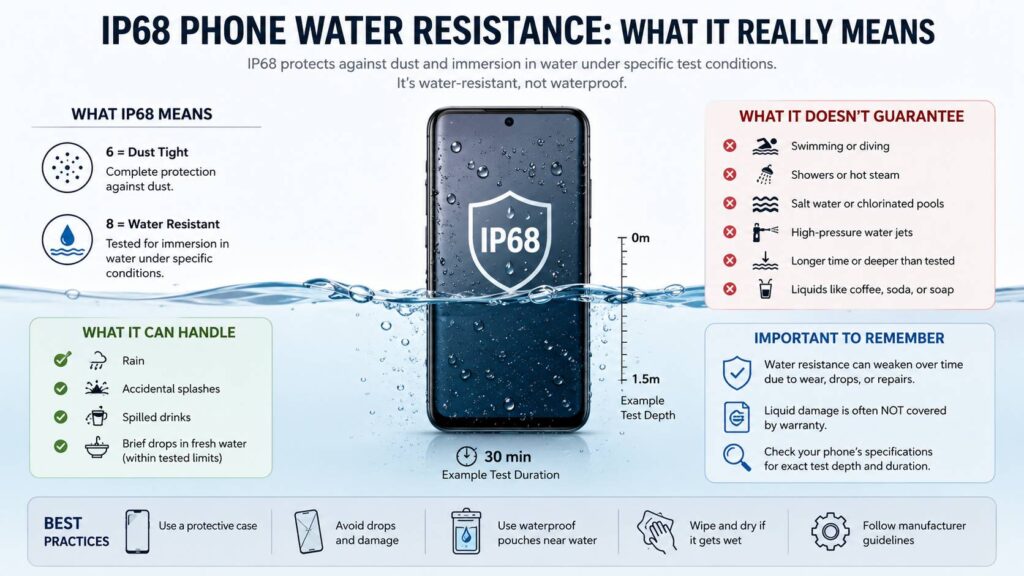
IP stands for Ingress Protection. The rating follows the IEC 60529 testing standard and contains two numbers.
The first number measures protection against dust and solid particles. In this case, the number 6 means the device offers the highest listed level of dust protection.
The second number measures protection against water. The number 8 means the device survived an immersion test under conditions chosen for that model.
Yet there is an important detail. IP68 does not mean the same thing on every phone.
For example, one phone can receive an IP68 rating after being tested at a depth of 1.5 meters for 30 minutes. Another phone can carry the same rating after a test at a deeper level. So, the IP68 label alone does not tell you the exact depth or time limit.
You need to read the specifications for your exact phone model. In practice, that small section often gives more useful information than the IP68 badge itself.
Why the IP68 Rating Can Feel Misleading
The IP68 rating sounds clear and reassuring. Yet the test conditions are often hidden in the smaller print.
A product page can place “IP68 water resistance” near the top in large text. Then, farther down, it may explain that the test used fresh water, a new device, a fixed depth, and a limited amount of time.
That presentation can easily create confusion. Many people read IP68 and assume the phone is safe in pools, showers, lakes, or the sea. In reality, those situations are often very different from a laboratory test.
For that reason, IP68 should be viewed as accident protection. It is not an invitation to use your phone as an underwater camera.
Phone makers should make the limits clearer. They should place the depth, duration, liquid type, and warranty terms next to the rating. That would give buyers a more honest picture of the protection they are paying for.
Laboratory Tests Do Not Copy Real Life
IP tests take place in controlled conditions. Real-world accidents rarely follow the same rules.
A phone can come into contact with:
- Salt water
- Chlorinated pool water
- Soapy bath water
- Shampoo or shower gel
- Coffee, juice, or soda
- Hot steam
- Fast-moving water
- Sand, dirt, or grit
Each of these can create a different risk.
For example, salt can speed up corrosion inside the charging port. Soap can help liquid move through tiny gaps. Chlorine can affect seals and coatings. At the same time, hot steam can place stress on adhesives around the display and back panel.
Water pressure is another issue. A phone sitting still in shallow water faces different conditions from a phone under a running tap or shower head. So, a device can pass an immersion test but still suffer damage from a strong jet of water.
The same rule applies to outdoor gear. A product built for use around water needs protection suited to its exact purpose. For example, portable systems such as the Joolca HOTTAP GO are designed with outdoor use in mind. A smartphone, by comparison, is not built to act as dedicated water equipment.
Water Resistance Gets Weaker Over Time
A phone does not keep the same level of water resistance forever.
Seals and adhesives face heat, cold, drops, pressure, pocket dust, and daily wear. Over time, those parts can weaken. So, a phone that handled water well when new can become more vulnerable after one or two years.
A cracked screen creates an obvious risk. Yet small damage can be just as important. A slightly bent frame, a loose back panel, or a tiny gap near the display can let liquid enter.
Battery swelling can create another problem. As the battery expands, it can push the display or rear panel away from the frame. Then, the original seal no longer works as intended.
Repairs can affect water resistance too. Opening the phone breaks the factory seal. A good repair shop can apply new adhesive and test the device, but the result may not match the original factory condition.
For that reason, ask the repair shop whether it performs a pressure test after the repair. Still, even a successful test cannot promise protection in every real-life situation.
Why Liquid Damage Is Often Excluded From Warranty
This is where many owners feel disappointed.
A phone can have an IP68 rating, yet the standard warranty may still exclude liquid damage. At first, that can seem unfair. Still, the manufacturer cannot confirm exactly what happened during the accident.
For example, the phone may have been exposed to salt water, soap, heat, pressure, or a depth beyond the tested limit. The device may have had a small crack before the accident. So, the service center often treats liquid exposure as accidental damage rather than a manufacturing fault.
Many phones contain liquid contact indicators. These markers change color after contact with moisture. A technician can inspect them during a repair assessment.
Consumer rights vary by country, and some insurance plans offer wider protection. Yet an IP68 rating does not act as automatic insurance. Read the warranty terms and accidental-damage cover before using the phone near water.
Can You Shower With an IP68 Phone?
You should avoid using a standard IP68 phone in the shower.
A shower adds warm water, steam, soap, and direct water pressure. Those conditions do not match a normal immersion test. So, even a brief shower can create more risk than a short drop in clean water.
The same warning applies to baths, saunas, and steam rooms. Heat can weaken seals, and soap can move through gaps more easily than plain water.
That does not mean the phone will fail every time. Many phones survive showers without visible damage. Yet repeated exposure can raise the chance of problems over time.
Can You Swim With an IP68 Phone?
Swimming with an IP68 phone is risky.
Pools contain chlorine. The sea contains salt. Lakes can contain dirt and fine particles. Then, movement through the water creates changing pressure around the phone.
Diving creates even more pressure. The deeper the phone goes, the greater the stress on its seals.
So, the safest choice is a proper waterproof case or pouch. Before using one, place dry tissue inside and test the empty case in water. If the tissue stays dry, the case is more likely to protect the phone.
Still, check the case seal each time. Sand, hair, or dirt around the closure can create a leak.
What Should You Do If Your Phone Gets Wet?
Act quickly, but do not panic.
Follow these steps:
- Remove the phone from the liquid.
- Disconnect all cables and accessories.
- Remove the case.
- Wipe the outside with a soft cloth.
- Hold the charging port downward.
- Let the phone dry in a place with natural airflow.
- Wait before connecting a charging cable.
- Follow the manufacturer’s instructions for your model.
Do not use a hair dryer, radiator, oven, or strong heat source. Heat can damage the battery, screen, seals, and internal parts.
Do not push cotton swabs or paper into the charging port. That can force water farther inside or leave fibres behind.
Rice is not a reliable drying method either. Small particles can enter the port, and rice does not remove corrosion.
For example, a wet charging port may need several hours to dry. In some cases, the warning can remain for a day or longer. So, do not ignore the warning just to charge the phone.
If the device becomes hot, smells unusual, restarts, or shows screen problems, stop using it. Then, contact a repair center.
How to Protect Your Phone Near Water
A few simple habits can reduce the risk:
- Keep the phone away from pool edges and sinks.
- Use a protective case that guards the frame.
- Repair cracked glass quickly.
- Do not open the SIM tray when the phone is wet.
- Keep sand away from ports and speaker holes.
- Use a waterproof pouch near pools, lakes, or the sea.
- Avoid charging the phone in damp areas.
- Check the exact IP68 test limit for your model.
- Treat repaired phones with extra care around water.
These steps may feel cautious. Still, they are far cheaper than a display, charging port, or motherboard repair.
Is IP68 Better Than IP67?
IP68 normally offers stronger immersion protection than IP67.
IP67 often covers immersion up to 1 meter for a limited time. IP68 covers deeper immersion under conditions set by the manufacturer.
Yet condition matters more than the label in some cases. A new IP67 phone with no damage can resist water better than an older IP68 phone with a cracked frame.
So, do not compare ratings without checking the age, condition, repair history, and exact test details.
IP69 is different again. It focuses on high-pressure and high-temperature water jets. It does not always mean the device is made for deep underwater use.
Should IP68 Affect Your Buying Decision?
Yes, IP68 is useful. It can save a phone during heavy rain, a spilled drink, or a quick drop in fresh water.
Still, it should not be the only reason to buy a phone. Repair quality, build strength, case options, warranty terms, and accidental-damage cover matter too.
My honest view is that IP68 is best treated as a backup feature. It can protect you during an accident, but it should not change how carefully you handle the device.
What IP68 Really Means for Your Phone
An IP68 phone is water-resistant, not fully waterproof. It passed a controlled test when it was new. Real life adds heat, pressure, chemicals, salt, wear, and accidental damage.
So, trust the rating for unexpected splashes and brief accidents. Do not rely on it for swimming, showering, or planned underwater use.
The safest habit is simple. Keep your phone away from water whenever possible. Then, use a proper waterproof case when water exposure cannot be avoided.