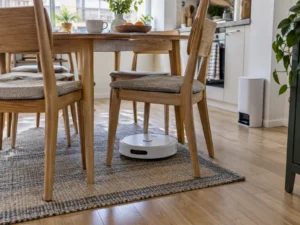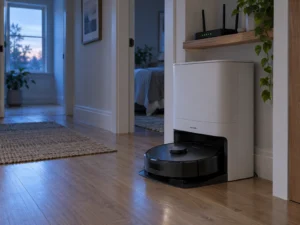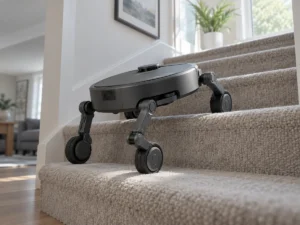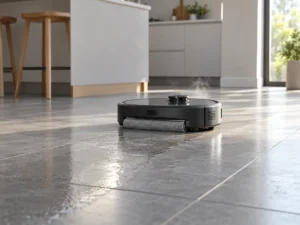
On September 9, 2026, the FCC announced the first exemption from its new restrictions on foreign-produced robots. It went to four Husqvarna robotic lawn mowers. Still, the news matters to anyone shopping for a robot vacuum in the United States. The same FCC robot vacuum rules cover a typical connected model. The rules govern FCC authorization for the US market only, so this guide speaks to US buyers.
The FCC’s Covered List change of July 28, 2026
The FCC added foreign-produced advanced robotic devices to its Covered List on July 28, 2026. That list holds equipment that national security agencies have judged to pose an unacceptable risk. The FCC cannot add items on its own. It acts on a determination from qualifying agencies, and here a White House-convened interagency body made the call.
The determination warned that data from these robots could help malign actors “surveil Americans” or even “remotely commandeer the robots.” It also cited supply chain risk.
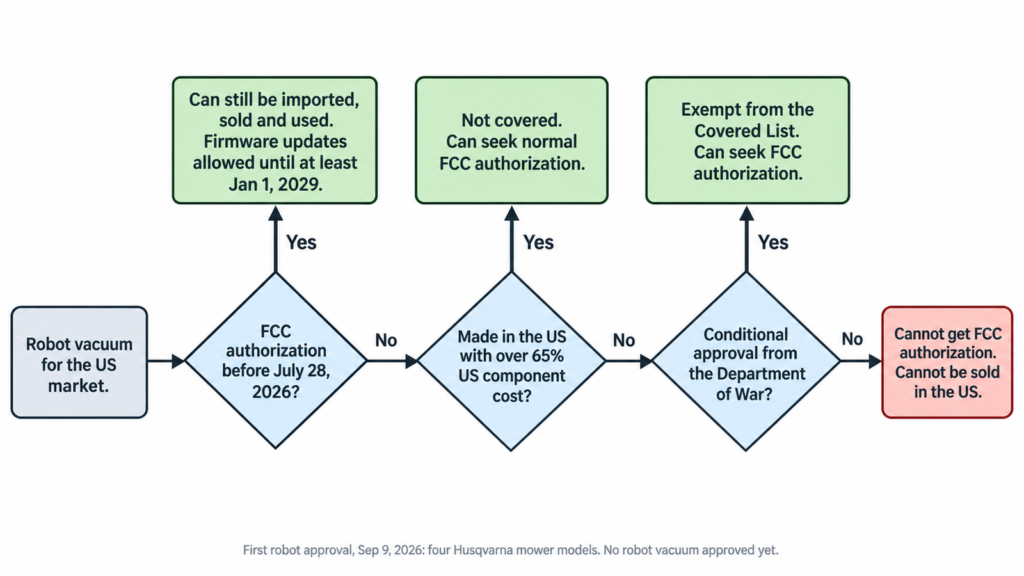
Equipment on the list cannot receive a new FCC equipment authorization. Most electronic devices need that authorization before they can be imported, marketed or sold in the United States. So the practical effect is a stop on new models, not a recall of old ones.
Does a robot vacuum count as an advanced robotic device?
The definition never uses the words “robot vacuum,” but its wording is broad. It covers a mobile robot that moves on the ground and operates at a distance from a person, based on commands or sensor data. It must also meet every one of these tests:
- The device and its dock or ground station together weigh more than 4.4 pounds, which is about 2 kilograms.
- A sensor lets it perceive its surroundings.
- Its network connection reaches at least 200 kbps in either direction, over Wi-Fi, Bluetooth, cellular or a wired link.
- Software, running locally or in the cloud, controls its navigation, data collection or remote control.
In our reading, a typical app-connected robot vacuum with a charging dock meets every part of that list. The FCC has also said that pool-cleaning robots are not excluded when they can work out of the water. That shows how widely the definition reaches.
Where a robot is made matters more than the brand
The rule turns on production. The nationality of the company does not enter into it. A robot counts as domestic only when two things are true. It must be manufactured in the United States, and US components must make up more than 65 percent of its total component cost. That threshold applies to items delivered from 2024 through 2028. From 2029, it rises to 75 percent.
Off-the-shelf parts still count toward that calculation. So the rule covers an American brand that builds its robots abroad, just as it covers a Chinese or European one.
Robot vacuums already on sale are not affected
The rule does not pull existing models. The FCC says stores can keep importing, marketing and selling models it authorized earlier. Owners can keep using the robots they already have, and the FCC places no direct restriction on operating a covered robot that already holds authorization.
You can check any model yourself. Devices certified through the FCC carry an FCC ID, usually on a label on the robot itself. You can search that ID in the FCC’s equipment authorization database. Some devices use a supplier’s declaration of conformity instead. Those have no FCC ID, but the seller must supply compliance information.
The FCC does have a separate process for stopping further imports of equipment it had already authorized. That process requires a public notice, at least 30 days of comment and a public interest analysis. As of the FCC’s September 9 update, robotic devices are not on the list of equipment facing those import and marketing bans.
App features and firmware updates
For owners, updates are the practical concern, because a robot vacuum depends on its app and its firmware. FCC rules normally restrict certain changes to covered equipment. On July 28, 2026, the FCC’s Office of Engineering and Technology waived those limits for robots authorized before the Covered List change. Software and firmware updates that mitigate harm to US consumers can continue at least until January 1, 2029. That explicitly includes patches for security flaws and updates that keep devices working.
The waiver lets a maker ship updates. Nothing obliges anyone to do so. How long a brand supports a model was already a real buying factor, and it still is. Our comparison of the Dreame X60 Max Ultra Complete, Roborock Qrevo Edge 3 Pro and iRobot Roomba Plus 415 makes that point. It lists support length among the honest tiebreakers between flagships that look alike on paper.
The first exemption went to a lawn mower
On September 9, 2026, the FCC’s Public Safety and Homeland Security Bureau published the first robot approvals. The Department of War had granted conditional approvals to Husqvarna’s 305v IQ, 310v IQ, 420v IQ and 440v IQ robotic platforms. Those four models are now exempt from the Covered List. The same notice approved router families from ASUS and Comtrend.
The Husqvarna decision showed that the process works for consumer robots, and not only for drones and routers. The router approvals issued that day end on March 6, 2028. By contrast, the FCC’s list shows no end date for the Husqvarna entry.
Matic is the first robot vacuum approved
On October 2, 2026, the same bureau announced the first approval for a robot vacuum, in Public Notice DA 26-1063. The Department of War granted conditional approval to Matic Robots’ Robotic Floor Cleaner, model 4MA0001, and its Charging Dock, model 4DK0008. That pair is now exempt from the Covered List.
The approval carries no end date. It stays in force as long as Matic follows the onshoring plan in its application and its products pass updated vetting. If Matic strays from that plan, or the government finds a false statement in the application, the approval can end and the robot goes back on the Covered List. Matic designs and assembles its robots in California, but its co-founder told Forbes in August that the company did not yet meet the domestic component test, which is why it needed an approval at all.
How a robot vacuum maker gets approved
Any company involved in producing a robot can apply, and one application can cover a whole class of products. The FCC passes each application to the Department of War, which decides whether the device poses an unacceptable risk. Submission does not guarantee approval, and the guidance says all decisions are final.
The guidance asks for far more than a normal FCC filing. Applicants must submit:
- their full ownership structure, including any foreign government ownership, control, influence or financing
- a bill of materials, with the country of origin for every component and for the design
- the country of origin for onboard software and firmware, and who is responsible for updates
- a time-bound plan to establish or expand US manufacturing, with investment, hiring and facility targets
- quarterly progress reports on that plan once an approval is granted
Applications must arrive by January 1, 2028. For a large robot vacuum maker, the onshoring plan is the heavy part. It asks for committed spending over one to five years.
What the FCC robot vacuum rules mean if you are shopping now
A few practical points follow from the rules as they stand today:
- Buy on today’s merits. Models already authorized are not threatened, so there is no need to rush a purchase or to avoid a brand.
- Watch new launches. A foreign-produced robot vacuum that lacked FCC authorization on July 28, 2026 cannot reach US stores unless it passes the domestic test or wins a conditional approval.
- Be careful with imports. The FCC says that if you buy a covered robot abroad and it lacks FCC authorization, you generally cannot operate it in the United States.
- Ask about support. The FCC allows updates at least until January 1, 2029, but each brand decides how long it supports each model.
What changes for your robot vacuum
The first exemption under the FCC robot vacuum rules went to a lawn mower, and the first robot vacuum followed on October 2. For now, nothing changes for the robot vacuum you own or for the models already in stores. Firmware updates also remain protected at least until January 1, 2029. The open question is whether the larger robot vacuum brands will apply, and when. So far Matic is the only robot vacuum maker on the FCC’s list.