Matic Robot: Specs, Features, Pros & Cons
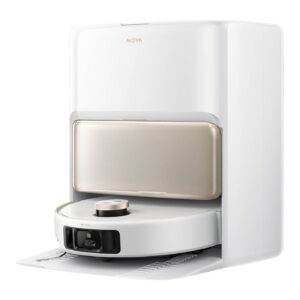
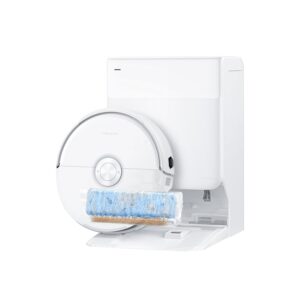
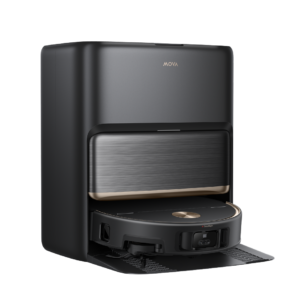
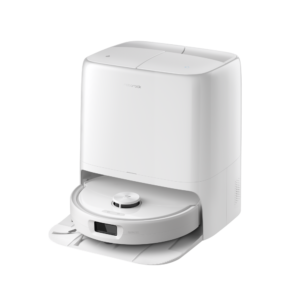
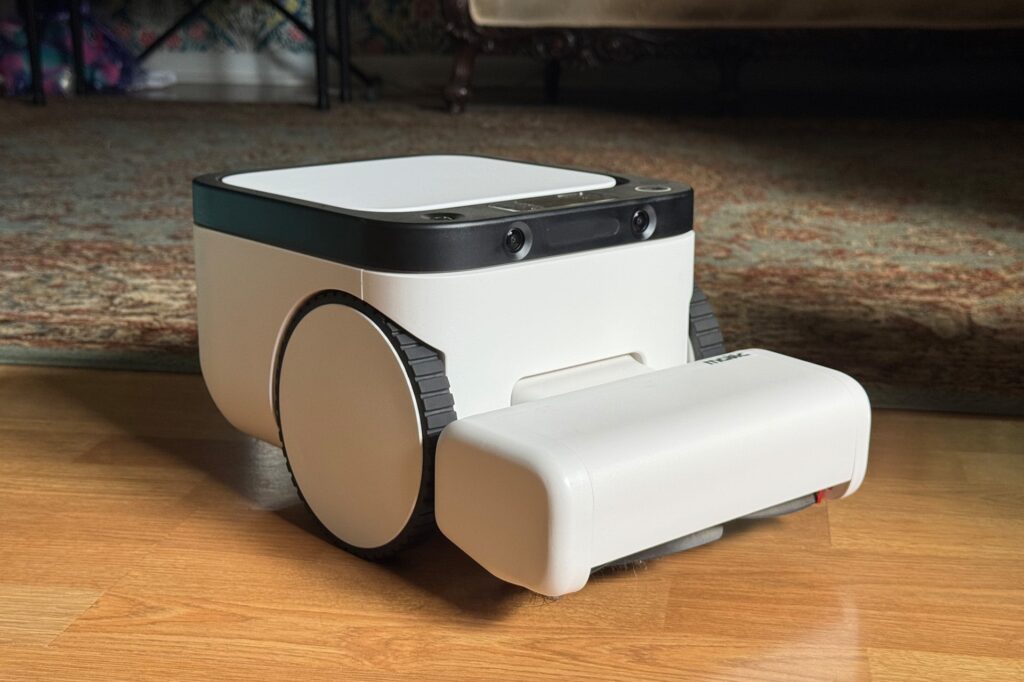
At 198 mm tall, about twice the height of a typical robot vacuum, the Matic will not fit under a sofa, and its whole design follows from standing tall. It carries its dirt and its water on board, in a bin and a tank several times larger than a docked robot carries, so there is no base station that empties or refills it.
That makes it a very different object in the hallway. The dock is small and simple, and the robot does its own work between visits from you. The mop is a roller that cleans itself as it turns, a HEPA filter is fitted, and the robot runs quietly, which suits a home where someone works during the day. Navigation is visual. A camera builds the map, and the app uses it for rooms, no-go zones and obstacle avoidance, with carpet detection and recharge-and-resume on top. The rated runtime is 150 min.
Matic does not publish a suction figure, and the robot's shape points to the reason. This is a machine built around frequent passes with a scrubbing roller on hard floors, with carpet cleaning left to other robots. Owners who expect it to pull grit out of a deep rug will be comparing it against a job it was never set.
It fits a home of wood, tile or vinyl where the floor is mopped more often than vacuumed, and where the owner would rather empty a big bin by hand than give a corner to a large dock. Everything under the furniture stays out of reach, and carpet, pet hair or a wish for a hands-off routine point to another robot. Emptying and refilling stay a person's job.
Category strengths
Where the Matic Robot beats the median
- A much bigger water tank ?600 ml vs 110 ml (median)
- A much bigger dustbin ?1,000 ml vs 300 ml (median)
- Has HEPA filter ?
- Slightly quieter operation ?55 dB vs 60.1 dB (median)
Where the Matic Robot trails the median
- No self-empty dock ?
- A much taller design ?198 mm vs 96.8 mm (median)
- No auto-refill mop ?
- No automatic detergent dispenser ?
- A shorter runtime per charge ?150 min vs 194 min (median)
- A slightly lower threshold clearance ?23 mm vs 24 mm (median)
How this VS Score was computed
Score 43: each known spec is measured against the median of all robot vacuums (58 products), then weighted; 50 means level with that median. In classes of six or more, a value beyond the class’s 10th–90th percentile range counts as that limit, so one extreme product cannot set the scale. 40% of the scoreable weight could be used; unknown values, features not applicable to this class and proxies (battery capacity where a rated life exists) add or remove nothing.
| Specification | This product | Cohort median | Score weight | Points moved |
|---|---|---|---|---|
| Self-empty dock | No | 91% of the class have it | 0.7 | −33.6 |
| Mopping | Yes | 79% of the class have it | 0.6 | +30.0 |
| HEPA filter | Yes | 29% of the class have it | 0.4 | +20.0 |
| Auto-refill mop | No | 87% of the class have it | 0.4 | −19.2 |
| Automatic mop removal | No | 37% of the class have it | 0.4 | −19.2 |
| Navigation | Camera (vSLAM) | LiDAR | 1 | −17.0 |
| Water tank | 600 — capped at the class’s upper range (300) | 110 | 0.3 | +15.0 |
| Automatic detergent dispenser | No | 76% of the class have it | 0.3 | −14.4 |
| Runtime | 150 | 194 | 0.8 | −8.8 |
| Dustbin capacity | 1,000 — capped at the class’s upper range (395) | 300 | 0.4 | +6.4 |
| Height | 198 — capped at the class’s upper range (106.7) | 96.8 | 0.5 | −2.5 |
| Noise level | 55 — capped at the class’s lower range (56.9) | 60.1 | 0.4 | +1.2 |
| Threshold clearance | 23 | 24 | 0.3 | −0.6 |
Not scored: Suction power (unknown: not scored); Mop lift (unknown: not scored); Carpet detection (standard for the class (98% have it)); Edge-cleaning extension (unknown: not scored); Cleaning modes (unknown: not scored); Max cleaning area (unknown: not scored); Mapping (standard for the class (98% have it)); Multi-floor maps (unknown: not scored); Obstacle avoidance (standard for the class (100% have it)); No-go zones (standard for the class (100% have it)); Battery capacity (unknown: not scored); Recharge & resume (standard for the class (95% have it)); Mop self-cleaning (standard for the class (92% have it)); Mop wash temperature (unknown: not scored); Warm-air drying temperature (unknown: not scored); Dirt detection & re-mop (unknown: not scored); App control (standard for the class (100% have it)); Voice assistant (unknown: not scored); Scheduling (standard for the class (100% have it)); Zone / room cleaning (standard for the class (100% have it)); Washable filter (unknown: not scored); Anti-tangle brush (standard for the class (98% have it)); Removable mop pads (standard for the class (90% have it)).
Editor’s note
The Matic is the odd one out here, and its design argues with almost every assumption the rest of the category makes.
Start with the dock: there isn't a self-emptying one. Instead the machine carries a 1,000 ml bin and a 600 ml water tank, several times what its rivals hold, since they are built around returning to a base that empties and refills them. The result is a robot that runs for a long time unattended and a much smaller, simpler dock, at the cost of emptying it yourself.
Where rivals use spinning pads, the Matic mops with a roller that cleans itself as it works. A roller applies continuous pressure across its width and keeps presenting a cleaner surface to the floor, which handles dried-on marks better than a pad being dragged over them.
Navigation is camera-based vSLAM with obstacle avoidance, mapping, room-by-room cleaning and no-go zones. It is capable, though camera systems need light where LiDAR does not.
The number to weigh is suction, and the awkward part is that Matic does not publish one. There is no pascal rating on its own spec page, and the design explains why: this is a machine built around a scrubbing mop roller and frequent light passes, and pulling grit out of carpet was never its job.
Buy it if your floors are mostly hard, you value mopping quality over raw suction, and a big onboard bin suits you better than a large dock. Carpet and pet hair are jobs for a high-suction LiDAR machine.
Specifications
Quality bars show where each figure sits between the lowest and highest of the 58 robot vacuums this VS Score is measured against.
Cleaning
Navigation
Battery & dock
Design
Smart features
Maintenance & filtration
Sources and verification
Where the specifications come from
- Official product pagematicrobots.com
- Independent testingrtings.com
Verification
- First published
- Specifications last checked
- Sheet completeness
- 26 of 39 specifications verified; the rest show as Unknown and are never estimated or scored
- Page type
- Product specification page — Compiled from the manufacturer’s published specifications and the cited sources; this is not a hands-on test.
- Basis
- Research-based: specifications and editorial text were compiled from the documents listed here and the manufacturer’s published data. We have not tested this unit ourselves; where independent measurements are mentioned they belong to the linked publication.
Robot Vacuums with similar specs to the Matic Robot
Ratings & reviews
No reviews yet. Be the first to share your experience.
The bottom line
The Matic Robot earns a VS Score of 43, below the median of the 58 robot vacuums it is measured against (a score of 50 is level with that median).
- Who it’s for
- Hard-floored homes that care most about how well the floor is mopped and would rather empty a big onboard bin than house a large dock.
- Who should look elsewhere
- Carpet, pet hair and low furniture all rule it out, as does any wish for a robot that empties itself.
- The trade-off that matters
- Emptying and refilling are yours. The large onboard bin and tank stretch the interval, and there is still no station to do it for you.
- The main alternative
- Ecovacs DEEBOT T80 OMNI: a self-rinsing roller mop with a dock that empties and washes it for you
The VS Score is calculated from the weighted specifications above, each measured against the median of comparable robot vacuums — a shortlisting guide, not a substitute for your own priorities. See how we score.