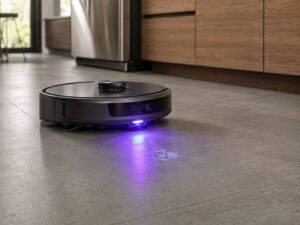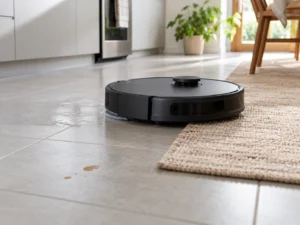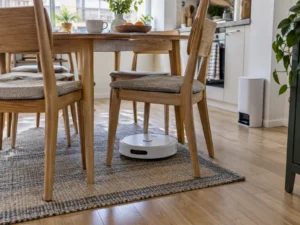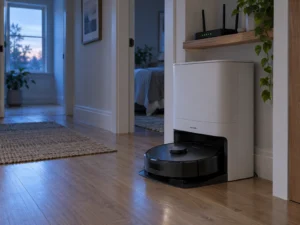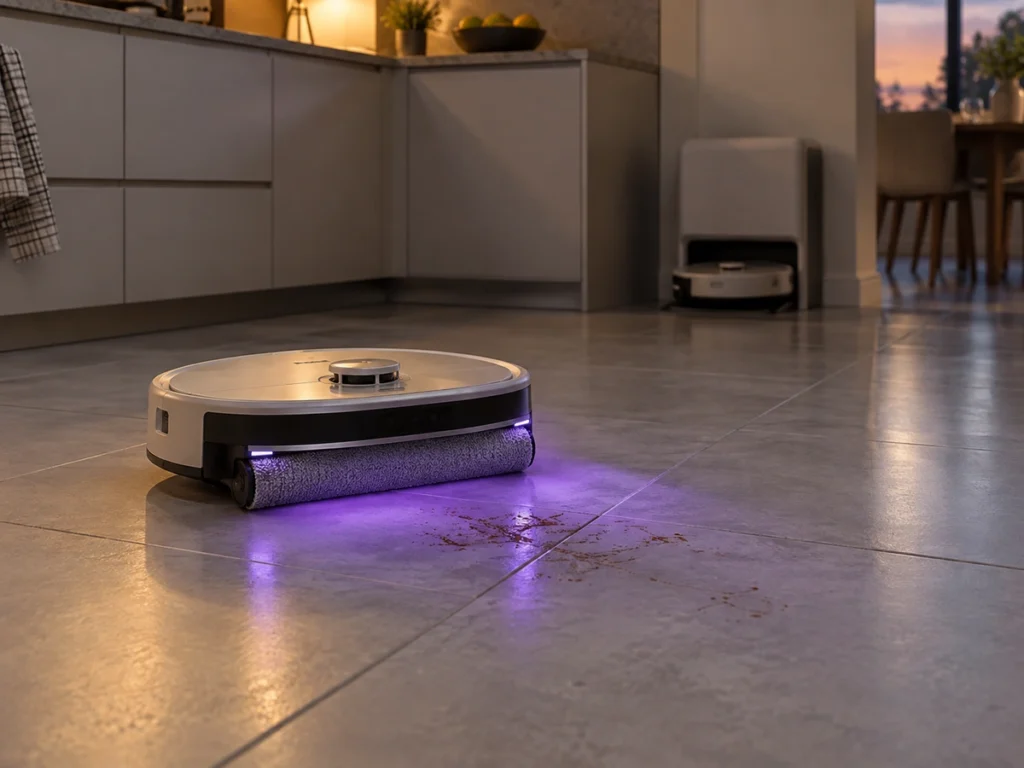
Dyson announced its Nurovi robot vacuums at an event in Berlin on September 3, 2026. The flagship, the Dyson R3 Nurovi Spot+Scrub UV, went on sale in the United States on September 15 at a list price of $1,199.99. On October 10, 2026, Dyson’s US store listed it in stock at that price, and listed the older Spot+Scrub Ai at $849.99, down from $1,199.99. So the choice is a real one. You can buy the proven model at a discount, or pay about $350 more for the new one. This comparison sets out what Dyson has published for both machines, where the Dyson R3 Nurovi is better on paper, and which questions stay open until independent testing arrives.
What Dyson announced on September 3
The Nurovi range has three models. Dyson says the name combines its Neural Intelligence technology with its latest Vision system.
- R1 Nurovi Dry is a vacuum-only robot with 21,000 Pa of suction and Dyson’s new Twin-capture system. That system uses brush bar bristles to sweep in larger debris, while the motor focuses on fine dust.
- R2 Nurovi Wash+Dry adds mopping with Reuleaux triangle pads, a constant-width shape designed to reach into corners. Its dock heats water to 167°F. In the US, it sells as a Costco exclusive for about $700.
- R3 Nurovi Spot+Scrub UV is the flagship wet and dry robot, and the model Dyson compares directly with the Spot+Scrub Ai.
Dyson’s launch materials do not give a US price for the R1.
R3 Nurovi vs Spot+Scrub Ai: the published numbers
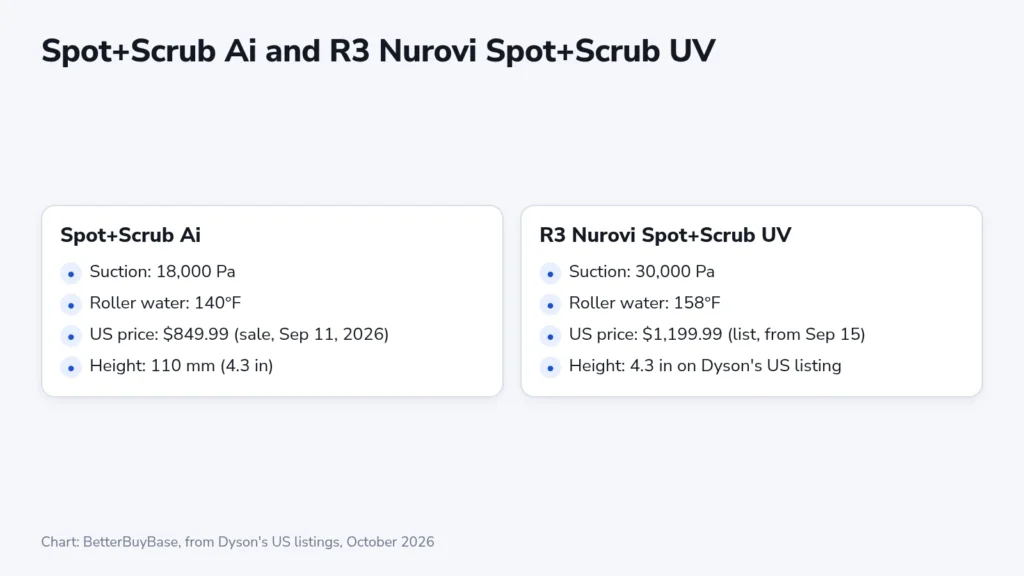
The table uses Dyson’s published figures for both models, plus the suction and height listed on our Dyson Spot+Scrub Ai page. Prices are the ones Dyson’s US store showed on October 10, 2026.
| Feature | Spot+Scrub Ai | R3 Nurovi Spot+Scrub UV |
|---|---|---|
| Suction | 18,000 Pa | 30,000 Pa |
| Roller water temperature | 140°F | 158°F |
| Roller edge reach | Extends 1.6 in | Extends 1.6 in |
| Stain detection | Lights up and identifies wet and dry spills | UV light, AI vision and green illumination, nearly 200 substance and object types |
| Height | 110 mm | 4.3 in, the same as the Spot+Scrub Ai on Dyson’s US listing |
| US price | $849.99 on sale, was $1,199.99 | $1,199.99 list |
Both machines use a self-cleaning wet roller rather than spinning pads. Both also rewash a stain in repeated passes until the robot judges it gone. So the R3 is a refinement of the same design, not a new cleaning method.
Where the R3 is better on paper
The suction jump is the clearest change. Dyson says the R3 has 65 percent more suction pressure than the Spot+Scrub Ai. A quick check agrees: 30,000 divided by 18,000 is about 1.67, or roughly 67 percent more. Suction pressure is measured at the motor, though, and it does not translate directly into dirt picked up from a rug. Brush design and airflow matter too. Still, a stronger motor gives the most benefit on carpet, and our product page already flags suction as the Spot+Scrub Ai’s weak point.
Stain detection is the headline feature. Dyson’s US listing says the Spot+Scrub Ai already lights up hidden stains and identifies wet and dry spills. The R3 adds ultraviolet light to that system, and Dyson says the combination identifies nearly 200 types of household substances and objects. Dyson’s Romanian store makes a similar “nearly 200” claim for the Spot+Scrub Ai, so the count itself may not be new. The UV light is. Some dried residues are easier to see under UV light than under ordinary white light. Our guide to UV stain detection in robot vacuums explains why, and where the technique runs out.
The water is also hotter. The R3 feeds its roller with 158°F water through a 12-point hydration system, compared with 140°F on the older model. Hotter water tends to help with greasy and sticky marks. But Dyson has not published results that isolate the effect of that change.
What the R3 launch materials left out
Several specifications that shape a real purchase were missing from the launch materials. Dyson’s US listing has since filled in the first three.
Height. At 110 mm, the Spot+Scrub Ai is tall for a robot vacuum. Most robot vacuums sit between 80 and 100 mm. As of October 2026, Dyson’s US listing gives the R3’s height as 4.3 in, the same height it lists for the Spot+Scrub Ai.
Detergent dosing. Our product page notes that the Spot+Scrub Ai dock doses detergent automatically. Dyson’s R3 announcement describes a dock that empties, cleans and recharges, but it does not mention automatic detergent. As of October 2026, Dyson’s US listing says the R3 dock auto-doses Dyson 02 Probiotic hard floor cleaning solution, which is sold separately.
Dock capacity. Dyson says the Spot+Scrub Ai stores dry debris for up to 100 days. For the R1 and R2 dock, Dyson quotes up to 90 days. As of October 2026, Dyson’s US listing gives the R3 dock the same 100 days.
Real-world results. Dyson footnotes its stain claims with the warning that results vary by stain type and severity. This comparison relies on Dyson’s own figures. How much better the R3 cleans than the older model is a question for independent testing.
Which one should you buy?
The right choice depends on your floors, your furniture and how much the price gap matters to you.
- Buy the Spot+Scrub Ai now if most of your home is hard flooring, your furniture clears the robot’s height, and the $849.99 price appeals. You get a roller mop, automatic detergent dosing and a known track record. Sale prices can change without notice, so check the current price first.
- Pick the R3 if you have a lot of carpet or deal with dried spills that are hard to see, such as in a kitchen or a home with pets. The suction and UV upgrades target exactly those jobs. Even so, it is worth reading independent tests before paying $1,199.99.
- Look at the R2 if you are a Costco member and want corner-reaching mop pads at a lower price, and you can live without stain detection.
Bottom line for shoppers
On paper, the Dyson R3 Nurovi is a clear step up from the Spot+Scrub Ai in suction, stain detection and water temperature. Yet it costs about $350 more than the older model’s current sale price. If the discounted Spot+Scrub Ai fits your home, it remains a sound buy. If carpet and invisible stains are your main problems, the R3 is the better match on paper.