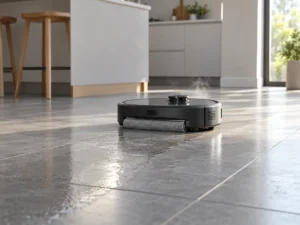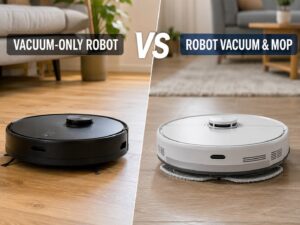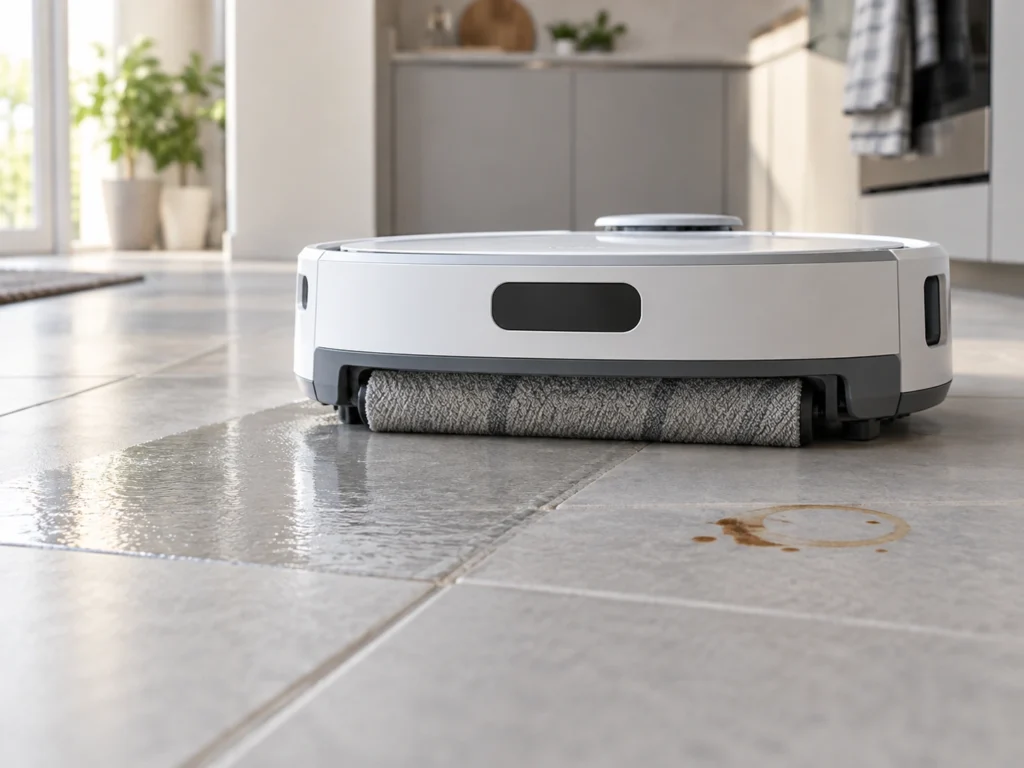
Anker eufy published a number that most robot vacuum brands leave off the page. The new Robot Vacuum Omni E35 lists 1.6 kg of downward pressure next to 35,000 Pa of suction and a roller that spins at 220 RPM. Suction gets the marketing budget, yet robot vacuum mop pressure tells you far more about whether dried coffee lifts off your kitchen tile.
What eufy published, and when
The Omni E35 sits at the top of the company’s current roller-mop range. On the United States eufy store, checked on September 19, 2026, the product page shows a list price of 1,299.99 dollars, a 300 dollar coupon that brings it to 999.99 dollars, and a line reading “Pre-orders close Sept. 24th. Shipping starts Sept. 25th.” The same page carries a brand notice that eufy now trades as Anker eufy.
More useful than the price is the comparison table eufy prints below the sales copy. It puts the E35 next to the cheaper E25 and lists the same six measurements for both. Very few brands publish mop downforce at all, so a like-for-like pair from one manufacturer is worth reading closely.
| Specification | Omni E35 | Omni E25 |
|---|---|---|
| Mop type | Rolling mop | Rolling mop |
| Suction power | 35,000 Pa | 20,000 Pa |
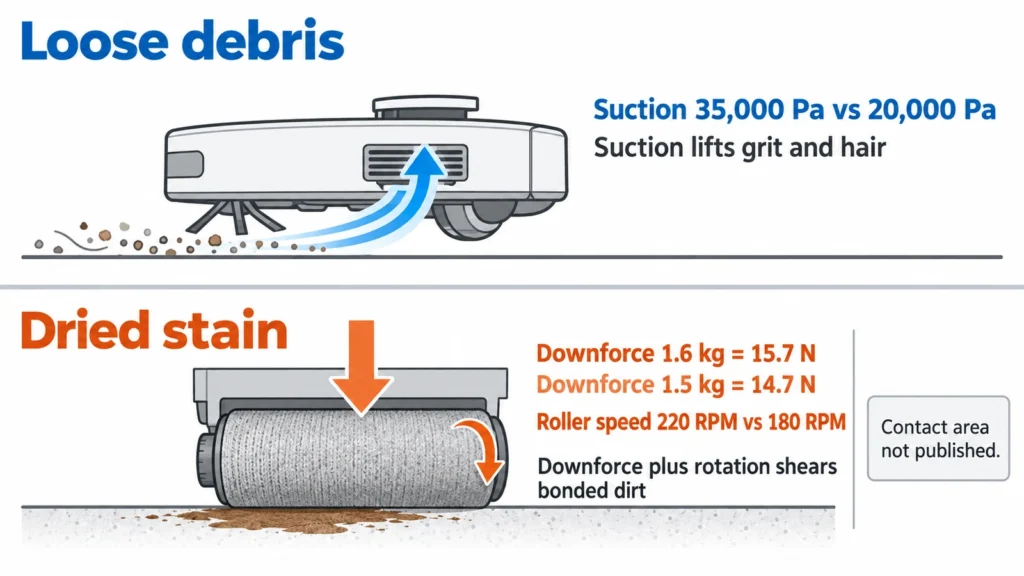
| Downward pressure | 1.6 kg | 1.5 kg |
| Rotations per minute | 220 RPM | 180 RPM |
| Obstacle clearance height | 1.18 in | 0.83 in |
| Listed price | 999.99 dollars | 649.99 dollars |
Read the two middle rows together and the pattern jumps out. Suction rose by 75 percent between the two models. Mop pressure rose by about 6.7 percent.
Downforce, in units you can check
A “kg” of downward pressure is a force written in kilogram-force, not a mass and not a pressure. One kilogram-force equals 9.80665 newtons. So the conversion is simple:
force in newtons = downforce in kg x 9.80665
That gives roughly 15.7 N for the E35 and 14.7 N for the E25. Picture the E35’s rated figure as a weight resting on the roller and pressing it into the floor, and you have the right mental image. A full one-liter bottle of water weighs a little less than that.
Manufacturers use the kilogram figure because it sounds tangible. The newton figure is the one that belongs in any comparison with a physics textbook, and it is the one you need for the next step.
Why pressure matters more than suction for a dried stain
Suction and mopping solve different problems. Airflow lifts loose grit, hair and crumbs, and a higher pascal figure helps pull debris out of carpet pile. A dried stain is not loose. It is bonded to the floor, so removing it takes mechanical work: a scrubbing force applied over a distance.
The scrubbing force available to a roller depends on how hard the roller presses down. Friction against the floor scales with that normal force, so downforce sets the ceiling on how much the mop can shear away. Water softens the bond, but the roller still has to do the shearing.
Speed supplies the distance. At 220 RPM against 180 RPM, the E35 roller completes about 22 percent more rotations in the same time, so each patch of floor gets more passes. Pressure and speed work together, and neither one alone predicts a clean floor.
The number nobody publishes
Pressure in the engineering sense is force divided by area:
pressure = force / contact area
Here the calculation stalls. No brand in this class publishes the width of the strip where the roller touches the floor. Without that area, you cannot convert 15.7 N into kilopascals, and you cannot compare one brand’s downforce claim against another’s in any rigorous way.
An illustration shows why the gap matters. Assume, purely as an example, a contact strip 25 cm long and 1 cm wide. That is 0.0025 square meters, so 15.7 N spread across it gives about 6.3 kPa. Now assume the same force across a strip twice as wide. The pressure halves. The assumed area is doing as much work in that sum as the published force, and the assumed area is the part you are never told.
Treat downforce figures, then, as a guide within one brand’s range and as a weak signal across brands. Two robots quoting the same kilogram figure do not necessarily press equally hard on the floor, because their contact patches may differ.
What a spec sheet will and will not tell you
Most product pages skip downforce entirely. Our specification page for the Dreame Aqua10 Ultra Roller lists mop type, a stated 30,000 Pa of suction and a 14 mm mop lift, and no downforce figure appears anywhere in the published specifications. That absence is normal rather than sloppy. The industry settled on pascals as its headline number, and pressure never became a standard disclosure.
So when a listing does quote downforce, note it, and note which model it is being compared against. When a listing omits it, look instead at the things that are published and that still change the result:
- Mop lift height, which decides whether the wet roller clears your rugs.
- Whether the roller rinses continuously or drags the same water around.
- Wash temperature and drying at the dock, which control smell more than cleaning power.
- Roller speed, where it is stated.
Practical reading of the numbers
For mostly hard floors with dried marks near a cooker or a pet bowl, weight the mop specifications ahead of the suction figure. A mostly carpeted home is where the pascal number earns its place, because there the job is pulling grit out of pile.
Be skeptical of any year-on-year jump that lands entirely in one column. A 75 percent gain in suction next to a 6.7 percent gain in mop pressure describes a robot that got better at carpets and only slightly better at scrubbing. That is a real improvement, and it is not the improvement the headline implies.
One last caution on prices. The figures above were on eufy’s own store on September 19, 2026, during a pre-order window with a coupon attached. Promotional pricing moves, so check the current page before you treat 999.99 dollars as the real cost of entry. On October 9, 2026, eufy’s US store listed the E35 at 1,299.99 dollars.