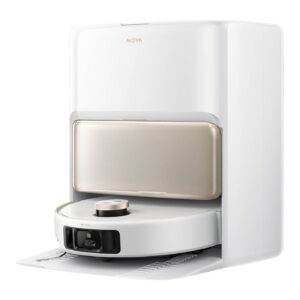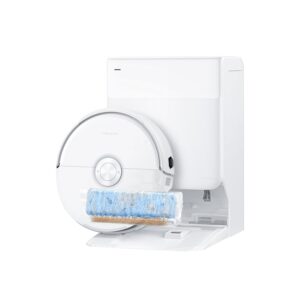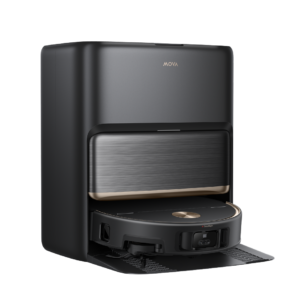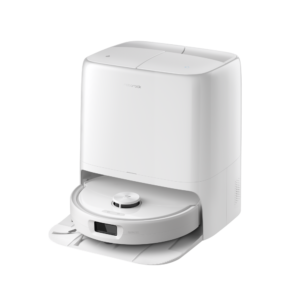
Dreame Aqua10 Ultra Roller: Specs, Features, Pros & Cons
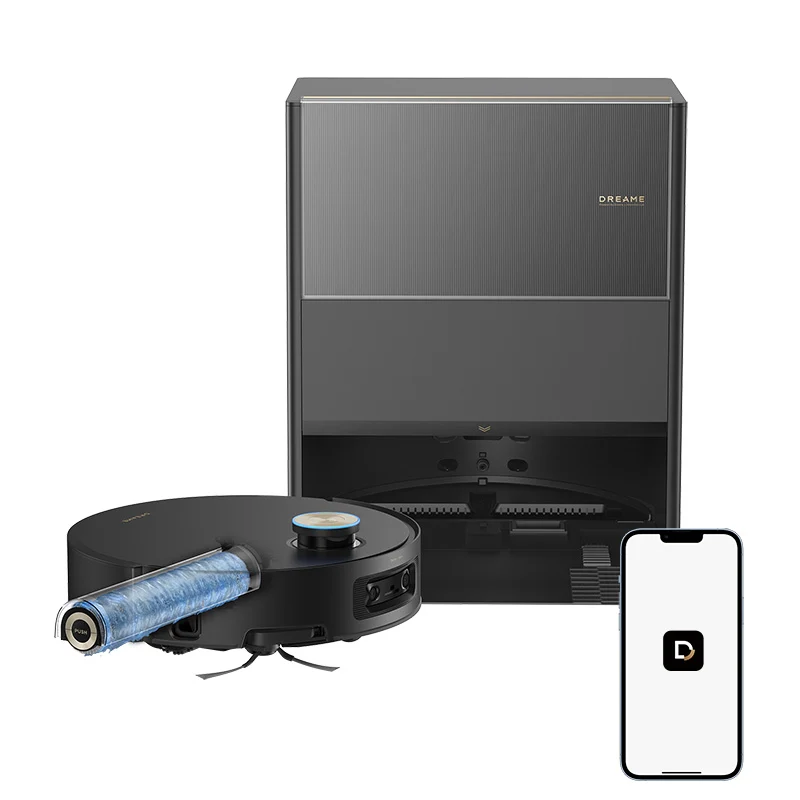
Robot mopping has split into two design schools. This machine belongs to the newer one. One camp spins a pair of round pads against the floor and washes them at the dock between runs. The other runs a single full-width roller, feeds it clean water continuously and scrapes it off as it turns. Dreame builds both, and the Aqua10 Ultra Roller is the company's argument for the second approach.
The practical consequence is about water rather than scrubbing force. A pad-based robot carries a fixed amount of clean water and keeps pressing whatever is already in the pad back onto the floor. A roller can be wetted and wrung continuously, so the surface touching your tiles is in roughly the same condition at the end of a room as at the start. Across a large open hard floor that difference accumulates into a visible one. In a small apartment with a couple of rugs it barely registers.
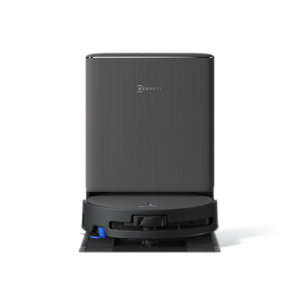
What a buyer should examine hardest is not the robot but the station it lives in. All-in-one docks of this kind are tall, wide and permanent. They need a position near a socket that you will not want back, they hold clean and dirty water, and they consume detergent on a schedule. Critics who dismiss this whole class of machine usually do it on those grounds, and for a small hallway the objection is a fair one.
This is equipment for a home where hard flooring dominates, where washing the floor is the main job, and where the footprint is an acceptable trade for never doing the job yourself. Put it in a carpeted house and most of what you paid for stands idle.
Category strengths
Where the Dreame Aqua10 Ultra Roller beats the median
- Much stronger suction ?30,000 Pa vs 19,750 Pa (median)
- A much higher threshold clearance ?42 mm vs 24 mm (median)
- A bigger battery ?6,400 mAh vs 5,200 mAh (median)
- A higher mop lift ?14 mm vs 10.5 mm (median)
- A higher mop wash temperature ?100 °C vs 75 °C (median)
- A higher warm-air drying temperature ?70 °C vs 50 °C (median)
- More cleaning modes ?
Where the Dreame Aqua10 Ultra Roller trails the median
- A smaller dustbin ?220 ml vs 300 ml (median)
- A slightly shorter runtime per charge ?180 min vs 194 min (median)
How this VS Score was computed
Score 62: each known spec is measured against the median of all robot vacuums (58 products), then weighted; 50 means level with that median. In classes of six or more, a value beyond the class’s 10th–90th percentile range counts as that limit, so one extreme product cannot set the scale. 52% of the scoreable weight could be used; unknown values, features not applicable to this class and proxies (battery capacity where a rated life exists) add or remove nothing.
| Specification | This product | Cohort median | Score weight | Points moved |
|---|---|---|---|---|
| Suction power | 30,000 | 19,750 | 1.2 | +31.2 |
| Mopping | Yes | 79% of the class have it | 0.6 | +30.0 |
| Edge-cleaning extension | Yes | 79% of the class have it | 0.4 | +20.0 |
| Dirt detection & re-mop | Yes | 79% of the class have it | 0.4 | +20.0 |
| Automatic mop removal | No | 37% of the class have it | 0.4 | −19.2 |
| HEPA filter | No | 29% of the class have it | 0.4 | −19.2 |
| Automatic detergent dispenser | Yes | 76% of the class have it | 0.3 | +15.0 |
| Threshold clearance | 42 | 24 | 0.3 | +11.4 |
| Battery capacity | 6,400 | 5,200 | 0.5 | +6.0 |
| Dustbin capacity | 220 | 300 | 0.4 | −5.2 |
| Mop lift | 14 | 10.5 | 0.3 | +5.1 |
| Mop wash temperature | 100 | 75 | 0.3 | +5.1 |
| Cleaning modes | 5 | 4 | 0.3 | +3.9 |
| Runtime | 180 | 194 | 0.8 | −3.2 |
| Warm-air drying temperature | 70 — capped at the class’s upper range (63) | 50 | 0.2 | +2.6 |
| Navigation | LiDAR | LiDAR | 1 | +0.0 |
| Height | 97.5 | 96.8 | 0.5 | +0.0 |
Not scored: Carpet detection (standard for the class (98% have it)); Max cleaning area (unknown: not scored); Mapping (standard for the class (98% have it)); Multi-floor maps (unknown: not scored); Obstacle avoidance (standard for the class (100% have it)); No-go zones (standard for the class (100% have it)); Recharge & resume (standard for the class (95% have it)); Self-empty dock (standard for the class (91% have it)); Auto-refill mop (standard for the class (87% have it)); Mop self-cleaning (standard for the class (92% have it)); Water tank (unknown: not scored); Noise level (unknown: not scored); App control (standard for the class (100% have it)); Voice assistant (standard for the class (100% have it)); Scheduling (standard for the class (100% have it)); Zone / room cleaning (standard for the class (100% have it)); Washable filter (standard for the class (88% have it)); Anti-tangle brush (standard for the class (98% have it)); Removable mop pads (standard for the class (90% have it)).
Editor’s note
The Dreame Aqua10 Ultra Roller is built around one idea: mop the way a person would, with constant clean water and real pressure. Its full-width AquaRoll roller runs a continuous spray-scrub-squeeze-refresh cycle, so it never reuses dirty water the way a static pad does. If you want floors washed properly and a light freshen-up is not enough, this is one of the most effective mopping robots on the market.
Suction is strong too, at a stated 30,000 Pa, and the HyperStream DuoBrush is designed to shed hair before it winds into a tangled mess. Navigation uses a retracting laser sensor plus cameras for mapping and obstacle avoidance, and the tall All-in-One dock handles the tedium: up to 100 days of auto-emptying, a hot wash at 100 degrees C for the roller, hot-air drying, and automatic water and detergent refills.
The cleverest touch is carpet handling. When the robot detects a rug, an AutoSeal shutter closes over the wet roller and the mop lifts about 14 mm, so it can vacuum carpet in the same pass without leaving it damp, which is a common failure point for roller designs.
The trade-offs are practical ones. It is expensive, the dock is large and needs space, and one blunt reviewer summed up the category by saying you could "just buy a mop", which misses the point if you value hands-off convenience. It is also happiest on hard floors, and carpet-heavy homes gain less from the roller.
Buy the Aqua10 Ultra Roller if mopping quality is your top priority and your home is mostly hard flooring, especially with pets. Skip it if you are carpet-dominant, tight on dock space, or shopping on a budget.
Specifications
Quality bars show where each figure sits between the lowest and highest of the 58 robot vacuums this VS Score is measured against.
Cleaning
Navigation
Battery & dock
Design
Smart features
Maintenance & filtration
Sources and verification
Where the specifications come from
- Official product pagedreametech.com
- Independent testingrtings.com
Verification
- First published
- Specifications last checked
- Sheet completeness
- 34 of 39 specifications verified; the rest show as Unknown and are never estimated or scored
- Page type
- Product specification page — Compiled from the manufacturer’s published specifications and the cited sources; this is not a hands-on test.
- Basis
- Research-based: specifications and editorial text were compiled from the documents listed here and the manufacturer’s published data. We have not tested this unit ourselves; where independent measurements are mentioned they belong to the linked publication.
Robot Vacuums with similar specs to the Dreame Aqua10 Ultra Roller
Ratings & reviews
No reviews yet. Be the first to share your experience.
The bottom line
The Dreame Aqua10 Ultra Roller earns a VS Score of 62, above the median of the 58 robot vacuums it is measured against (a score of 50 is level with that median).
- Who it’s for
- Large homes dominated by hard floor, often with pets, where proper floor washing is the reason to buy and doing it by hand is the chore to retire.
- Who should look elsewhere
- Carpet-dominated homes, tight hallways with no room for the dock and anyone on a budget should pass.
- The trade-off that matters
- The station. It is large, needs a permanent spot by a socket and a steady supply of detergent, and that footprint is the price of hands-off mopping.
- The main alternative
- Ecovacs DEEBOT T80 OMNI: a self-rinsing roller for less money, with weaker suction
The VS Score is calculated from the weighted specifications above, each measured against the median of comparable robot vacuums — a shortlisting guide, not a substitute for your own priorities. See how we score.