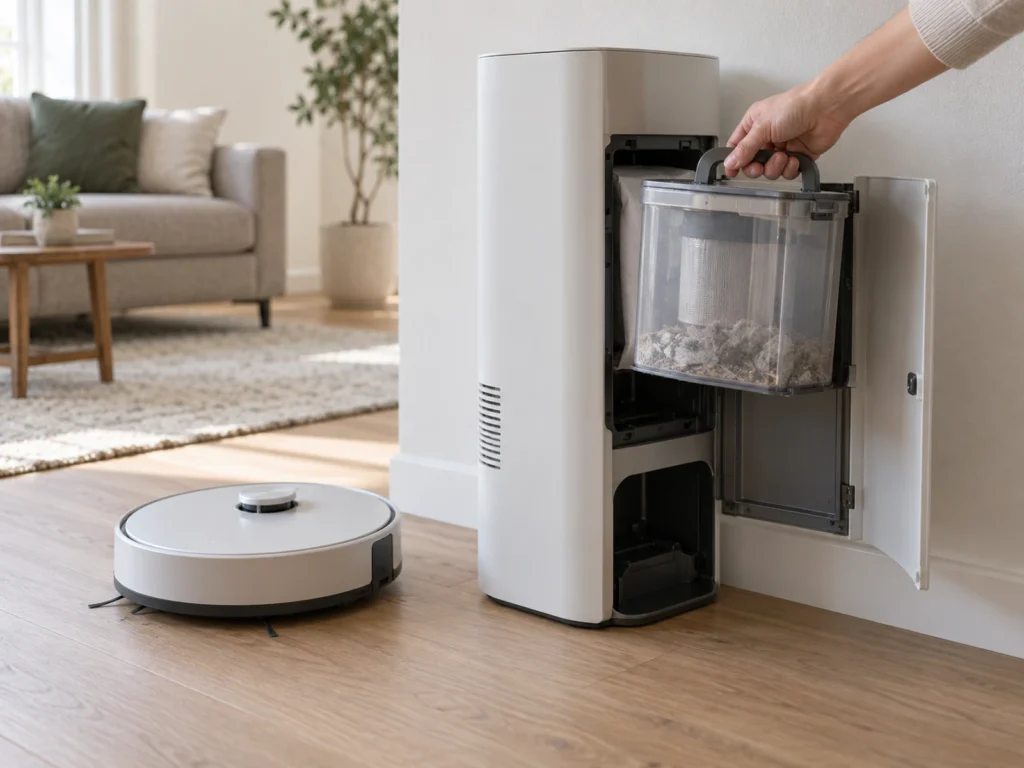
ECOVACS put the DEEBOT X12S OmniCyclone in front of European buyers at IFA 2026 in Berlin, and the notable part sits in the dock rather than the robot. That station separates dust with a cyclone and drops it into a reusable canister instead of a disposable bag. Bagless docks keep spreading across the premium tier, and the pitch is easy to follow. You stop buying bags. The trade is less obvious, because a bag is not only a container. It also filters the exhaust and seals the dust away from you.
What was announced, and on what date
IFA 2026 ran from 4 to September 8, 2026 in Berlin, and ECOVACS used the show to push the DEEBOT X12S OmniCyclone. In the United States the machine lists at 1,299.99 dollars. ECOVACS ran a launch promotion that brought it to 999.99 dollars from 4 to September 11, 2026, then to 1,099.99 dollars from 12 to September 18, 2026. Regional pricing differs, so check the price in your own market.
ECOVACS quoted 27,000 Pa at launch and rates the blower at 53 air watts. Those two numbers describe different things. Still, the dock is the reason to single out this model, because the same generation also ships with a bagged station.
A bag does three jobs, and a cyclone does one
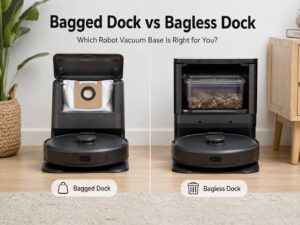
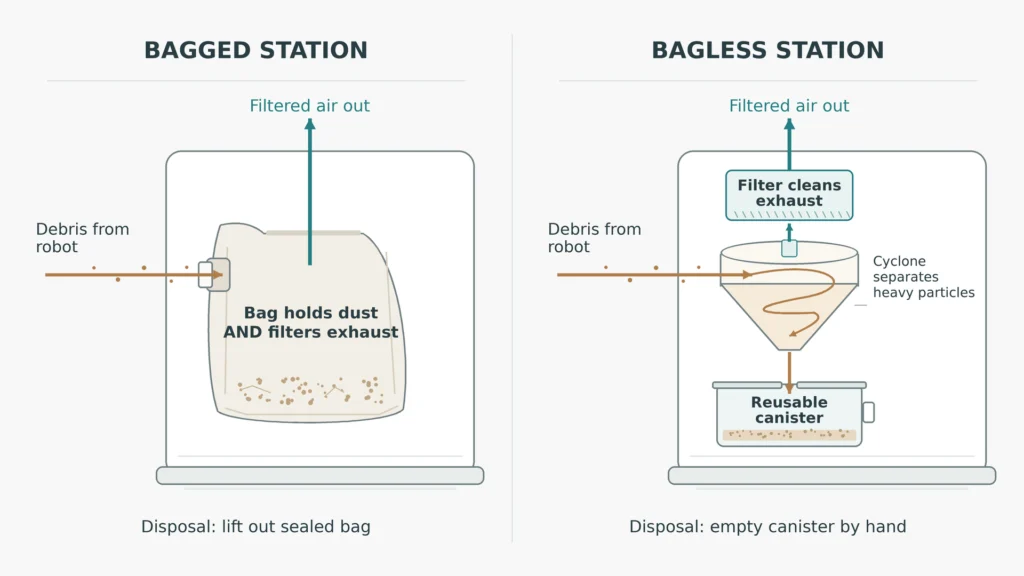
A bagged station pulls debris from the robot and pushes it into a sealed paper or fabric bag. That bag holds the dust, filters the air leaving the station, and stays shut when you lift it out. You never meet the contents again.
A bagless station spins the air instead. Cyclonic separation throws heavier particles outward against a chamber wall, so they drop into a canister while the airflow carries on to a filter. The canister is reusable, and you empty it by hand.
So the bag handles containment, filtration and disposal together. On a bagless dock the cyclone handles the first and a separate filter the second, which leaves the third to you. That last transfer is the part the marketing rarely spells out.
Running the cost calculation yourself
ECOVACS counts the saving on this station at roughly 25 bags over five years. You can turn that into something checkable:
annual bag cost = bags per year x price per bag
five year saving = 5 x annual bag cost
Twenty-five bags across five years averages five bags a year, which suits a home that fills one about every ten weeks. Bag prices swing widely by brand and pack size, so use the price your own model charges. Then subtract what the bagless dock still costs you, because a cyclone station keeps a filter and filters carry replacement intervals. As of October 2026, ECOVACS’s product page links an instruction manual for this model. It says to replace the station’s dust container filter every 3 to 6 months, or after multiple washes, so add that filter to the calculation.
What you take back on when the bag goes
Emptying a canister puts you in the same room as the dust at the moment you tip it out. A sealed bag exists partly to avoid that moment, and the difference matters far more in a home with allergies than in one without. If that describes your household, a bagged dock stays the simpler answer, and the bag cost buys something real.
Maintenance shifts as well. A cyclone chamber and its filter both need cleaning to keep airflow up, and a clogged filter costs suction long before it fails outright. A bag hides none of that work, because you replace the whole assembly and start clean. So the honest comparison is not bags against no bags. It is a recurring purchase against a recurring chore.
The rest of the station still counts
The dock does more than empty the robot. On this model ECOVACS lists 60.2 dB for the robot while it vacuums and gives the station a footprint of 380 by 493 by 465 mm. Height and depth decide whether it fits under a console or inside a hallway cupboard, and noise decides whether you schedule cleaning while you are home. Buyers often compare suction figures first, then discover the dock will not fit the spot they had in mind.
For the full picture on this particular machine, the specification breakdown for the ECOVACS DEEBOT X12S OmniCyclone covers the mop system and the chassis alongside the station.
Which dock suits you
Pick a bagless auto-empty station if you dislike buying consumables, you empty bins without much thought, and nobody in the house reacts badly to dust. Pick a bagged one if allergies are the reason you bought a robot at all, or if you want the lowest-effort routine and accept a running cost for it. Both designs clean the floor in the same way. Only the dock differs, and the dock is where your attention will go for the next five years.