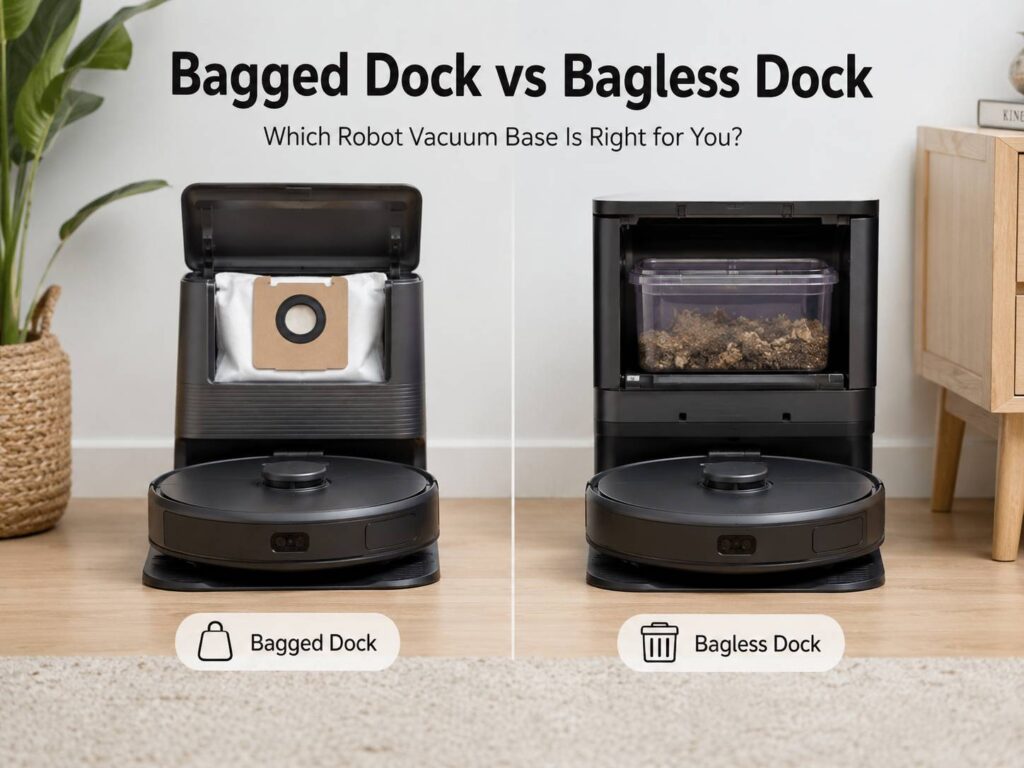
A robot vacuum with a self-emptying dock sounds like the easy answer to floor cleaning. The robot vacuums, returns to its base, and the dock pulls the dirt into a larger container. After that, you only deal with the mess once in a while instead of after every run.
Still, the dock design matters more than it first seems. Some robot vacuum docks use disposable dust bags. Others use a bagless bin that you empty by hand. At first, that sounds like a small detail. Then, after a few weeks of pet hair, fine dust, crumbs, and filter cleaning, the difference becomes very clear.
So, in the bagged dock vs bagless dock debate, which one should you buy? For most homes, a bagged dock is the cleaner and easier choice. A bagless dock can still make sense, mainly for people who want to avoid buying replacement bags and do not mind a little extra cleaning.
Both designs can work well. The better choice depends on your dust level, pets, allergies, floor type, and patience for maintenance.
What Is a Bagged Dock?
A bagged dock stores dirt inside a disposable dust bag built into the charging base. After the robot finishes cleaning, it returns to the dock. Then, the dock uses strong suction to pull dirt, crumbs, hair, and dust out of the robot’s small onboard bin.
The big advantage is simple: the mess stays inside the bag. In many models, the bag closes or seals when you remove it. That makes disposal cleaner and less annoying.
This design works especially well for homes with pets, carpets, allergies, or a lot of dust. It also suits busy households where nobody wants to clean a plastic dustbin every few days.
A bagged dock is usually best for:
- Pet owners
- People sensitive to dust
- Homes with carpets and rugs
- Large homes with frequent cleaning
- Buyers who want low-contact maintenance
- Anyone who dislikes emptying vacuum bins by hand
In my opinion, a bagged dock feels better in daily use. You open the dock, pull out the bag, throw it away, and move on. The only real downside is the ongoing cost of replacement bags.
What Is a Bagless Dock?
A bagless dock uses a reusable plastic bin instead of a disposable bag. The robot still empties itself into the base, but the debris collects in a container that you empty into the trash.
At first, this sounds like the smarter option. You do not need to buy bags. You can see the dirt level. You create less disposable waste. Plus, over time, the running cost can be lower.
That said, the emptying process is not always pleasant. Fine dust can puff out when you dump the bin. Pet hair can cling to the sides. Filters need cleaning. Sometimes, dirt collects around the seals or in the intake path.
A bagless dock is usually best for:
- Buyers who want lower running costs
- Homes with light dust
- People without dust sensitivity
- Small apartments with hard floors
- Users who already clean vacuum filters often
- Anyone who dislikes buying replacement bags
Bagless docks are not bad. In fact, they can be a smart choice. Still, they ask more from the owner. The dock empties the robot, but you still clean the dock.
Bagged Dock vs Bagless Dock: The Main Difference
The main difference is not the robot itself. It is how the dock stores dirt.
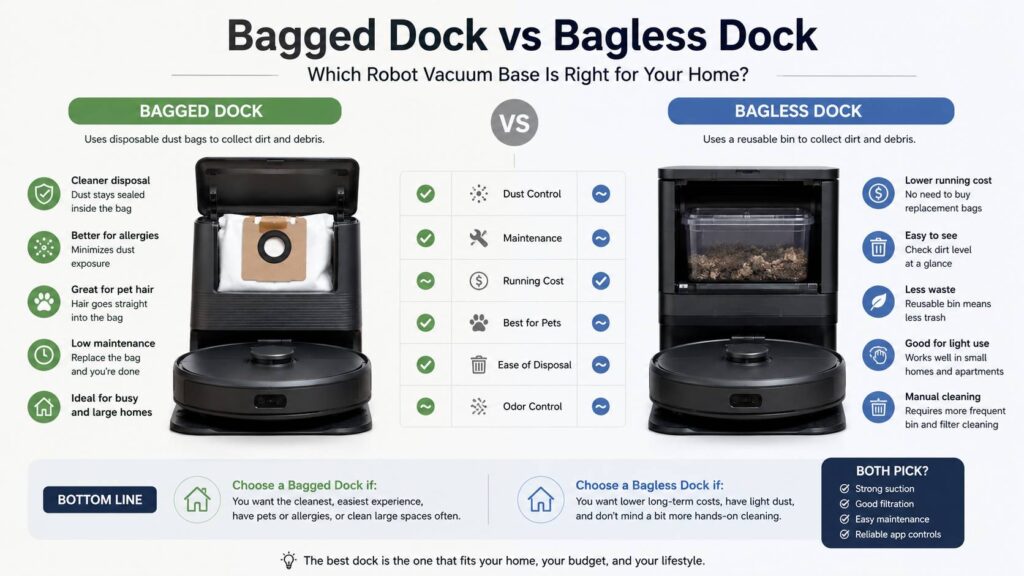
A bagged dock traps debris inside a disposable bag. A bagless dock stores debris in a reusable bin. Both reduce how often you empty the robot. Still, the maintenance routine feels very different.
Here is the practical version:
- A bagged dock is cleaner to empty
- A bagless dock costs less to run
- A bagged dock is better for dust control
- A bagless dock needs more hands-on cleaning
- A bagged dock suits pet homes better
- A bagless dock suits light-use homes better
This choice is similar to choosing between a regular bagged vacuum and a bagless vacuum. One costs more over time. The other saves money, but it can be messier.
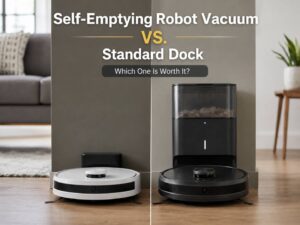
If you are still deciding between a self-empty base and a simpler charging station, this guide on self-empty robot vacuum vs standard dock is a useful next read.
Dust Control and Allergies
Dust control is where bagged docks usually win.
When you remove a full bag, most of the dust stays contained. That matters a lot if you have allergies, asthma, pets, or fine dust from carpets. Even if the robot vacuum has strong filtration, the disposal step still matters.
With a bagless dock, the dust is easier to disturb. You lift out the bin, open it, and dump it into the trash. During that step, fine particles can escape. Sometimes, the dust cloud is small. Other times, it is enough to make you step back.
This does not mean every bagless dock is terrible for dust. Some designs are better than others. Still, the basic problem remains: you are exposing the dirt container every time you empty it.
For allergy-prone homes, I would choose a bagged dock without much hesitation. The cleaner disposal is worth the extra cost.
Pet Hair and Long Hair
Pet hair makes this decision much easier. If you have a dog or cat that sheds often, a bagged dock is usually the better pick.
Pet hair fills small robot bins fast. A self-emptying base helps, but the dock still needs to store all that hair somewhere. With a bagged dock, the hair goes into the bag and stays there. With a bagless dock, hair can cling to the bin, stick around the filter, or build up near the intake channel.
Long human hair is another issue. It often wraps around the robot’s main brush before it even reaches the dock. No dock design fully solves that. You still need to cut hair from the roller and side brush from time to time.
Still, for pet homes, bagged docks feel easier. You avoid pulling dusty hair clumps out of a plastic bin. That alone can make the extra bag cost feel fair.
Maintenance and Cleaning Effort
A bagged dock needs less messy maintenance. You replace the bag, check the dock opening, wipe dust from the base, and clean the robot’s brushes and filters. That is about it for normal use.
A bagless dock needs a more active routine. You empty the bin, tap out loose dust, clean or replace filters, wipe dirty seals, and check for packed debris. From time to time, you may need to clean the bin more deeply.
Common bagless dock issues include:
- Dust clouds during emptying
- Hair stuck to the bin walls
- Fine dust coating the filter
- Debris packed near the intake
- Static making hair cling to plastic
- Bad smells from old dirt or pet hair
Common bagged dock issues include:
- Replacement bags running out
- Bags filling faster than expected
- Cheap third-party bags fitting poorly
- Full-bag alerts appearing early
- Odor from damp debris or pet hair
- Lower emptying performance from an overfilled bag
So, neither option is maintenance-free. The bagged dock simply keeps the dirtiest part more contained.
Running Costs Over Time
Bagless docks usually cost less to run. You do not buy dust bags, so the yearly accessory cost drops. You still need filters, brushes, mop pads, rollers, and other parts, but you avoid one recurring item.
Bagged docks add a small ongoing cost. The exact cost depends on the brand, bag size, cleaning schedule, and how much debris your home collects.
Here is a simple example:
- One dust bag lasts 2 months
- You use 6 bags per year
- A 6-pack costs $20
- Yearly bag cost: 6 bags ÷ 6 bags per pack = 1 pack
- Total yearly cost: 1 × $20 = $20
Now take a heavier-use home:
- One dust bag lasts 1 month
- You use 12 bags per year
- A 6-pack costs $20
- Yearly bag cost: 12 bags ÷ 6 bags per pack = 2 packs
- Total yearly cost: 2 × $20 = $40
The yearly bag cost is not huge. Still, it is a real cost. If you hate subscriptions, refills, and extra consumables, a bagless dock will feel more appealing.
For me, the cleaner emptying process usually wins. I would rather spend a small amount on bags than clean dusty plastic bins all year.
Odor Control
Odor is another detail people often ignore before buying.
Robot vacuums collect pet hair, crumbs, dust, pollen, and tiny bits of dirt. If the robot also mops, damp debris can make smells worse. Food crumbs and pet hair are the main problems.
A bagged dock can trap odors better, at least for normal dry debris. Once the bag starts to smell, you remove it and replace it. That is clean and simple.
A bagless dock gives you more direct access to the bin. That helps if you like washing or wiping parts, as long as the manual allows it. Still, odors can stick around filters, seals, and plastic corners.
To reduce dock odor:
- Replace or empty the dock before it gets packed full
- Remove damp debris quickly
- Clean washable parts only as instructed
- Replace filters on schedule
- Do not let pet hair sit for too long
- Avoid vacuuming wet food or sticky messes
Bagged docks control odors better with less effort. Bagless docks can stay fresh too, but only with regular cleaning.
Noise During Self-Emptying
Both dock types can be loud. During the emptying cycle, the dock uses strong suction for a short time. It can sound like a small shop vacuum.
The difference between bagged and bagless docks is not always clear here. Motor design, dock shape, robot bin layout, airflow path, and emptying time all affect noise. Some bagged docks sound slightly softer. Some bagless docks sound sharper. It varies by model.
A common issue is timing. People schedule the robot to clean at night, then the self-empty cycle wakes someone up. The better move is to schedule cleaning during the day. Some apps also let you turn off auto-emptying during quiet hours.
So, do not choose bagged or bagless only for noise. Check model-specific owner feedback if noise matters in your home.
Which Dock Is Better for Apartments?
For apartments, I usually prefer a bagged dock. Smaller homes do not always mean less dust. In fact, dust, pet hair, and crumbs can build up fast in compact spaces.
A bagged dock keeps disposal cleaner, which matters if your trash can sits in the kitchen or close to your living area. It also helps if you do not have a balcony, garage, or outdoor bin nearby.
Choose a bagged dock for an apartment if:
- You have pets
- You have allergies
- You clean several times per week
- Your trash area is indoors
- You want the cleanest emptying routine
Choose a bagless dock for an apartment if:
- Your floors stay fairly clean
- You have mostly hard floors
- You want lower running costs
- You do not mind cleaning the bin
- You have easy access to outdoor trash
A bagless dock can work well in an apartment. Still, dust exposure feels more annoying in a small room.
Which Dock Is Better for Large Homes?
Large homes usually benefit more from a bagged dock. The robot covers more space, collects more debris, and empties itself more often. As the volume of dirt rises, cleaner disposal becomes more valuable.
If your home has carpets, pets, kids, rugs, or lots of foot traffic, a bagged dock is the safer choice. You get less mess, less dust exposure, and an easier routine.
A bagless dock can still make sense in a large home with mostly hard floors and low dust. Still, you should expect more frequent bin and filter cleaning.
For large homes, I would choose bagged in most cases. The convenience is not just marketing. It actually makes ownership easier.
What to Check Before Buying
Do not pick a robot vacuum only by dock type. The robot itself still matters. Navigation, obstacle avoidance, suction, brush design, app controls, and part availability all affect the experience.
Before buying, check these points:
- Dock capacity: Bigger is useful, but real-life capacity depends on dust and pet hair.
- Bag price: Check replacement bag cost before purchase.
- Filter access: Filters should be easy to reach and replace.
- Clog access: You should be able to clear blockages without a fight.
- Pet hair handling: Anti-tangle brush design helps a lot.
- Bin seal quality: Poor seals can leak fine dust.
- App controls: Auto-empty settings help with noise and scheduling.
- Spare parts: Bags, filters, brushes, and mop pads should be easy to find.
- Dock size: Self-empty bases can take more floor space than expected.
- Floor type: Carpet and rugs fill bins faster than hard floors.
If you are unsure whether the extra dock cost makes sense, read this guide on is a self-emptying robot vacuum worth it. It explains the value side of the upgrade in more detail.
Bagged Dock Pros and Cons
Pros:
- Cleaner emptying
- Better dust containment
- Better for allergy-prone homes
- Easier with pet hair
- Less direct contact with dirt
- Better for busy households
- More comfortable for large homes
Cons:
- Replacement bags cost money
- Bags create extra waste
- Bags can run out
- Cheap third-party bags can fit poorly
- A packed bag can reduce performance
- Odor can build up if the bag stays too long
Best for: pet owners, allergy-sensitive users, families, carpeted homes, large homes, and anyone who wants the least messy maintenance routine.
Bagless Dock Pros and Cons
Pros:
- No dust bag purchases
- Lower running cost
- Less disposable waste
- Easy to see how full the bin is
- Good for light cleaning needs
- Practical for hard floors
- Better for users who clean bins often
Cons:
- Messier emptying
- More dust exposure
- More filter cleaning
- Hair can cling to the bin
- Fine dust can escape during disposal
- Odor can build up around filters and seals
- Less pleasant for pet-heavy homes
Best for: budget-focused buyers, light-use homes, hard-floor apartments, and people who do not mind hands-on cleaning.
Common Problems People Notice After Buying
The first week with a self-emptying dock usually feels great. After that, the small problems start to show.
With bagged docks, the biggest issue is replacement planning. If you forget to buy extra bags, the dock fills up, and the robot loses part of its convenience.
With bagless docks, the biggest issue is dust. The robot empties itself, but the owner still has to dump the dock bin. That step can feel messy, especially with fine dust or pet hair.
Other common problems include:
- The robot bin does not fully empty
- Hair blocks the dock intake
- The base smells after pet hair or food crumbs
- The emptying cycle sounds too loud
- The app gives full-bin alerts too early
- Dust collects around dock seals
- Filters clog faster than expected
- Dirty mop water creates extra maintenance
- The dock takes more floor space than planned
A self-empty dock reduces work. It does not remove every chore. You still need to check brushes, filters, sensors, wheels, mop pads, and the dock pathway.
My Practical Recommendation
Choose a bagged dock if you want the cleanest and easiest ownership experience. It is the better fit for most homes, especially homes with pets, carpets, allergies, kids, or frequent cleaning schedules.
Choose a bagless dock if you care more about lower running costs and you accept a messier maintenance routine. It can be a smart choice for smaller homes, hard floors, and lighter dust.
My honest view: bagless docks look great on paper. No bags, no refills, less waste, and lower long-term cost. Still, bagged docks feel better in real daily use. The cleaner disposal process matters every time the dock fills up.
Final Verdict: Bagged Dock vs Bagless Dock
The best choice in the bagged dock vs bagless dock comparison comes down to convenience, dust control, and running cost.
A bagged dock costs more over time, but it keeps dirt sealed and makes maintenance easier. A bagless dock saves money on bags, but it exposes you to more dust and needs more cleaning.
For pet hair, allergies, carpets, and busy homes, buy a bagged dock. For light dust, hard floors, and lower accessory costs, a bagless dock can still be a good choice.
In the end, the dock should make your robot vacuum easier to live with. If the base creates a dusty chore every few weeks, it may not feel as automatic as expected.