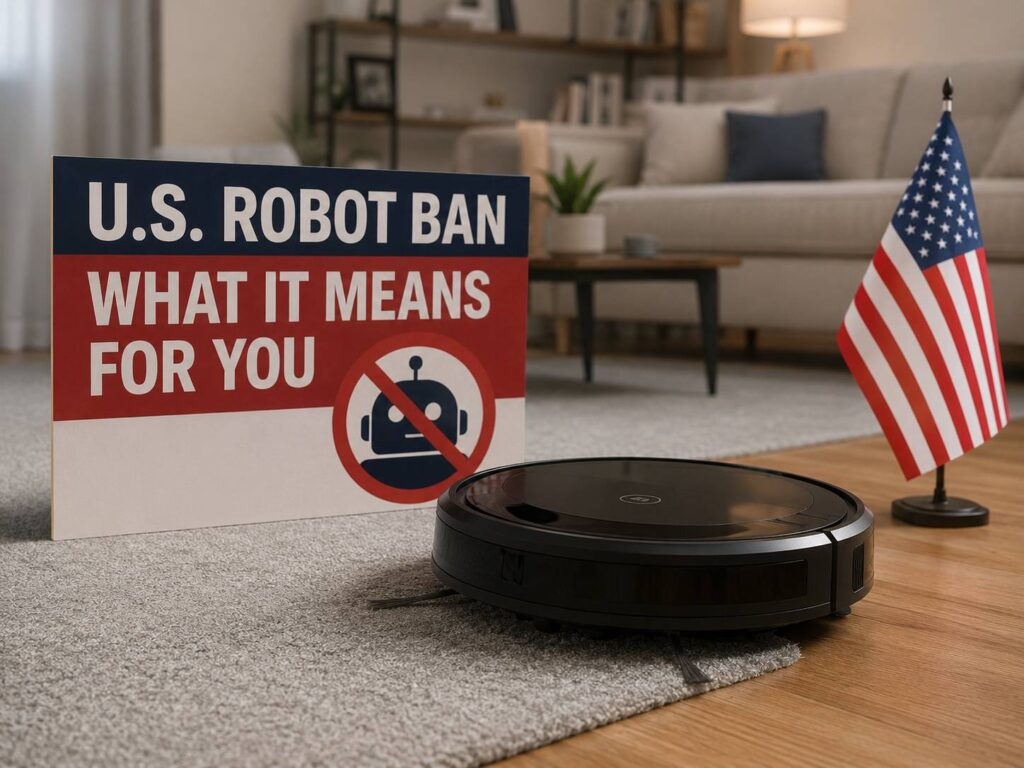
A proposed U.S. robot ban has sparked an unexpected question. Could the new restrictions reach robot vacuums?
Right now, no nationwide law bans Americans from buying or using a robot vacuum. Stores can still sell them, and current owners can keep using their devices. Still, proposed legislation uses broad wording that may cover certain autonomous cleaning robots linked to companies from China, Russia, Iran, or North Korea.
The key issue sits in the legal definition of an “unmanned ground vehicle system.” That phrase sounds like military equipment at first. Yet the definition can cover machines that move across the ground, react to sensor data, and work away from a human operator.
A modern robot vacuum does all three.
So, the concern is not entirely far-fetched. At the same time, the current proposals focus mainly on federal agencies, contractors, grant recipients, and purchases made with federal money. They do not create a direct consumer ban.
What the Proposed U.S. Robot Ban Covers
The American Security Robotics Act of 2026 was introduced in both the Senate and the House of Representatives. As of July 30, 2026, neither version has become law.
The proposals would restrict federal executive agencies from purchasing certain unmanned ground vehicle systems made or assembled by covered foreign entities. After a set transition period, agencies would face limits on operating those machines too.
The restrictions could cover robots obtained through service contracts. They could also stop agencies from using federal funds to buy or operate covered systems.
That means the bill reaches further than robots sitting inside government buildings. For example, a private company working on a federal contract could face the same purchasing limits. A university or research group using a federal grant could face them too.
Still, private consumers would not fall under those rules when they use their own money.
Why Robot Vacuums May Fit the Definition
The proposed bill does not name robot vacuums. Instead, it lists examples such as autonomous patrol machines, remote surveillance vehicles, mobile robotics, and humanoid robots.
The wider definition covers a mechanical device that can:
- Move or travel on the ground
- Navigate with little direct human control
- React to commands or sensor data
- Carry a payload or use an external controller
Most current robot vacuums meet several of those points. They move across floors, detect objects, map rooms, return to their charging docks, and respond to commands from an app.
Some models go further. For example, they may use cameras to recognize furniture, pets, cables, or dirty areas. Others can stream video, support remote driving, or store detailed maps of a home.
For that reason, a robot vacuum used inside a government office may fall under the bill’s broad wording. Yet the proposal offers no list of covered household products. It also provides no clear appliance exemption.
So, I cannot confirm that every robot vacuum would qualify. Federal agencies, later regulations, amendments, or court decisions would need to settle those details.
This Is Not a Consumer Robot Vacuum Ban
Many headlines make the proposal sound like a full ban on household robots. That is not accurate.
The legislation does not stop a person from buying a robot vacuum at a local retailer or online store. It does not require current owners to stop using their machines. It does not order brands to remotely disable products that people already own.
Instead, the proposal deals mainly with federal purchasing and federal funding.
A covered robot may remain legal for home use but become unavailable for a government contract. In practice, that could affect federal offices, military facilities, laboratories, public agencies, and organizations that receive federal money.
This distinction matters. A federal procurement restriction is very different from a nationwide retail ban.
Why U.S. Lawmakers Are Looking at Connected Robots
Supporters of the bills point to cybersecurity, remote access, data collection, and national security risks. Their concern focuses on connected machines that collect information and act inside physical spaces.
Robot vacuums once relied on simple bump sensors. Now, many models create detailed room maps, recognize objects, connect to cloud accounts, and receive commands over the internet.
That added technology makes them easier to use. Still, it raises fair privacy questions.
Buyers should ask:
- Where does the vacuum store floor maps?
- Can the user delete stored data?
- Does the device send images to a cloud server?
- Which company controls the mobile app?
- Can the robot clean without an internet connection?
- How long will the manufacturer provide security updates?
- Can employees or contractors review camera images?
These questions matter for any connected device, not only robot vacuums. For a related look at how technology companies are adding safety notifications, read our report on OpenAI parent alerts for teen ChatGPT safety bans.
In my view, lawmakers should target clear and proven security risks. They should focus on data storage, remote access, ownership, software support, and product control. A broad country label alone does not tell buyers whether a device is safe.
How the GUARD Act Is Different
Another proposal, called the GUARD Act of 2026, has added more confusion to the story.
This bill focuses on communications equipment and services used in humanoid and quadruped robots. In plain terms, it mainly targets human-shaped robots and four-legged machines.
The bill would require a national security review of covered products. Products found to present an unacceptable risk could enter the Federal Communications Commission’s Covered List.
By comparison, the American Security Robotics Act uses broader wording. Its definition refers to mobile ground robots, not only humanoid or four-legged designs.
That is why robot vacuums have entered the discussion. They are mobile robots that travel across the ground and use sensors to make decisions.
Still, neither proposal directly says that Americans will lose access to home cleaning robots.
Could Chinese Robot Vacuum Brands Face Restrictions?
The proposed rules do not create a public list of banned robot vacuum brands.
Instead, they target products made or assembled by a covered foreign entity. That can include a business based in a covered country, controlled by its government, or connected through ownership and corporate ties.
China receives most of the attention since many leading robot vacuum brands design or manufacture products there. Yet the referenced definition covers Russia, Iran, and North Korea too.
A logo on the front of a robot may not provide the full answer. For example, a company may have headquarters in one country, factories in another country, and cloud servers in several regions.
Federal buyers may need to review:
- The location of final assembly
- The company’s ownership structure
- The source of major electronic components
- The location of cloud servers
- The organization controlling the mobile app
- The people or companies with remote access
- The software update process
For consumers, the same details can help with a buying decision. A brand that clearly explains its privacy and security practices deserves more trust than one that hides behind vague marketing.
What the Bills Could Mean for Manufacturers
A federal purchasing ban can affect the wider market, even without a consumer sales ban.
Government contracts can represent valuable business for robot manufacturers. So, companies that want access to those contracts may need to provide more detailed records about ownership, manufacturing, software, and data handling.
Manufacturers may need to document:
- Country of origin
- Final assembly location
- Parent companies and subsidiaries
- Cloud hosting regions
- Remote administrator controls
- Camera and microphone functions
- Data retention rules
- Software update periods
- Third-party parts and services
- Offline operating features
Next, some manufacturers may create separate models for government buyers. Others may add local data processing, remove remote viewing tools, or move cloud services to U.S.-based systems.
These changes are possible responses, not confirmed company plans.
Still, better documentation would help regular buyers too. Clear update promises, simple map deletion, and local controls can make a robot vacuum safer and easier to own.
Should Robot Vacuum Buyers Be Worried?
Most household buyers do not need to panic.
No current law requires consumers to stop using robot vacuums. No official order has removed popular models from retail stores. The proposals remain focused on government purchasing and federally funded use.
For now, shoppers should judge each product on its real features and support record.
Before buying a robot vacuum, check the following points:
- Software support: Look for a clear update policy from the manufacturer.
- Map controls: Check whether the app lets you view and delete stored maps.
- Camera controls: Pick a model that lets you disable cameras or remote viewing.
- Offline cleaning: See whether the vacuum can perform basic cleaning without cloud access.
- Account security: Use a strong password and two-step verification where available.
- App permissions: Grant only the permissions the product needs.
- Company details: Check the parent company and final assembly country.
- Privacy policy: Read how the company stores maps, images, and account information.
- Factory reset: Confirm that personal data can be removed before resale or recycling.
These checks take a little time. Yet they provide more useful information than a simple “made in” label.
What Existing Owners Can Do Now
Current owners can lower privacy and security risks without replacing a working vacuum.
Start with the basics:
- Install every available firmware update
- Update the mobile app
- Replace reused account passwords
- Turn on two-step verification
- Disable remote camera access when unused
- Review shared household accounts
- Delete old floor maps
- Remove rooms or zones you no longer use
- Factory-reset the robot before selling it
- Remove the device from your account after the reset
At the same time, place smart-home products on a separate guest or Internet of Things network where your router supports that feature. This step can keep them away from laptops, work files, and personal storage devices.
Not every household needs a complex network setup. Still, basic account protection and regular updates make a real difference.
Will Robot Vacuum Prices Rise?
There is no confirmed price increase linked to the proposed bills.
The legislation has not passed, and its main restrictions target federal purchasing. So, any effect on retail prices remains uncertain.
Still, manufacturers may face higher costs if they need new security audits, local cloud systems, updated hardware, or different assembly arrangements. Some companies may pass part of those costs to customers.
Others may choose to stop selling certain models to government buyers. A few may release special versions that meet federal contract requirements.
For home shoppers, any near-term effect should remain limited. A more visible change may appear in marketing. Brands may promote local processing, longer software support, secure cloud regions, or domestic assembly more heavily.
Could the Restrictions Expand Later?
Congress can amend bills before a vote. Lawmakers can introduce new proposals too.
Still, no reviewed proposal creates a nationwide consumer robot vacuum ban. Claims that all Chinese robot vacuums will soon become illegal go far beyond the current text.
Future rules may target selected companies, imports, wireless approvals, government contracts, or certain connected features. I cannot confirm that any broader consumer restriction is planned.
People following the issue should watch for:
- Committee votes
- New bill versions
- Amendments that narrow or widen the definition
- Lists of covered companies
- Federal agency guidance
- Product exemptions
- Final rules after a bill becomes law
Until those steps occur, robot vacuums remain legal and widely available to U.S. consumers.
What This Means for Robot Vacuum Owners
The U.S. is not banning robot vacuums for private households.
Two federal robot bills are moving through Congress, but neither has become law. One focuses mainly on humanoid and four-legged robots. The other uses broader language that may reach some mobile cleaning robots bought or operated with federal money.
For most buyers, the practical advice remains simple. Choose a well-supported model. Review its privacy settings. Install updates. Delete old maps. Reset the device before selling it.
Lawmakers need clear rules that target verified security risks without treating every cleaning appliance like military hardware. Until the legal wording becomes more precise, the robot vacuum question will remain open for federal buyers, not ordinary households.