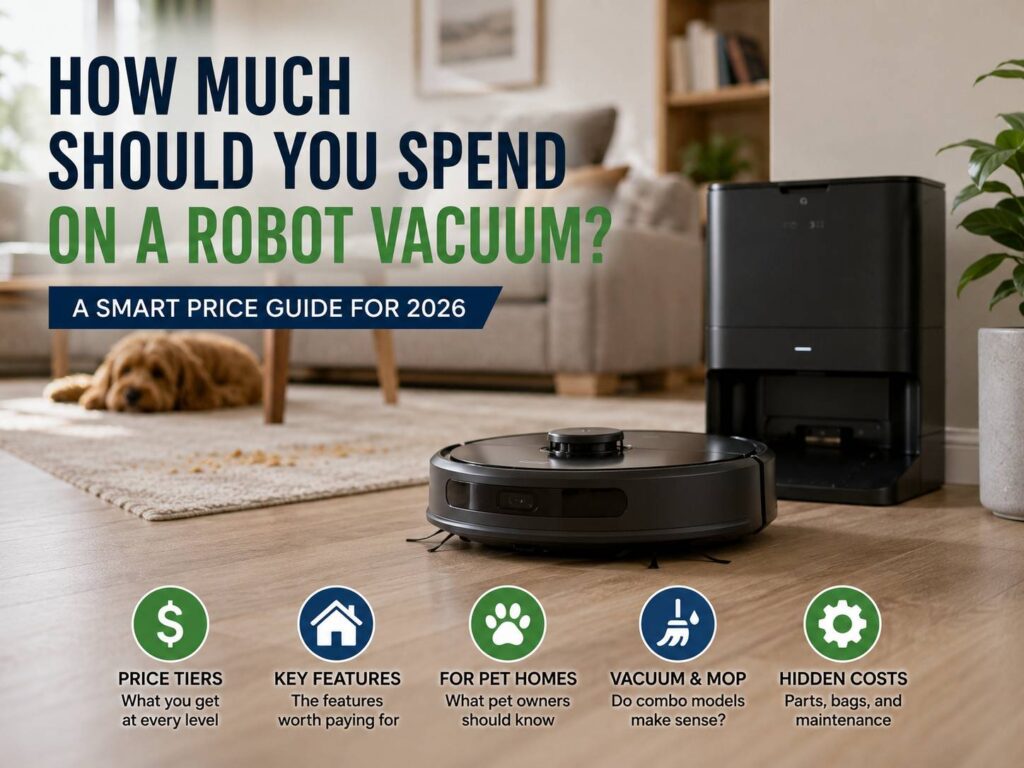
Robot vacuums look simple at first. One model costs under $200. Another costs more than $1,200. Both promise cleaner floors, app control, and less work. So, the hard part is not finding a robot vacuum. The hard part is knowing how much you should spend without paying for features you will barely use.
For most homes, the best robot vacuum budget sits between $350 and $700. That range gives you good cleaning power, smart mapping, app control, and fewer daily chores. Still, some homes need more. Pet owners, large families, and people with lots of hard flooring often get better value from the $700 to $1,000 range.
At the same time, not everyone needs a premium robot vacuum. A small apartment with hard floors can do well with a cheaper model. So, the right price depends on your rooms, floor type, pets, mess level, and how much maintenance you can tolerate.
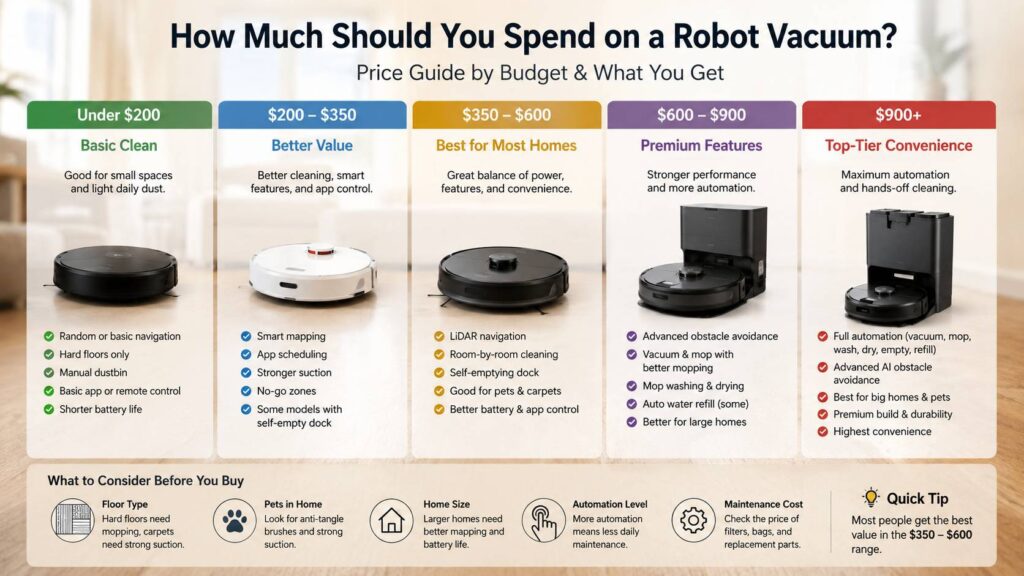
The Quick Answer: Most Buyers Should Spend $350 to $700
A robot vacuum under $200 can help with light dust. Still, it often needs more babysitting. It can bump into furniture, miss spots, or get stuck on cables. So, it works best as a simple helper, not as your main floor cleaner.
Between $350 and $700, the value gets much better. You start to see smart mapping, stronger suction, room-by-room cleaning, better app controls, and self-emptying docks. This is the price range where you get the most for your money.
Then, from $700 to $1,000, robot vacuums become much more hands-off. Many models can mop, wash mop pads, dry them, empty dust, refill water, and avoid more obstacles. For pet homes and busy families, that extra cost can feel worth it.
Above $1,000, you mostly pay for comfort. These models can clean well, but the main upgrade is convenience. So, spend that much only if you want the robot to handle almost everything by itself.
What You Get Under $200
Robot vacuums under $200 can look tempting. The price feels low, and the promise sounds useful. Still, this is the weakest tier for navigation and long-term comfort.
Most models in this range work best in small spaces. They can pick up crumbs, hair, and dust from hard floors. But they often struggle with carpets, room mapping, and clutter. Some move in a random pattern, so they clean the same area twice and miss another area completely.
This price range makes sense for:
- A studio apartment
- A small bedroom
- Mostly hard floors
- Light daily dust
- A second robot for one room
Still, there are real trade-offs. You may need to empty the dustbin often. You may need to rescue the robot from cables or chair legs. Plus, you may need to clean the brush more often, since cheaper models can struggle with long hair.
My honest opinion: do not buy under $200 for a busy home. It can work for light cleaning, but it rarely feels like a true upgrade.
What You Get From $200 to $350
This range is better for buyers who want a low price without going too cheap. You can find robot vacuums with app schedules, stronger suction, basic mapping, and better battery life. Some models in this tier also go on sale with a self-emptying dock.
So, if your home is small or medium-sized, this price range can make sense.
Look for:
- App control
- Scheduled cleaning
- Basic mapping
- No-go zones
- Decent suction
- Washable filters
- Easy brush removal
- Replacement parts that are easy to find
Still, mopping at this price is usually basic. Many cheaper robot vacuum and mop combos only drag a damp pad over the floor. That helps with fine dust, but it will not scrub dried food or sticky kitchen marks.
For that reason, buy in this range for vacuuming first. Treat the mop feature as a nice extra.
What You Get From $350 to $600
This is where robot vacuums start to feel useful every day. You get better navigation, better cleaning paths, and fewer annoying mistakes. Many models in this tier clean in straight lines and remember your rooms.
Within this tier, $400 to $600 is the smartest range. It gives you a real step up from cheap models without pushing you into luxury pricing.
This tier works well for:
- Apartments
- Small and medium homes
- Mixed hard floors and rugs
- Low-pile carpet
- One or two pets
- Daily dust and crumbs
A self-emptying dock is one of the best upgrades in this range. It saves time and keeps dust out of your face. Instead of emptying the robot after every run, you only change the dock bag after several weeks.
Plus, app features get better here. You can clean only the kitchen after dinner. You can skip the bedroom. You can set no-go zones around pet bowls or cables. These small controls make the robot easier to live with.
If you are planning other home office or tech upgrades too, it helps to compare budgets across categories. For example, this same price-checking mindset works well for bigger purchases like how much should you spend on a monitor in 2026.
What You Get From $600 to $900
This range is best for buyers who want stronger cleaning and less manual work. Robot vacuums here often include self-emptying docks, better mopping, stronger obstacle detection, and improved carpet handling.
So, this is a strong range for homes with pets, kids, and regular floor mess.
You should expect features like:
- LiDAR mapping
- Better room detection
- Stronger suction
- Self-emptying dust collection
- Mop lifting
- Spinning or vibrating mop pads
- Better edge cleaning
- Obstacle avoidance
- Recharge and resume
Mopping gets much better in this tier. A basic wet pad only wipes. A better mop system can remove more dust, paw prints, and light stains. Then, if the dock can wash and dry the mop pads, the robot feels much easier to manage.
Still, these systems are not perfect. Dirty water tanks can smell if you ignore them. Mop pads need washing or replacement. Brushes still collect hair. So, you reduce chores, but you do not remove every chore.
My real-world view: this is the best range for pet owners. It costs more, but it saves time every week.
What You Get Above $1,000
Premium robot vacuums focus on comfort. They do more by themselves and need less daily input from you. Some models can vacuum, mop, wash the mop, dry it, empty dust, refill water, and clean around obstacles with less trouble.
This price range makes sense for:
- Large homes
- Heavy pet hair
- Hard floors across many rooms
- Daily mopping
- Busy families
- Buyers who hate floor cleaning
Still, the jump in price is large. A $1,200 robot vacuum is not always twice as good as a $600 robot vacuum. It may clean a bit better, but it mostly saves more effort.
So, spend over $1,000 only if convenience matters more than price. If you just need clean floors and decent mapping, a mid-range model will usually make more sense.
Robot Vacuum or Robot Vacuum and Mop?
A robot vacuum and mop combo sounds like the better choice. In some homes, it is. Still, the mop system matters more than the label on the box.
A cheap mop pad only drags water across the floor. It can remove fine dust, but it will not replace real mopping. Better systems use spinning pads, vibrating plates, or roller mops. These apply more pressure and clean better.
Choose a robot vacuum and mop if you have:
- Tile floors
- Vinyl floors
- Sealed hardwood
- Laminate
- Pet paw marks
- Kitchen spills
- Dusty hallways
Choose a vacuum-only model if you have:
- Mostly carpet
- Thick rugs
- Limited dock space
- A tight budget
- No real need for mopping
In that case, a good vacuum-only robot beats a weak mop combo. So, do not pay extra just to see “mop” in the name.
Hidden Costs You Should Plan For
The purchase price is not the full cost. Robot vacuums need replacement parts. So, check the cost of parts before buying.
Plan for:
- Dust bags
- Filters
- Side brushes
- Main brushes
- Mop pads
- Cleaning fluid
- Roller parts
- Battery replacement after long use
A cheap robot can become annoying if parts are hard to find. Filters and brushes should be easy to buy. The app should still receive updates. The dock should use bags or parts that do not cost too much.
Bagged self-empty docks are cleaner to empty, but bags cost money. Bagless docks save on bags, but they can release dust during emptying. So, allergy-sensitive buyers may prefer a bagged dock.
Features Worth Paying More For
Some robot vacuum features matter every day. Others sound better in ads than they feel at home.
Pay more for:
- LiDAR mapping
- Room-by-room cleaning
- Self-emptying dock
- No-go zones
- Carpet detection
- Anti-tangle brush
- Auto mop lifting
- Mop washing and drying
- Good replacement parts
- Strong app control
Be careful with:
- Huge suction claims
- Cheap mop labels
- Too many cleaning modes
- Voice control as the main selling point
- Unknown brands with poor part support
Suction matters, but it does not tell the whole story. Brush design, navigation, airflow, and floor contact matter too. A smart robot with a good brush can clean better than a loud robot with a bigger suction number.
How Much Should Pet Owners Spend?
Pet owners should spend more than the bare minimum. Fur, litter, crumbs, and tracked dirt expose weak robots fast.
For one short-haired pet, $350 to $600 can work. For two pets, long hair, or heavy shedding, $600 to $900 is a better target. Look for anti-tangle brushes, strong suction, a self-emptying dock, and easy brush access.
The biggest pet-owner problem is hair wrap. Better robots reduce it, but they do not remove it. So, expect to check the roller and side brush each week.
If your pet tracks dirt inside, a mop combo can help. The robot can vacuum fur first, then wipe paw marks from hard floors. That makes the home feel cleaner between deeper cleanups.
How Much Should Apartment Buyers Spend?
Apartment buyers can spend less. A small home does not need a huge dock or the most advanced mapping system.
For a studio or one-bedroom apartment, $250 to $400 is often enough. You should still look for app control, scheduled cleaning, and decent mapping. These features help the robot clean faster and avoid repeat passes.
A compact self-empty dock can be useful, but a large auto-wash dock may take too much space. So, measure the area near the outlet before buying.
If you rent, check thresholds, rugs, and tight furniture gaps. Some cheap robots get stuck on small height changes. A better navigation system can save you time and frustration.
How Much Should Large Home Buyers Spend?
Large homes need stronger mapping, longer battery life, and better dock features. A low-cost robot may clean one room well, then fail across a full floor.
For a larger home, start around $500. For lots of hard flooring, $700 to $1,000 is a better target. If you want strong mopping and low maintenance, premium models can make sense.
Look for:
- Recharge and resume
- Multi-room cleaning
- Multi-floor maps
- Strong battery life
- Larger water tanks
- Good obstacle avoidance
- Reliable dock performance
A larger home also benefits from better app controls. You can clean high-traffic rooms more often and skip unused rooms. Then, the robot spends time where dirt builds up most.
When Spending More Is Not Worth It
A premium robot vacuum is not always the smart buy. It is easy to pay for features you never use.
Do not overspend if:
- Your home is small
- You have mostly carpet
- You already mop by hand
- You do not mind emptying the bin
- Your floors have lots of loose cables
- You only need light dust pickup
Also, avoid paying extra for a mop system if your floors do not need it. A better vacuum-only model can be the cleaner choice.
The same idea applies to smaller tech buys too. If you are matching your budget to real use, this guide on how much should you spend on a mouse in 2026 follows a similar buyer-first logic.
The Best Price Range for Most People
Here is the easiest way to choose:
- Spend $200 to $350 for light cleaning in a small home.
- Spend $350 to $600 for the best value.
- Spend $600 to $900 for pets, kids, and better mopping.
- Spend $900 to $1,500 for large homes and low-maintenance cleaning.
If you are unsure, $400 to $700 is the right budget. It gives you the features that matter without forcing you to pay luxury prices.
Still, sales can change the math. Robot vacuums often drop in price during big shopping events. So, a $900 model on sale for $600 can be a better buy than a weaker model at full price.
Final Verdict: Spend for Your Home, Not the Biggest Feature List
A robot vacuum should make your life easier. It should clean often, avoid trouble, and need only light maintenance. So, the best model is not always the most expensive one.
For a small apartment, spend $250 to $400. For a normal home, spend $400 to $700. For pets, kids, and regular mopping, spend $700 to $1,000. For a large home with lots of hard floors, a premium model can make sense.
My honest advice is simple: buy the cheapest robot vacuum that handles your real mess without constant help. That is where the best value sits.