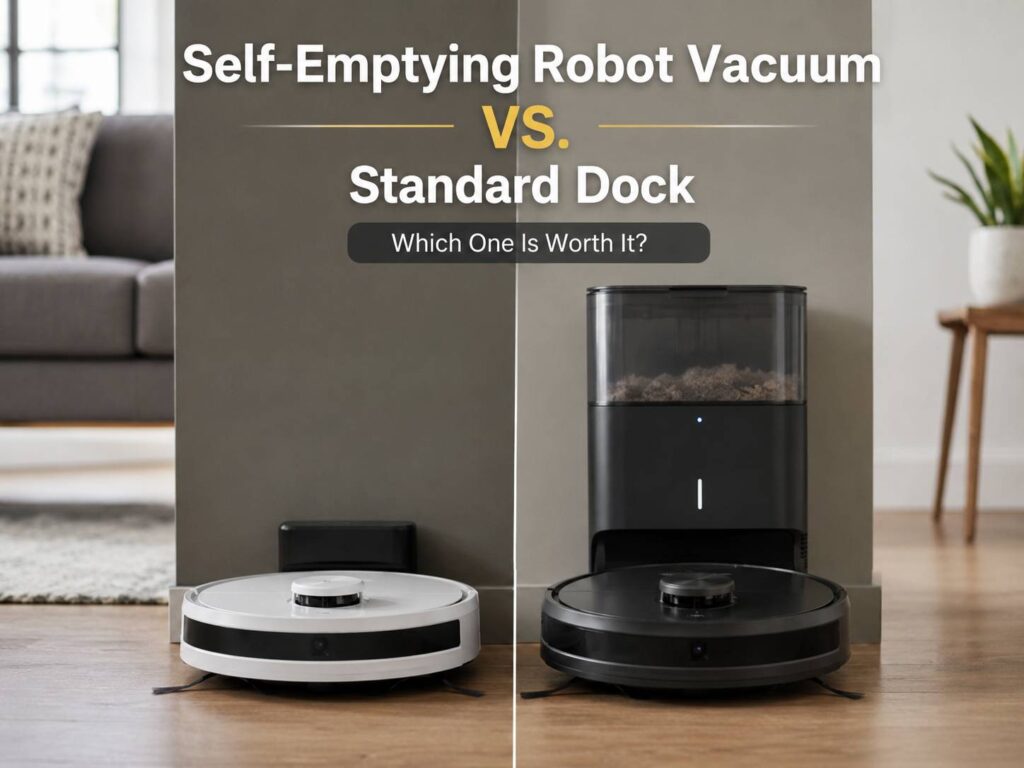
A self-emptying robot vacuum sounds like the kind of upgrade that should make cleaning almost effortless. The robot vacuums your floors, returns to its dock, and empties the dirt by itself. That alone can make it feel more useful than a standard robot vacuum.
Still, the feature is not perfect. The dock costs more. It takes more room. It can be loud for a few seconds after each cleaning run. Some models use disposable bags too, so there is a small ongoing cost.
So, is self-emptying worth it on a robot vacuum? For busy homes, pet owners, allergy-sensitive users, and larger spaces, yes, it often is. For a small apartment with light dust and no pets, a regular dock can still make sense.
The key is not just the feature itself. You need to know how it works, what problems owners run into, and whether it fits your home.
What Does Self-Emptying Mean on a Robot Vacuum?
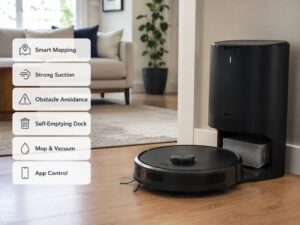
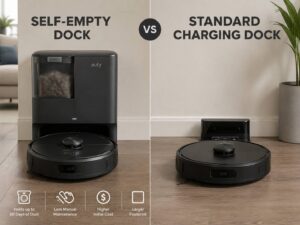
A self-emptying robot vacuum comes with a larger charging base. After the robot finishes cleaning, it returns to the dock. Then the dock uses strong suction to pull dirt, dust, crumbs, pet hair, and debris out of the robot’s small onboard dustbin.
That debris goes into a larger bag or container inside the base. Instead of emptying the robot after every run, you empty the dock after several weeks. The exact timing changes from home to home.
A clean apartment with hard floors will fill the dock slowly. A house with pets, rugs, kids, and daily cleaning will fill it faster. Fine dust, cat litter, cereal crumbs, and pet fur can all affect how often the base needs attention.
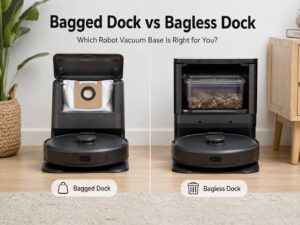
Most self-emptying docks come in two main types:
- Bagged docks, which collect dirt in a sealed disposable bag
- Bagless docks, which collect dirt in a reusable plastic bin
Bagged docks are cleaner to empty. Bagless docks save money on bags, but they can release more dust into the air during disposal.
Why This Feature Feels More Useful Than It Sounds
At first, self-emptying can sound like a small comfort feature. After all, emptying a robot vacuum bin takes less than a minute. In real life, though, that small chore becomes annoying fast.
Robot vacuums have tiny dustbins. Pet hair, dust, and crumbs can fill them quickly. Once the bin gets full, the robot can lose pickup power or leave dirt behind. Then you need to stop, open the bin, dump the mess, clean the filter, and start again.
A self-empty dock removes that routine from most daily cleaning. The robot can run on a schedule and clear itself after each session. That makes you more likely to use it every day.
This is where the feature starts to matter. A robot vacuum works best as a maintenance cleaner. It keeps floors from getting bad between deeper cleaning sessions. The easier it is to run, the more value you get from it.
For a closer comparison of the two dock styles, this guide on self-empty robot vacuum vs standard dock can help you decide which setup fits your home better.
Who Gets the Most Value From a Self-Emptying Robot Vacuum?
A self-emptying robot vacuum makes the most sense in homes that collect dust and debris every day. The more often your floors need cleaning, the more useful the dock becomes.
It is a strong upgrade for:
- Pet owners dealing with fur, dander, litter, and tracked-in dirt
- Families with kids who drop crumbs under tables and sofas
- Larger homes with several rooms to clean
- Allergy-sensitive users who want less contact with dust
- Homes with carpets, rugs, or high-traffic areas
- Busy people who want the robot to clean on a schedule
- Anyone who forgets to empty a standard robot vacuum bin
Pet owners usually notice the biggest difference. Dog hair and cat hair can fill a normal robot bin fast. A self-empty base helps the robot keep going with less babysitting.
People with allergies can benefit too, especially with a bagged dock. Sealed bags reduce direct contact with dust when you throw them away. That does not make the robot a full allergy fix, but it can make routine floor cleaning less irritating.
Who Should Skip the Self-Emptying Upgrade?
Not every home needs this feature. A regular robot vacuum can still work well in a small, tidy space. If your floors do not collect much debris, the onboard bin may not fill up after each run.
You can skip self-emptying if:
- You live in a small apartment
- You have mostly hard floors
- You do not have pets
- You clean only a few times per week
- You do not mind emptying the dustbin by hand
- You want the lowest purchase price
- You have very limited space around the dock
- You dislike loud appliances
A standard robot vacuum is not a bad choice. In fact, a good standard model can beat a weak self-emptying model. Smart mapping, strong pickup, good brush design, and reliable navigation still matter more than the dock.
This matters a lot in budget models. Some cheaper robot vacuums add a self-empty base but cut corners on navigation or obstacle detection. That can lead to missed rooms, stuck cleaning runs, or weak carpet pickup.
Bagged vs Bagless Self-Emptying Docks
The dock style matters too.
A bagged self-empty dock collects dirt in a disposable bag. This is the cleaner option. You pull the bag out, seal it, and throw it away. Less dust escapes, so it suits pet owners and people sensitive to dust.
The downside is the cost of replacement bags. It is not usually a huge cost, but it is still something to factor into the total price.
A bagless self-empty dock uses a reusable plastic container. You empty it into the trash, then put it back. This saves money and creates less waste from bags.
The drawback is mess. Fine dust can puff out when you empty the bin. Pet hair can cling to the plastic. You may need to tap, wipe, or rinse the container.
My honest opinion: bagged docks are better for most homes. They feel cleaner and easier. Bagless docks make sense if you hate buying replacement bags and do not mind a bit more dust during emptying.
Does Self-Emptying Make the Robot Clean Better?
Self-emptying does not directly make the robot more powerful. The robot still uses its own motor, brush, wheels, sensors, and cleaning path. A weak robot will not become great just by sitting on a smarter dock.
Still, self-emptying can help the robot clean more consistently. A full onboard bin can block airflow and reduce pickup. It can also cause dirt to stay behind during the next run.
With a self-empty base, the robot starts most cleaning sessions with an empty bin. That helps in homes with pet hair, carpet dust, and daily crumbs.
So, the dock improves convenience and consistency more than raw suction. If you want better cleaning results, pay attention to the robot itself. Look at navigation, brush design, suction levels, carpet pickup, edge cleaning, object avoidance, and app controls.
For a better idea of what matters beyond the dock, read this breakdown of robot vacuum features that actually matter. It can help you avoid paying extra for features that sound better than they feel in daily use.
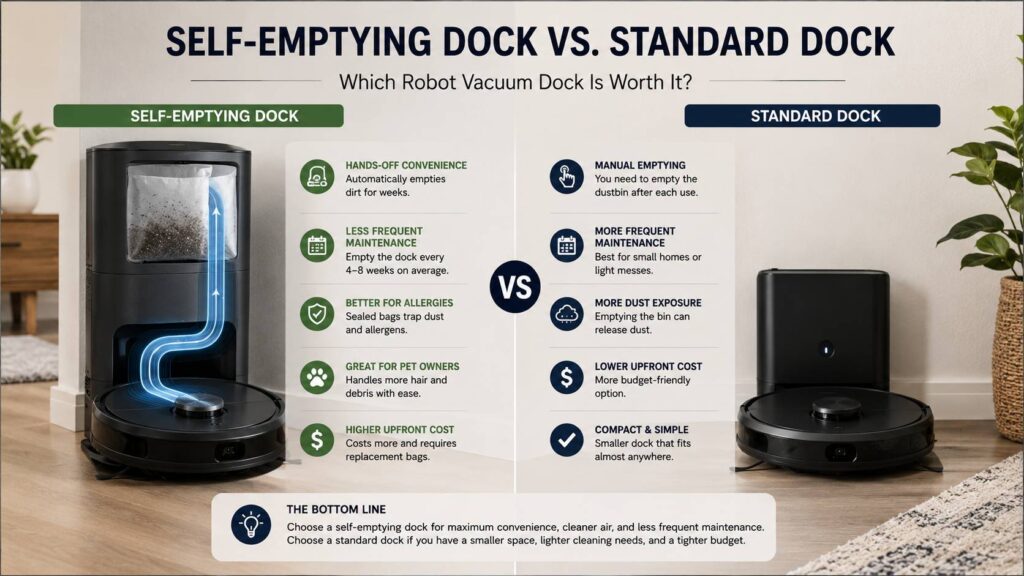
Real Problems Owners Run Into
Self-emptying docks are useful, but they still need care. Some issues show up often across different brands and price ranges.
The dock can be loud. The emptying cycle usually lasts only a few seconds, but it can sound like a small shop vacuum. That noise may scare pets or bother someone working nearby.
Clogs can happen too. Long hair, packed dust, paper scraps, food crumbs, and pet fur can block the robot bin or the dock’s suction path. Then the robot returns to base, the dock runs, and some dirt stays inside the robot.
Odor is another issue. If the robot picks up food debris, pet mess, or damp dirt, the dock bag can smell over time. A full bag is not the only reason to replace it. Sometimes smell is reason enough.
Some docks need careful placement. The base should sit on a flat surface with open space around it. A tight corner, uneven rug, or crowded hallway can cause docking failures.
Replacement bags can be annoying too. You need to keep spares ready. Running out of bags makes the self-empty feature useless until you buy more.
Hair still wraps around brushes. This is a big one. Self-emptying clears the bin, but it does not remove hair from rollers, side brushes, axles, or wheels. Pet homes still need weekly brush checks.
Is Self-Emptying Worth It for Pet Hair?
Yes, this is one of the clearest cases where self-emptying makes sense.
Pet hair fills small robot bins quickly. A self-empty dock clears the bin after cleaning, so the robot is ready for the next run. That makes daily cleaning easier to maintain.
This is useful for homes with dogs, cats, or both. It helps with fur on hard floors, rugs, hallways, and under furniture. It can also reduce the visible hair that collects along baseboards and around chairs.
Still, pet owners should not expect a fully hands-free setup. Long hair can wrap around the brush. Fine fur can clog filters. Cat litter can pack into corners of the bin. Pet toys and food bowls can still cause trouble.
For pet homes, look for:
- Anti-tangle brush design
- Rubber rollers or easy-clean rollers
- Strong suction on rugs
- Good edge cleaning
- Bagged self-empty dock
- Washable or easy-replace filters
- No-go zones for bowls and litter areas
- Reliable obstacle detection
A self-emptying robot vacuum can help a lot with pet hair, but it still needs basic care. Think of it as less work, not zero work.
Is Self-Emptying Worth It for Allergies?
A bagged self-emptying model can be a smart choice for allergy-sensitive users. Emptying a standard robot bin by hand can release dust, pollen, pet dander, and fine particles back into the air.
A sealed dock bag keeps more of that debris contained. You remove the bag, throw it away, and move on. That feels much cleaner than tapping a dusty plastic bin over the trash.
Still, a robot vacuum is not a complete allergy plan. You still need to change filters, dust surfaces, wash bedding, and use a stronger vacuum for deeper cleaning. Robots are best for regular floor maintenance.
For allergies, choose a model with a bagged dock, strong filtration, easy filter access, and available replacement parts. Skip models that make filter cleaning messy or difficult.
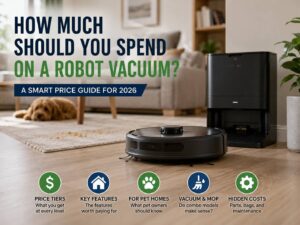
How Much Extra Is Self-Emptying Worth?
The self-emptying feature is worth paying extra for, but not at any price.
If the price jump is small and the robot already has good mapping, strong pickup, and useful app controls, the self-empty dock is easy to recommend. If the robot itself is weak, the dock does not save the purchase.
Before paying more, check these points:
- Does the robot map rooms accurately?
- Can it clean room by room?
- Does it avoid common objects well?
- Is the dock too large for your space?
- Are replacement bags easy to find?
- Does it clean carpets well?
- Can it handle pet hair?
- Is the app simple to use?
- Are filters and brushes easy to replace?
- Does the warranty cover the dock?
Price alone can be misleading. A cheap self-emptying robot with poor navigation may waste more time than it saves. A better robot with a standard dock may clean more reliably.
Self-Emptying Robot Vacuum and Mop Combos
Many newer models combine vacuuming, mopping, and self-emptying. Some docks go even further. They can wash mop pads, dry them, refill water, and collect dirty water.
These all-in-one stations can be worth it if you want less manual work. They suit homes with hard floors, pets, kids, and regular spills.
The catch is maintenance. Mop pads still need care. Dirty water tanks need emptying. Clean water tanks need refilling. The dock tray can get dirty too.
If mopping matters to you, do not buy a combo model only for self-emptying. Look for mop pad washing and drying. Drying is especially useful, since wet pads can start to smell.
For mostly carpeted homes, a vacuum-first model with a good self-empty base may be the better choice.
Final Verdict: Is Self-Emptying Worth It on a Robot Vacuum?
Self-emptying is worth it for most people who use their robot vacuum often. It is especially useful for pet owners, families, allergy-sensitive users, and larger homes. The feature saves time, reduces dust contact, and makes daily scheduled cleaning easier to keep up with.
It is less useful in small homes with light dust and no pets. In that case, a standard dock can still do the job at a lower price.
My real opinion: self-emptying is one of the few robot vacuum upgrades that changes daily use in a noticeable way. It does not fix every problem, and it does not replace deeper cleaning. But it makes the robot feel much more automatic.
If you want a robot vacuum that needs less attention after each run, self-emptying is worth paying for. If you only clean a small space once in a while, save the money and buy a better basic robot instead.