Robot vacuums have become much better over the last few years, but the dock still makes a big difference. Some models come with a simple charging dock. Others include a self-empty base that pulls dirt from the robot into a larger bag or bin.
At first, that may sound like a small upgrade. In real life, it changes how often you touch dust, pet hair, crumbs, and fine dirt. For some homes, a self-empty robot vacuum feels like a major comfort upgrade. For others, a standard charging dock is still the smarter and cheaper choice.
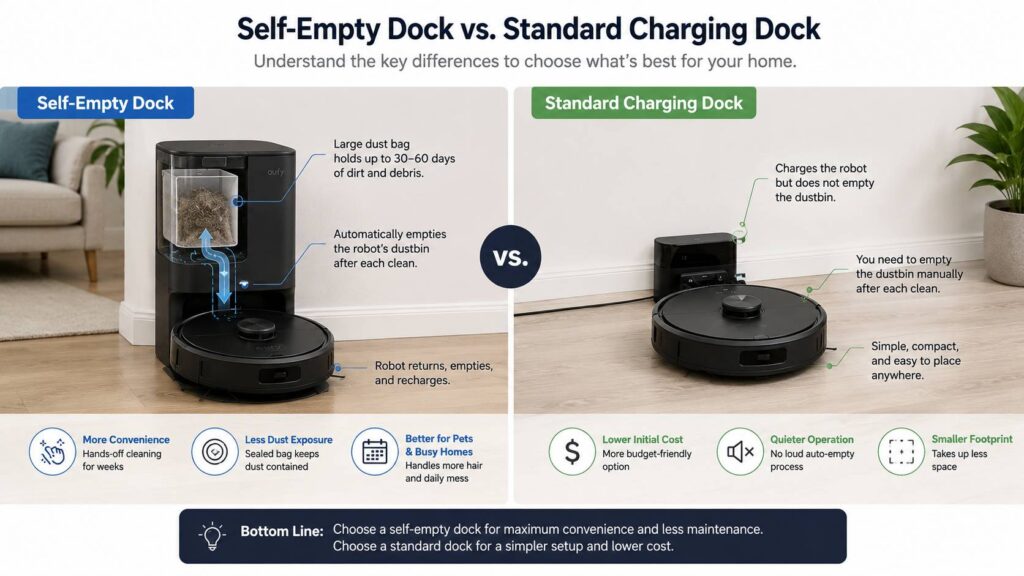
So, which one should you buy? A self-empty dock is better for busy homes, pet owners, allergy-sensitive users, and people who run their robot vacuum daily. A standard dock works better for small homes, lower budgets, and users who do not mind emptying the dustbin by hand.
What Is a Standard Robot Vacuum Charging Dock?
A standard charging dock is the basic base station that comes with many robot vacuums. Its job is simple. It charges the robot after each cleaning run.
The robot leaves the dock, cleans your floors, then returns to recharge. After that, you need to empty the small dustbin inside the robot. You can do this after every run or wait until the app sends a full-bin alert, if the model supports that feature.
This type of dock has a few clear benefits. It takes little space, makes almost no noise after docking, and keeps the total price lower. Plus, there are no dock bags to buy later.
Still, the manual emptying part can become annoying. The robot’s onboard bin is small, so pet hair and carpet dust can fill it quickly. In a home with kids, pets, rugs, or daily dirt near the entryway, the bin may need attention more often than expected.
For a simple apartment or a low-mess home, that may be fine. For a busier home, it can make the robot feel less automatic.
What Is a Self-Empty Robot Vacuum Dock?
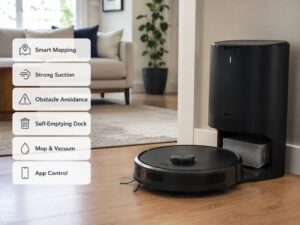
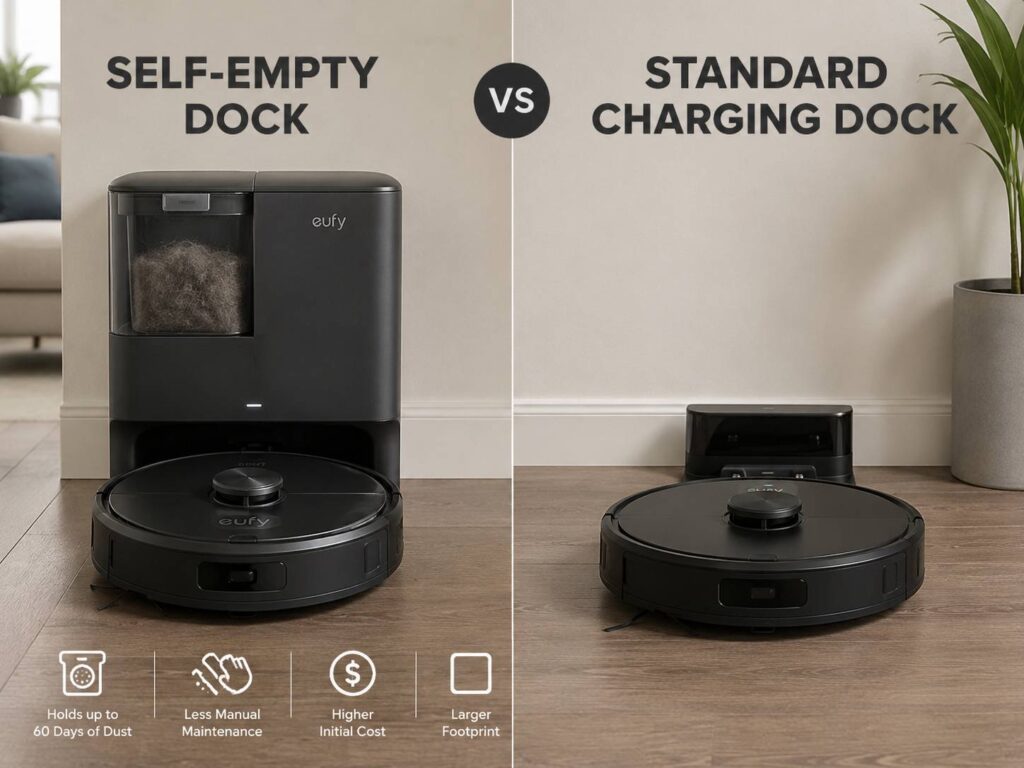
A self-empty dock charges the robot and empties its dustbin after cleaning. The dock uses suction to pull dirt from the robot into a larger dust bag or dust container inside the base.
This means you do not need to empty the robot after each cleaning run. Instead, you empty the larger base every few weeks, based on your home, floor type, pets, and cleaning schedule.
In daily use, this feature is more useful than it sounds. The robot can clean more often, and you deal with dust less often. That makes the whole setup feel closer to real hands-free cleaning.
Some self-empty docks use sealed dust bags. These are cleaner to remove and throw away. Other docks use bagless containers. These save money on bags, but they can release more dust when emptied.
The best choice depends on your tolerance for dust, noise, and running costs.
Self-Empty Dock vs Standard Dock: The Real Difference
The main difference is what happens after the cleaning run.
With a standard dock, the robot charges and waits for the next job. You handle the dirt.
With a self-empty dock, the robot charges, then the base pulls the dirt out of the robot’s bin. The base stores that dirt in a larger container or bag.
That one step matters. A robot vacuum with a full bin cannot clean as well. It may leave debris behind, drag hair around, or stop asking for maintenance. So, the dock does not just add comfort. It can help the robot stay ready for the next run.
Even so, the dock does not improve everything. It does not remove tangled hair from the brush. It does not clean the filter by itself on most models. It does not wipe the sensors. You still need basic robot vacuum maintenance.
For a deeper buying checklist, this guide on robot vacuum features that actually matter is useful before choosing a model.
Why a Self-Empty Robot Vacuum Feels Easier to Live With
The biggest benefit is routine. A robot vacuum should make cleaning easier, not add another small chore every day.
With a self-empty base, the robot can run on a schedule and empty itself after each session. That means fewer dustbin checks, fewer dirty hands, and fewer trips to the trash can.
This helps a lot in homes with pets. Dog hair and cat hair fill small dustbins fast. Carpet fibers, dust, crumbs, and litter can fill them even faster. Once the bin is full, cleaning performance drops.
A self-empty dock reduces that problem. The robot starts the next run with more available bin space, so it can keep working without constant attention.
There is another comfort benefit too. Manual dustbin emptying can create a small dust cloud. If you dislike that, a sealed self-empty bag feels much cleaner. You pull out the bag, throw it away, and move on.
The Problems With Self-Empty Robot Vacuum Docks
Self-empty docks are not perfect. The first issue is noise.
The emptying cycle can sound like a small vacuum cleaner. It usually lasts only a short time, but it can be loud enough to surprise you. In a small apartment, it may feel too harsh at night or during calls.
Next, there is the cost. Self-empty models cost more than standard-dock models. Bagged systems also need replacement bags. The cost is not huge for most homes, but it still adds up over time.
Space is another issue. A self-empty base is much bigger than a simple charging dock. It needs open space in front and enough room around it so the robot can dock correctly.
Clogs can happen too. Long hair, pet fur, large debris, or a full bag can block the air path. The dock may make noise, but the robot bin may not empty fully. That can be frustrating, especially if you expected the system to need almost no attention.
So, self-empty docks are very convenient, but they still need care.
Why a Standard Charging Dock Still Makes Sense
A standard dock still has a place. In fact, it can be the better option for many buyers.
The biggest advantage is price. Standard robot vacuums usually cost less, so they are easier to recommend for smaller budgets. They also have fewer dock parts, no dust bags, and less to troubleshoot.
The smaller size helps too. A standard dock fits under a side table, near a wall, or in a small hallway corner more easily than a tall self-empty station.
Noise is lower as well. The robot returns, charges, and stays quiet. There is no loud emptying blast after each run.
For light mess, a standard dock does the job. If you have mostly hard floors, no pets, and a smaller space, emptying the bin may take less than one minute. In that case, paying extra for a self-empty base may not feel worth it.
This is why many budget buyers still choose a standard charging dock and spend the savings on a robot with better mapping, stronger suction, or better obstacle avoidance.
Pet Hair: Which Dock Wins?
Pet owners will usually prefer a self-empty dock.
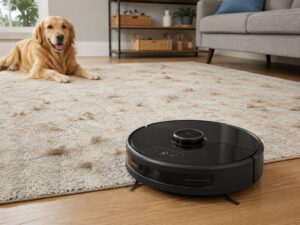
Pet hair fills robot vacuum bins quickly, especially on carpets and rugs. Even a short-haired dog can create enough fur to fill the bin after one full cleaning run. Long-haired cats can do the same.
A self-empty dock gives the robot a better chance to keep up. After each run, the base clears the robot bin, so the next clean starts fresh.
Still, pet hair creates other problems. Hair can wrap around the main brush. Fur can collect near the suction inlet. Fine dust from litter can clog the filter. For that reason, pet owners still need to check the brush and filter often.
For homes with heavy shedding, look for these features:
- Strong auto-empty suction
- Easy-to-clean brush roller
- Anti-tangle brush design
- Sealed dust bags
- Clear app alerts
- Easy access to the dock air path
- Replacement parts that are easy to find
A self-empty dock helps a lot, but it does not remove every pet-hair chore.
Allergies and Dust: Which Option Is Cleaner?
A self-empty dock with a sealed bag is usually the cleaner choice for dust handling.
Manual emptying can release dust back into the air. This is especially noticeable with fine dirt, carpet dust, pollen, and pet dander. A sealed dust bag reduces that contact.
Bagless self-empty docks are still convenient, but they are not always as clean to empty. You still open a larger container and dump the dirt into the trash. Some dust can escape during that step.
Standard docks expose you to dirt more often. You remove the robot bin, open it, empty it, then clean the filter area. If you are sensitive to dust, that routine may get annoying.
For allergy-sensitive homes, a bagged self-empty dock is the better pick.
Maintenance: What Still Needs Cleaning?
A self-empty dock lowers the dustbin chore, but it does not make the robot maintenance-free.
You still need to clean and check:
- Main brush
- Side brush
- Robot filter
- Sensors
- Charging contacts
- Wheels
- Dock air path
- Dust bag or dust container
- Robot dustbin opening
- Hair wrapped around moving parts
A standard dock needs less dock care, but it puts more work on you after each cleaning run. You empty the robot bin more often and clean the filter area more often.
So, the maintenance choice is not “work or no work.” It is really “small manual work often” versus “larger dock maintenance less often.”
That difference matters. Busy users usually prefer less frequent maintenance. Budget users may accept more hand work to save money.
Cost: Which One Gives Better Value?
Self-empty robot vacuums cost more upfront. They also bring possible bag costs later. If you choose a premium model with mop washing, mop drying, water refill, and dust emptying, the price rises even more.
Standard charging docks keep the total cost lower. There are no dock bags, no auto-empty motor, and fewer dock parts that can fail. You still need filters and brushes for the robot, but that applies to both types.
Value depends on how often the robot runs. If it cleans daily, a self-empty base can feel worth the extra cost. If it cleans once or twice per week, a standard dock may be enough.
For a broader cost and value breakdown, this article on are robot vacuums worth it in 2026 gives helpful context.
Space and Placement: Do Not Ignore the Dock Size
A standard dock is easy to place. It usually needs a wall outlet, a flat floor, and some open space in front.
A self-empty dock needs more room. Some bases are tall and deep. Others need extra clearance above the lid so you can remove the dust bag. If the dock sits in a tight corner, the robot may fail to park correctly.
Good placement matters for both types. Put the dock on a flat surface. Keep cables away. Leave open floor space around it. Avoid thick rugs under the dock. Keep it away from pet bowls, loose curtains, and clutter.
A robot that cannot dock well will not charge well. A self-empty dock that cannot align with the robot will not empty well either.
Common Real-Life Issues Buyers Notice
After using a self-empty dock, people often notice these issues:
- The emptying cycle sounds louder than expected.
- The dust bag fills faster in homes with pets.
- Hair can clog the dock inlet.
- The robot bin may not empty fully every time.
- The base takes more space than expected.
- Replacement bags feel like an extra chore.
- Fine dust can collect near the dock opening.
Standard dock users often notice different problems:
- The robot bin fills too quickly.
- Emptying the bin creates dust.
- The robot may clean poorly with a full bin.
- Pet hair makes the routine repetitive.
- Manual emptying becomes easy to forget.
- The robot feels less automatic than expected.
Neither setup is perfect. Still, the better choice becomes clear once you know which problem bothers you more.
Who Should Buy a Self-Empty Robot Vacuum?
A self-empty robot vacuum is the better choice for people who want less hands-on cleaning.
Choose a self-empty dock if you:
- Have pets
- Run the robot daily
- Have carpets or large rugs
- Hate emptying dustbins
- Want less contact with dust
- Have kids and frequent crumbs
- Forget to empty the robot bin
- Want a more automatic cleaning routine
- Have a larger home
- Prefer sealed dust bags
This upgrade makes the most sense in homes where dirt builds up quickly. It also suits anyone who bought a robot vacuum for convenience and wants the robot to handle more of the routine.
Who Should Buy a Standard Charging Dock?
A standard charging dock is the better pick for simple cleaning needs.
Choose a standard dock if you:
- Have a small apartment
- Have mostly hard floors
- Do not have pets
- Want the lowest upfront price
- Have limited floor space
- Do not want replacement dock bags
- Prefer a quieter dock
- Do not mind emptying the bin by hand
- Clean only a few times per week
This setup is basic, but that is part of the appeal. It costs less, takes less space, and keeps ownership simple.
Self-Empty Dock vs Standard Dock: Quick Comparison
| Feature | Self-Empty Dock | Standard Charging Dock |
|---|---|---|
| Main job | Charges and empties the robot bin | Charges the robot only |
| Best for | Pets, daily cleaning, busy homes | Small homes, light mess, lower budgets |
| Noise | Loud during emptying | Quiet after docking |
| Dust handling | Cleaner with sealed bags | More dust contact during manual emptying |
| Maintenance | Less bin emptying, more dock checks | More bin emptying, fewer dock parts |
| Running cost | Bags on many models | No dock bags |
| Space needed | Larger base | Smaller base |
| Convenience | Higher | Lower |
| Best value for | Frequent cleaning | Light cleaning |
Final Verdict: Which Dock Should You Choose?
A self-empty robot vacuum is worth it if you want the robot to clean often with less effort from you. It is the better choice for pet hair, daily dust, carpets, larger homes, and busy families.
A standard charging dock is still a good choice if your home stays fairly clean, your budget is tighter, or you do not mind emptying the bin yourself. It is smaller, quieter, and cheaper to own.
My honest view: choose a self-empty dock if your robot vacuum will run every day. The convenience adds up fast. Choose a standard dock if you only need light cleaning and want the best price.
For most busy homes, the self-empty base is the upgrade that makes a robot vacuum feel truly useful. For smaller spaces, the standard dock still does the job without extra cost or extra noise.