Robot Vacuum vs Upright Vacuum: The Simple Difference
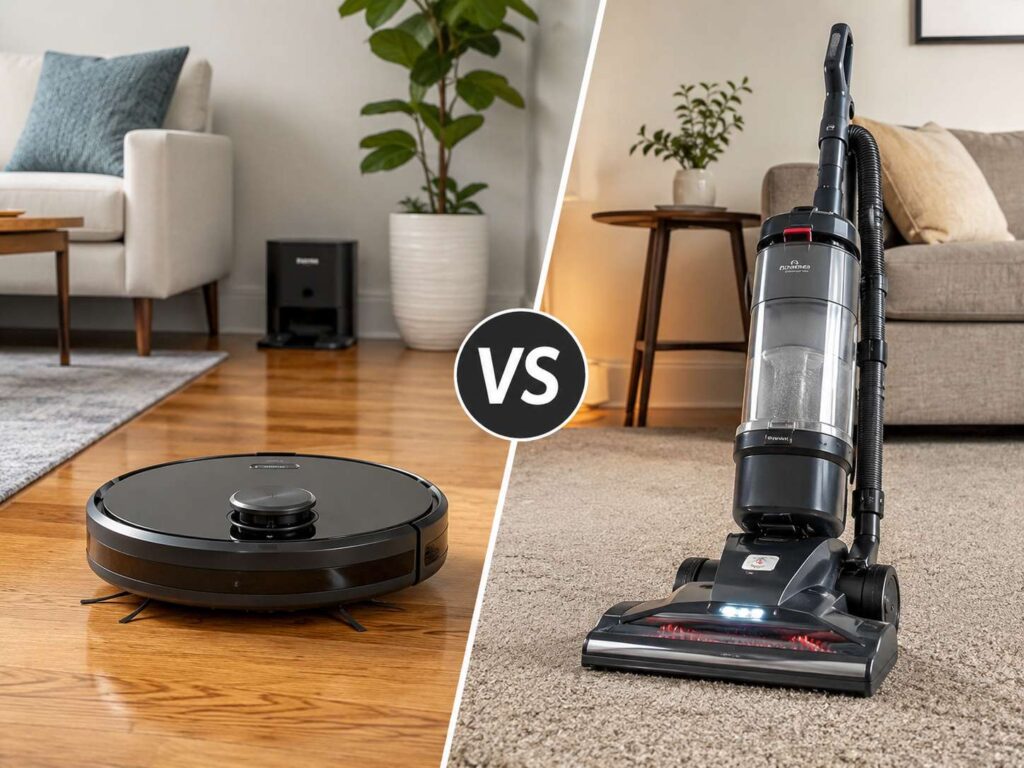
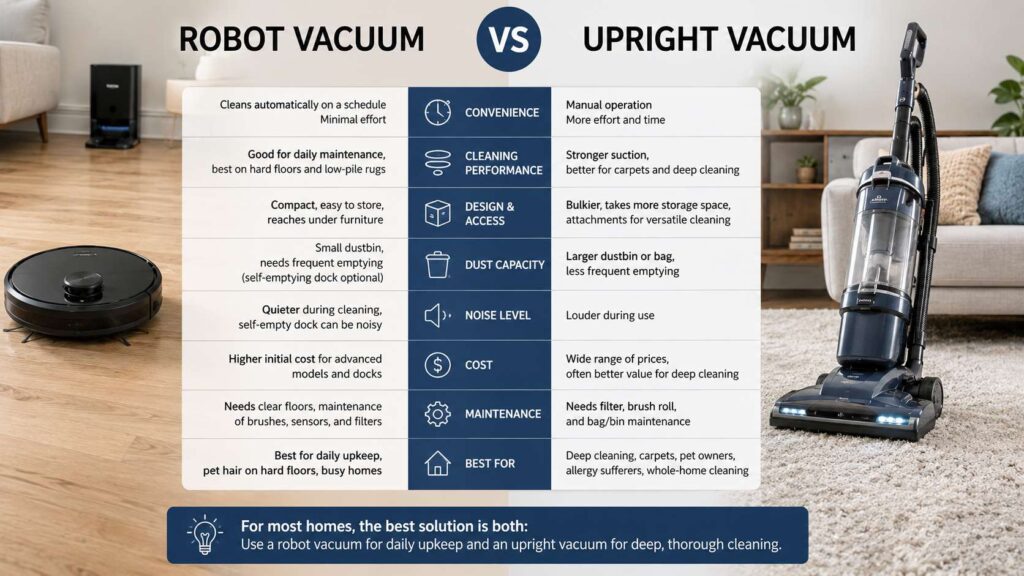
A robot vacuum and an upright vacuum both clean floors, but they do the job in very different ways. A robot vacuum is built for light, regular cleaning with very little effort from you. It moves around the home on its own, picks up dust, crumbs, pet hair, and surface dirt, then goes back to its dock.
An upright vacuum is more hands-on. You push it, guide it, and control where it cleans. In return, you usually get stronger suction, a bigger dustbin or bag, a wider cleaning head, and better carpet performance.
So, the real question is not just which one is better. The better question is: what kind of cleaning do you need most?
If you want cleaner floors during the week, a robot vacuum makes life easier. If you want deep cleaning power, an upright vacuum still wins. For many homes, the best setup is a robot vacuum for daily upkeep and an upright vacuum for the serious cleaning jobs.
Why Robot Vacuums Are So Popular
Robot vacuums are popular because they save time. You can set a schedule, leave the house, and come back to floors that look cleaner. That alone makes them appealing for busy families, pet owners, and anyone who hates vacuuming every few days.
They work best for:
- Daily dust on hard floors
- Pet hair that builds up fast
- Small crumbs under the table
- Light dirt near doors
- Low-pile rugs
- Dust under beds and sofas
- Keeping floors tidy between deeper cleans
Also, a robot vacuum helps with consistency. A floor that gets cleaned five times per week will often look better than a floor that gets cleaned once every two weeks, even if the manual vacuum is stronger.
Still, robot vacuums are not perfect. They can get stuck on cables, socks, rug edges, toys, and raised thresholds. Better models avoid more obstacles, but they still need a reasonably tidy floor. So, if your rooms often have clothes, chargers, and small objects everywhere, a robot vacuum can become frustrating.
My honest opinion: a robot vacuum feels brilliant in a tidy home with hard floors. In a cluttered home, it can feel like a small machine that needs too much babysitting.
Why Upright Vacuums Still Matter
Upright vacuums are still the better choice for raw cleaning power. They usually have stronger airflow, larger motors, bigger brush rolls, and more room for dirt. As a result, they can remove debris from carpets more effectively than most robot vacuums.
An upright vacuum is better for:
- Medium and thick carpets
- Large rugs
- Heavy pet hair
- Deep weekly cleaning
- Stairs
- Upholstery
- Dirt near entryways
- Bigger messes after kids or pets
- Cleaning around baseboards with tools
You also get more control. If one area looks dirty, you can go over it slowly. If the carpet has pet hair, you can work the brush roll over it. If crumbs fall beside the sofa, you can attach a crevice tool and clean that exact spot.
The trade-off is effort. Upright vacuums are louder, bulkier, and less convenient. Some are heavy, and corded models can be annoying in larger homes. Even so, they remain the stronger tool for deep cleaning.
Cleaning Hard Floors: Which One Does Better?
Hard floors are where robot vacuums make the most sense. Tile, laminate, vinyl, sealed wood, and smooth floors give the robot a flat surface to move across. Because of that, it can pick up dust, hair, and crumbs with less trouble.
A robot vacuum can also clean under furniture. That is a real advantage. Dust builds up under beds, TV stands, sofas, and cabinets. Most people do not move furniture every week, but a low-profile robot can reach many of those spaces.
An upright vacuum can clean hard floors too, but the cleaning head matters. Some uprights scatter crumbs on hard floors if the brush roll spins too aggressively. Others work very well because they have a hard-floor mode, a brush roll shutoff, or a soft roller.
For hard floors, the robot vacuum is better for daily cleaning. The upright vacuum is better for edges, corners, and bigger messes. So, if your home has mostly hard floors, a robot vacuum can make a big difference.
Cleaning Carpets and Rugs: Upright Vacuums Have the Edge
Carpet is the main reason upright vacuums still matter. Robot vacuums can clean low-pile carpet and thin rugs, but they struggle with deeper dirt. Their small motors and compact bodies limit how much air they can move. They can lift surface debris, but they often miss dirt trapped deeper in the fibers.
Upright vacuums usually perform better on carpet. Their larger brush rolls agitate carpet fibers more aggressively. Then, stronger suction pulls out dirt, dust, and hair. This makes a big difference in homes with pets, kids, or high foot traffic.
Thick rugs can create problems for both types. Robot vacuums can get stuck on fringe or fail to climb the edge. Upright vacuums can feel hard to push if the suction seals too tightly against the rug. Still, for overall carpet cleaning, the upright vacuum wins.
If your home has mostly carpet, buy an upright vacuum first. Then, add a robot vacuum later if you want help with daily surface cleaning.
Pet Hair: Daily Control vs Deep Cleaning
Pet hair changes the cleaning routine fast. One dog or cat can make floors look messy within a day, especially during shedding season. This is where robot vacuums can help a lot.
A robot vacuum can run every day and pick up loose hair before it spreads around the house. That helps on hard floors, low-pile rugs, and open spaces. A self-emptying robot vacuum is even better for pet owners, since pet hair fills small bins quickly.
Still, pet hair creates problems. Long hair can wrap around the brush roll. Fine hair can clog filters. Some robots also struggle with pet food, litter, and water bowls if the area is not set up well.
An upright vacuum is better for heavier pet cleanup. It can clean pet beds, stairs, sofas, thick rugs, and carpeted rooms. A pet-focused upright with a motorized mini tool can remove fur from upholstery much better than a robot vacuum.
So, for pet owners, the best answer is often both. Use the robot vacuum for daily floors. Then, use the upright vacuum for deep pet hair cleaning once or twice per week.
Allergies, Dust, and Filters
If dust or allergies are a concern, filtration matters. A vacuum should not just pick up dirt. It should also keep fine particles from leaking back into the room.
Many upright vacuums offer stronger filtration systems than robot vacuums. Some use sealed bodies, HEPA-style filters, or bags that trap dust more cleanly during disposal. Bagged uprights are often better for people who dislike emptying dusty bins.
Robot vacuums can still help allergy sufferers because they reduce dust buildup through frequent cleaning. Yet, their dustbins are small, and their filters need regular care. Self-emptying docks can reduce how often you touch the robot bin, but they still need bags or bin maintenance.
For allergy-focused cleaning, an upright vacuum is usually the safer first choice. A robot vacuum can help keep dust down between deeper cleans, but it should not be the only tool if air quality is a major concern.
Stairs, Corners, and Furniture
Robot vacuums cannot clean stairs. That is one of their biggest limits. If your home has stairs, you still need a manual vacuum, a cordless vacuum, or a handheld vacuum.
Corners are another weak spot. Most robot vacuums are round, so they do not fit tightly into corners. Side brushes help pull debris inward, but they do not replace a proper crevice tool.
Under furniture, though, robot vacuums are excellent. They can reach places that upright vacuums rarely reach without moving furniture. This makes them useful for dust under beds, desks, and low sofas.
Upright vacuums are better for detailed cleaning. With attachments, they can clean baseboards, sofa gaps, curtains, mattresses, car interiors, and stairs. That extra reach matters more than it seems at first.
Robot Vacuum Maintenance: What Owners Actually Deal With
A robot vacuum feels automatic, but it still needs care. If you expect it to work without any attention, it will annoy you.
Common robot vacuum maintenance includes:
- Emptying the dustbin or replacing dock bags
- Cleaning the main brush
- Removing hair from rollers
- Wiping sensors
- Cleaning charging contacts
- Checking the wheels
- Replacing side brushes
- Washing or replacing filters
- Updating maps after moving furniture
Also, robot vacuums can act strangely when sensors get dusty. They may miss rooms, fail to dock, spin in circles, or stop with an error message. Most of these issues are easy to fix, but they still take time.
The biggest robot vacuum issue is not suction. It is reliability in real homes. A clean, open floor helps a lot. A messy floor creates problems fast.
Upright Vacuum Maintenance: Simple, but Easy to Ignore
Upright vacuums need maintenance too, but the tasks are usually more familiar. You empty the bin, replace the bag, clean filters, and check the brush roll.
Common upright vacuum maintenance includes:
- Emptying the dust cup
- Replacing bags
- Washing filters if the manual allows it
- Replacing filters on schedule
- Cutting hair from the brush roll
- Checking for hose blockages
- Replacing worn belts on some models
- Cleaning attachments
- Checking the floor head for clogs
A vacuum that seems to have lost power often has a clogged filter or blocked hose. So, before replacing a vacuum, it is worth checking the basics.
A well-maintained upright vacuum can last for years. A poorly maintained one can feel weak after only a few months.
Cost: Which One Gives Better Value?
Robot vacuums can be cheap, but the best ones are not. Prices rise fast once you add LiDAR mapping, smart obstacle detection, self-emptying docks, mop washing, app controls, and room-by-room cleaning.
Upright vacuums usually offer better cleaning power for the money. A strong upright may cost less than a premium robot vacuum and still clean carpets better. For a home with rugs, pets, or stairs, that matters.
Long-term costs can include:
- Filters
- Dust bags
- Dock bags
- Brush rolls
- Side brushes
- Mop pads
- Batteries
- Belts
- Cleaning tools
A robot vacuum gives value by saving time. An upright vacuum gives value by cleaning more deeply. So, the better buy depends on whether you care more about convenience or power.
If you are comparing more vacuum types before buying, this guide on robot vacuum vs cordless vacuum can help you see where cordless models fit between the two.
Noise, Storage, and Daily Convenience
Robot vacuums are easier to live with because they can clean while you do something else. You can schedule them during work hours, after breakfast, or before you get home. Self-emptying docks are loud for a short time, but the cleaning itself is usually less disruptive than pushing an upright vacuum around the house.
Upright vacuums are louder and take more storage space. A full-size model can be awkward in a small apartment or narrow closet. Still, it is always ready for direct cleaning. You do not need maps, apps, Wi-Fi, or charging docks.
This is where lifestyle matters. If you want less daily effort, a robot vacuum feels better. If you want simple, direct cleaning with no app involved, an upright vacuum feels more dependable.
Features That Matter in a Robot Vacuum
Do not buy a robot vacuum only because it has high suction numbers. Real-world performance depends on navigation, brush design, obstacle handling, and how well it returns to clean missed areas.
Look for these features:
- Smart mapping
- Room-by-room cleaning
- No-go zones
- Strong obstacle detection
- Good battery life
- Self-emptying dock for pet hair
- Easy brush access
- Carpet boost mode
- Replaceable parts
- Reliable app controls
- Good edge cleaning
If you have pets, object detection matters more. If you have rugs, check climbing height and carpet performance. If you have a large home, battery life and recharge-and-resume cleaning become more useful.
Features That Matter in an Upright Vacuum
A good upright vacuum should clean well, feel comfortable, and be easy to maintain. Do not focus only on wattage or marketing claims. Better floor head design and airflow often matter more.
Look for these features:
- Strong suction and airflow
- Brush roll shutoff for hard floors
- Carpet height adjustment
- Sealed filtration
- Bagged design for allergy control
- Long power cord
- Easy-to-clean brush roll
- Useful attachments
- Good hose reach
- Manageable weight
- Replacement parts availability
If you want a deeper breakdown before buying, this guide on vacuum specs that matter most explains which numbers and features are actually worth checking.
Best Choice by Home Type
For a small apartment with hard floors, a robot vacuum is a smart choice. It can handle dust, crumbs, and hair with very little effort. Add a small handheld vacuum for corners and quick spills.
For a house with mostly carpet, choose an upright vacuum first. It will clean deeper and handle larger messes better.
For pet owners, the best setup is usually a robot vacuum plus an upright vacuum. The robot handles daily fur. The upright handles rugs, sofas, stairs, and pet beds.
For allergy sufferers, start with a sealed upright vacuum with strong filtration. Then, use a robot vacuum to reduce dust between deeper cleaning sessions.
For busy families, a robot vacuum can make the home feel cleaner during the week. Still, the upright vacuum will be needed after muddy shoes, snack spills, craft messes, and weekend cleaning.
For older adults or people who dislike heavy cleaning, a robot vacuum can reduce daily effort. A lightweight upright or cordless vacuum can then cover stairs and spot cleaning.
Common Robot Vacuum Problems
Robot vacuums are useful, but they can be annoying in real homes. The most common problems are easy to understand once you use one for a few weeks.
Owners often complain about:
- Cables getting tangled
- Socks blocking the brush
- The robot getting stuck under furniture
- Missed corners
- Poor performance on thick rugs
- Trouble with dark carpets
- Loud self-emptying docks
- App connection issues
- Small dustbins
- Hair wrapped around rollers
- Confusing maps after furniture moves
Also, pet owners should be careful with unsupervised cleaning. If a pet has an accident indoors, a robot vacuum can spread the mess. Some premium models have pet waste detection, but no system is perfect.
Common Upright Vacuum Problems
Upright vacuums have fewer smart features, but they come with their own frustrations.
Owners often complain about:
- Heavy weight
- Loud motors
- Short hoses
- Bulky storage
- Dust clouds during emptying
- Hair tangled around the brush
- Hard pushing on thick carpet
- Cords getting in the way
- Weak edge cleaning on cheaper models
- Filters that clog quickly
Even so, many of these problems can be avoided by choosing the right model. A lighter upright with good attachments, sealed filtration, and easy brush access can be much nicer to use than a basic budget vacuum.
Robot Vacuum vs Upright Vacuum: Which Should You Buy?
Choose a robot vacuum if your main goal is daily convenience. It is the better pick for hard floors, light debris, pet hair control, and regular maintenance. It also helps if you hate vacuuming but still want the floors to look decent most days.
Choose an upright vacuum if your main goal is cleaning power. It is the better pick for carpets, rugs, stairs, upholstery, heavy dirt, and deep cleaning. It also makes more sense if you want one machine that can handle most vacuuming jobs around the home.
The best choice for many homes is both. The robot vacuum keeps the floor from getting messy during the week. The upright vacuum handles the work that needs power, tools, and control.
If you only buy one, look at your floors first. Mostly hard floors? A robot vacuum makes sense. Mostly carpets? Buy an upright vacuum. Pets, allergies, and stairs? Start with an upright, then add a robot later if your budget allows.
Final Verdict
A robot vacuum is a convenience machine. An upright vacuum is a deep-cleaning machine. That is the easiest way to compare them.
A robot vacuum saves time, reduces daily dust, and keeps floors looking cleaner with less effort. It works best in tidy homes with hard floors and low-pile rugs.
An upright vacuum takes more work, but it cleans deeper and handles more surfaces. It is still the stronger choice for carpet, stairs, pet hair, upholstery, and heavy messes.
My practical opinion is simple: buy an upright vacuum first if your home needs serious cleaning power. Buy a robot vacuum first if your home has mostly hard floors and you want easier daily maintenance. Buy both if you want cleaner floors with less stress and better results across the whole home.