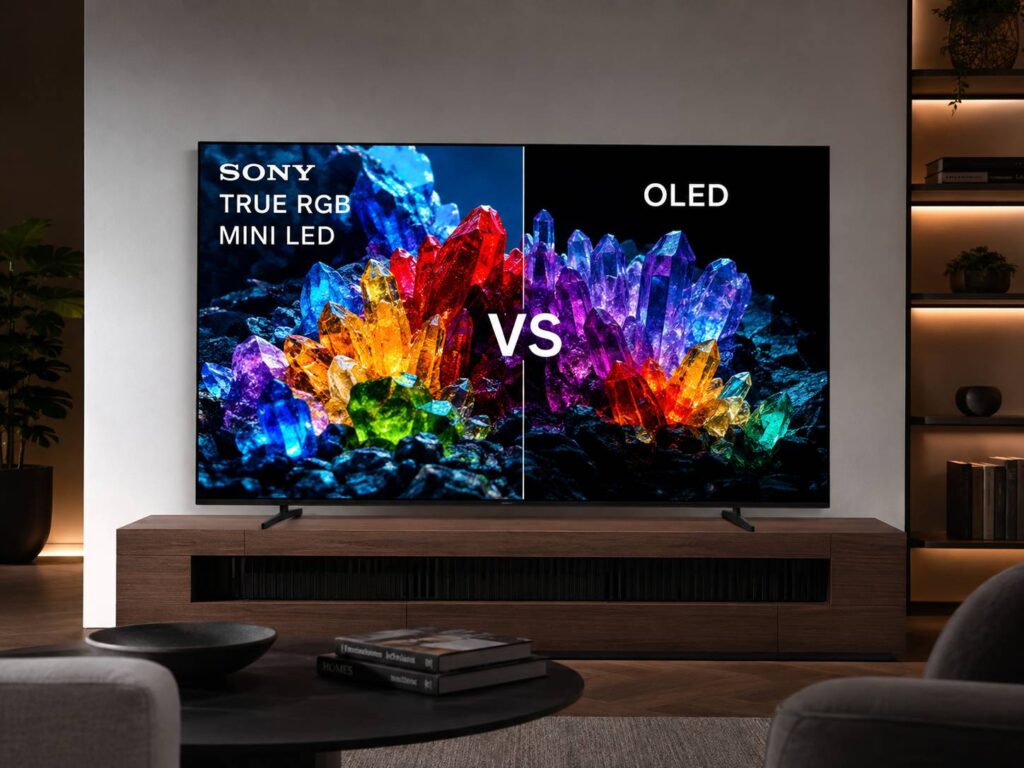
OLED has shaped the premium TV market for years. Perfect blacks, excellent contrast, and pixel-level lighting control have made it a favorite for movies and high-end home theaters. But Sony now has a new display technology that gives OLED a much tougher rival.
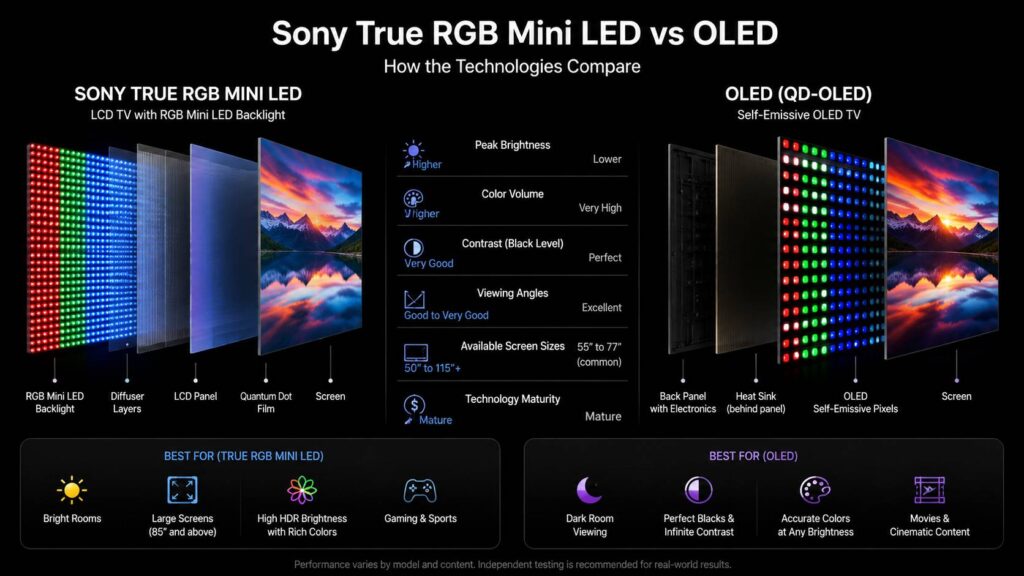
Sony True RGB Mini LED uses separate red, green, and blue LEDs behind an LCD panel. Each color can be controlled independently. So the backlight does more than brighten the picture. It plays a direct role in producing color.
The technology first appeared as a next-generation Sony display system in 2025. Then, in 2026, Sony brought it to consumer TVs through the BRAVIA 9 II and BRAVIA 7 II.
That move matters. Sony is trying to combine the brightness of Mini LED with color performance that gets much closer to premium OLED and QD-OLED TVs.
What Is Sony True RGB Mini LED?
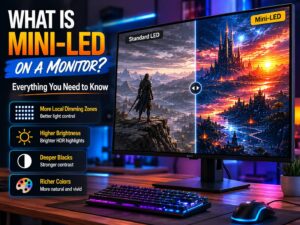
Traditional Mini LED TVs usually rely on blue LEDs behind the LCD panel. Quantum dots or other conversion layers then help produce the wider range of colors needed for HDR.
Sony True RGB takes a different path.
Its backlight contains separate red, green, and blue LEDs. Sony can control those colors individually through its RGB Backlight Master Drive Pro system. So the TV can adjust not only how much light reaches the screen, but which color of light it uses.
That gives Sony finer control over bright colors.
For example, a normal Mini LED TV may need to increase overall backlight intensity to create a bright red object. Sony True RGB can send more red light directly through the panel instead. As a result, the color has a better chance of staying rich at higher brightness levels.
The screen is still LCD-based. It does not become self-emissive like OLED. Yet the backlight works in a much more advanced way than the white or blue-heavy lighting systems found in most LED TVs.
Why True RGB Could Change the Mini LED Debate
Peak brightness gets plenty of attention in TV marketing. Still, brightness alone does not tell you how good an HDR image looks.
Color volume matters just as much.
Color volume measures how well a TV holds onto color saturation as brightness increases. Some displays can show rich colors at moderate brightness, then lose intensity near the top of their HDR range.
Sony designed True RGB to deal with that weakness.
Its development system reached more than 99% of DCI-P3 and around 90% of BT.2020. Those figures came from Sony’s display development work, not from every retail BRAVIA model. So they should not be treated as guaranteed measurements for the BRAVIA 9 II or BRAVIA 7 II.
Even so, the underlying idea is easy to understand. The TV can push red, green, and blue light independently instead of relying on one main backlight color.
For example, a bright blue sky can receive more blue light directly. A red neon sign can receive stronger red output. Then the LCD panel shapes that light into the final picture.
This is one reason Sony True RGB Mini LED has become such an interesting OLED competitor.
What About Sony’s 4,000-Nit Claim?
Sony attracted plenty of attention in 2025 after stating that its next-generation display system could exceed 4,000 cd/m² of peak brightness.
But that number needs context.
The figure referred to Sony’s display system under development. It was not a confirmed retail specification for every True RGB television.
So buyers should not assume that a BRAVIA 9 II automatically reaches more than 4,000 nits.
The same caution applies to other development figures. Retail brightness can change with screen size, picture mode, HDR content, power management, and panel design.
Still, the direction is clear. Sony built True RGB around very high brightness and high color saturation at the same time.
That combination is much more useful than chasing a large white-brightness number alone.
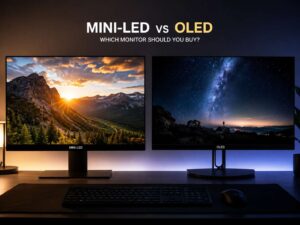
Sony True RGB Mini LED vs OLED
The real question is simple. Can Sony True RGB Mini LED beat OLED?
In some areas, it can make a strong case. In others, OLED still has a technical advantage.
OLED Still Wins at Pixel-Level Black Control
OLED creates light at the pixel level. Every pixel can switch itself off completely.
So a black pixel can sit directly beside a bright one without needing a large dimming zone. That gives OLED excellent control in dark scenes.
For example, a star field is a difficult image for a Mini LED television. Tiny points of light sit against a nearly black background. OLED can light those stars without illuminating the nearby pixels.
True RGB Mini LED still uses a backlight. So the TV relies on dimming zones rather than individual self-lit pixels.
Sony can make those zones very precise, but the basic limitation remains.
For dark-room movie watching, OLED still has a clear structural advantage.
True RGB Has More Room for Brightness
True RGB becomes more appealing in bright rooms.
OLED can produce strong HDR highlights, but LCD-based displays have more freedom to push sustained brightness across large parts of the screen.
So sports, daytime TV, nature documentaries, and bright HDR scenes can look especially impressive on high-end Mini LED sets.
Sony pairs True RGB with advanced luminance control on the BRAVIA 9 II. The goal is not just higher brightness. Sony wants that brightness to remain colorful and controlled.
That distinction matters.
A bright image that loses saturation can look washed out. A bright image with strong color volume looks far more convincing.
Bright Color May Be the Biggest Advantage
White peak brightness is easy to measure, so TV makers often promote it heavily.
Yet Sony True RGB may be more interesting for another reason.
It can create bright colors without leaning so heavily on white light.
For example, imagine a bright red sports car under sunlight. A conventional LED backlight may increase overall luminance, which can make the red look less saturated. True RGB can push more red light directly.
So the car can remain bright and strongly colored at the same time.
The same idea applies to sunsets, animation, concert lighting, neon signs, sports uniforms, and colorful video games.
This makes Sony True RGB Mini LED especially interesting for HDR content.
At the same time, QD-OLED remains very strong in wide-gamut color and black-level control. So the comparison is much closer than a simple LCD versus OLED argument.
Viewing Angles Are Better Than Older LCD TVs
OLED has long had another advantage. Its picture tends to remain more consistent when viewed from the side.
LCD TVs can lose contrast or shift color as viewers move away from the center.
Sony has worked to reduce that gap.
The BRAVIA 9 II uses X-Wide Angle Pro. The technology aims to maintain better color and contrast from wider seating positions.
That matters in larger living rooms.
For example, a family spread across a wide sofa may not sit directly in front of the screen. Better off-axis performance can make a large television much easier to enjoy from several seats.
Still, OLED keeps an inherent advantage here. Its self-emissive design does not rely on light passing through an LCD layer in the same way.
Large Screen Sizes Give True RGB Another Edge
Sony’s 2026 True RGB lineup reaches sizes that are difficult for OLED to match.
The BRAVIA 9 II is available in:
- 65 inches
- 75 inches
- 85 inches
- 115 inches
The BRAVIA 7 II is available in:
- 50 inches
- 55 inches
- 65 inches
- 75 inches
- 85 inches
- 98 inches
That 115-inch BRAVIA 9 II is especially interesting.
OLED is still common in 55-inch, 65-inch, 77-inch, and larger premium formats. But once buyers move into 98-inch and 115-inch territory, advanced LCD systems become much more practical.
So True RGB could appeal strongly to buyers building very large living rooms, media rooms, or home theaters.
BRAVIA 9 II vs BRAVIA 7 II
Sony uses True RGB in both the BRAVIA 9 II and BRAVIA 7 II, but the two ranges sit at different levels.
The BRAVIA 9 II is the flagship.
It combines RGB Backlight Master Drive Pro with Luminance Booster Pro, XR Contrast Booster 40, and Sony’s higher-end anti-reflection and wide-angle features.
The BRAVIA 7 II keeps the independent RGB backlight and RGB Backlight Master Drive Pro. But Sony pairs it with lower-tier brightness and contrast systems.
So both televisions use the same core backlight idea, but the BRAVIA 9 II pushes picture performance further.
This is similar to what happens across other display categories. The panel type tells only part of the story. Processing, brightness control, coatings, refresh behavior, and software can change the final experience. Readers interested in how those trade-offs appear in smaller display products can see another example in the BOOX Go 6 Gen II, where display choices shape usability in a very different product category.
Gaming Features Still Matter
Premium picture quality is only one part of a modern TV.
Sony’s 2026 True RGB models support key HDMI 2.1 gaming features, including 4K at 120Hz, VRR, and ALLM.
So they can pair well with current consoles and gaming PCs.
VRR helps reduce visible tearing when frame rates change. ALLM can switch the TV into a lower-latency mode during gaming. Meanwhile, 4K at 120Hz gives compatible games smoother motion than standard 60Hz playback.
Sony also keeps close integration with PlayStation 5.
Still, buyers should check the number of full-bandwidth HDMI ports before purchasing. That detail matters if you plan to connect several gaming devices, an AV receiver, and an eARC sound system at the same time.
Is Sony Abandoning OLED?
No.
Sony still sells premium OLED and QD-OLED televisions.
So True RGB is not replacing OLED across the entire BRAVIA lineup. Instead, Sony now has two high-end display paths.
OLED focuses on pixel-level blacks, dark-room contrast, and precise control around small bright objects.
True RGB focuses on high brightness, large screen sizes, strong HDR color, and advanced backlight control.
That makes Sony’s TV lineup more interesting. Buyers can choose the technology that fits their room and viewing habits rather than treating one display type as the automatic premium option.
What Should Buyers Compare in Real Tests?
Marketing terms can make any display sound impressive. So independent measurements remain important.
Look at more than peak brightness.
Useful comparisons should include:
- HDR peak brightness
- Sustained brightness
- Black level
- Local dimming performance
- Blooming around bright objects
- Shadow detail
- Color volume
- Reflection handling
- Viewing angles
- Motion clarity
- Gaming latency
- Power use
For example, a TV can hit a huge brightness number in a small test window but perform very differently across a bright full-screen scene.
Likewise, strong local dimming can matter more than raw brightness during dark movies.
So buyers should compare the whole picture rather than focus on one headline specification.
Is Sony True RGB Mini LED Better Than OLED?
Sony True RGB Mini LED does not make OLED obsolete.
OLED still has the advantage of individual self-lit pixels. So it remains difficult to beat for black levels and pinpoint contrast in a dark room.
True RGB offers a different set of strengths. It can push brightness higher, maintain stronger color at high luminance, and reach very large screen sizes.
So the better choice depends on how the television will be used.
A dark home theater still gives OLED plenty of reasons to shine. A bright living room, large screen setup, sports-heavy household, or HDR gaming setup may favor True RGB.
The bigger story is that premium LCD technology has changed.
Sony True RGB Mini LED is not just another brighter Mini LED television. It changes how the backlight creates color, and that gives Sony a stronger answer to OLED than traditional LCD TVs could offer.
For 2026, that makes Sony True RGB one of the most interesting display technologies to watch.