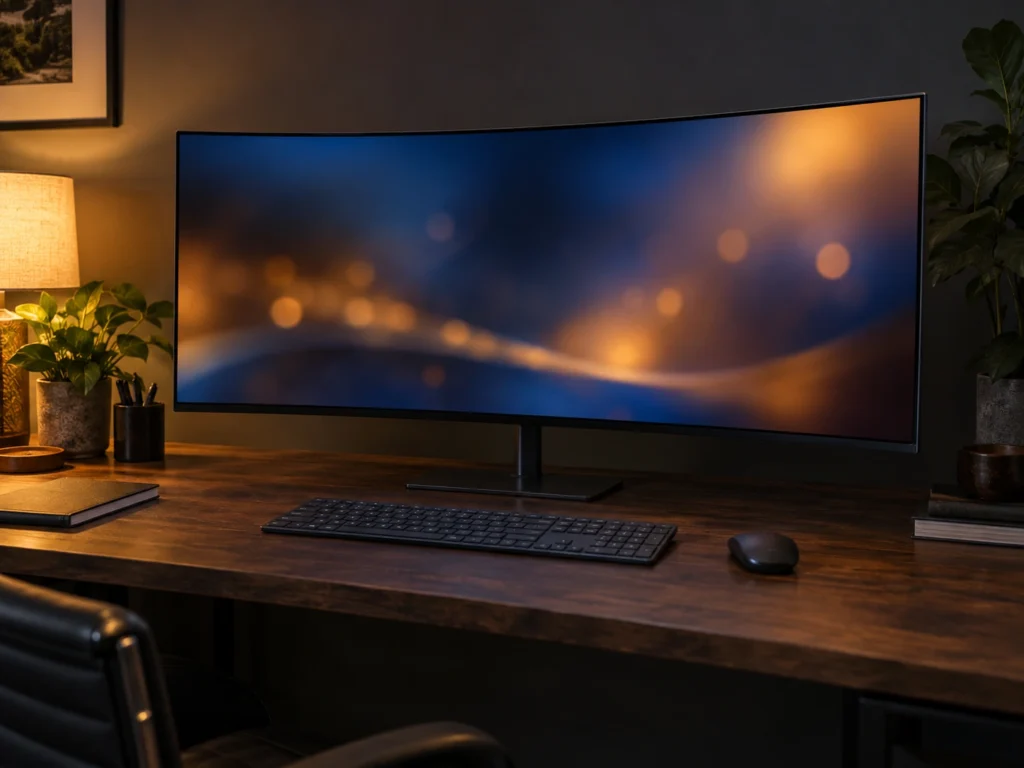
Samsung unveiled the Odyssey OLED G7, model G75SJ, on 27 August 2026 at Gamescom in Cologne, and called it the world’s first 42-inch 16:9 curved OLED gaming monitor. The company put it on stage again during IFA week in Berlin. The specification list is short and clear: 1000R curvature, 4K resolution, a 165 Hz refresh rate and a 0.03 ms grey-to-grey response time. What that list does not tell you is how a 42-inch curved OLED monitor behaves on a normal desk, which is where the interesting arithmetic lives. This article works through the pixel density, the screen area, the curve radius and the one specification that looks out of place.
What Samsung announced, and what it left out
The 2027 Odyssey range has four models. The Odyssey OLED G9 is a 49-inch Dual QHD screen at 360 Hz. The Odyssey OLED G8 is a 32-inch 4K panel with three switchable modes, topping out at 360 Hz in 4K, 520 Hz in QHD and 680 Hz in Full HD. The Odyssey G6 is a 27-inch Fast IPS model that reaches 1,100 Hz in HD. The G7 sits apart from all of them.
Samsung named the panel technology for the G9 and the G8 in its announcement, describing both as fifth-generation QD-OLED with a five-layer Penta Tandem structure and an RGB stripe subpixel layout. It did not state the panel type for the G7. I cannot confirm what panel the G7 uses. Samsung also said pricing and launch timing will follow later, and it did not publish the port list.
The pixel density nobody quotes
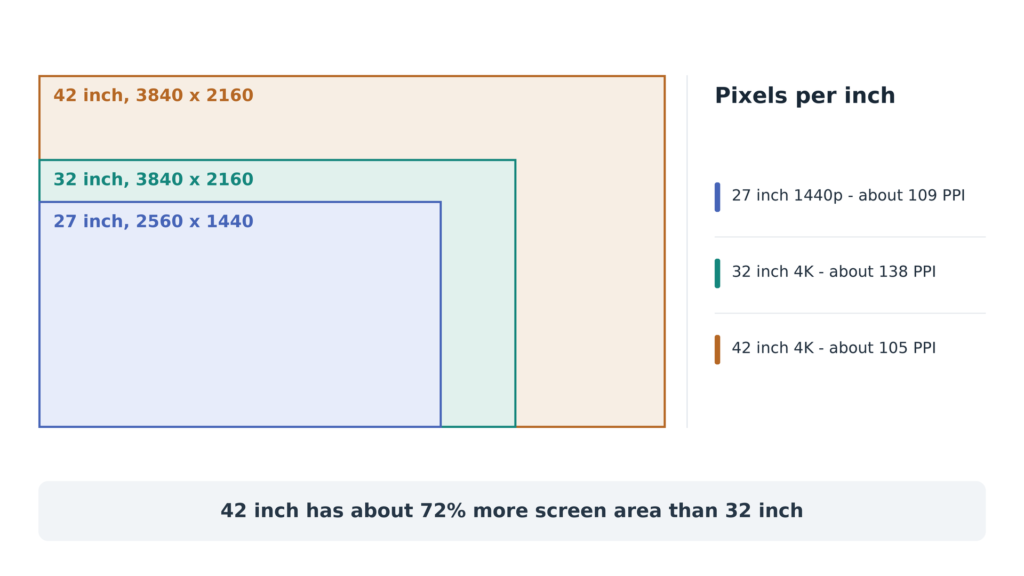
Pixel density follows from the resolution and the diagonal. A 4K panel has 3,840 by 2,160 pixels, so the diagonal measures the square root of 3,840 squared plus 2,160 squared, which is about 4,406 pixels. Divide that by the screen diagonal in inches and you get pixels per inch.
At 42 inches, that works out at roughly 105 PPI. A 32-inch 4K screen gives about 138 PPI, and a 27-inch 4K screen about 163 PPI. Here is the part worth pausing on. A common 27-inch 1440p monitor sits at about 109 PPI, so this 42-inch 4K panel is slightly coarser than the 1440p screen many people already own. The resolution is high, but the pixels are spread thin.
That is not a flaw so much as a trade. You gain area and lose sharpness per unit of area, and how you feel about it depends on how close you sit.
Checking the 72 percent claim
Samsung says the G7 offers approximately 72 percent more screen area than the previous 32-inch model. For screens with the same aspect ratio, area scales with the square of the diagonal. So 42 divided by 32 gives 1.3125, and squaring that gives 1.72. The claim holds.
To picture it, a 42-inch 16:9 screen measures about 93 cm wide and 52 cm tall. Compare that with a 32-inch 4K panel such as the Samsung Odyssey OLED G80SD, which is the model class the 72 percent figure refers back to, and you are adding most of a laptop screen to each side.
What 1000R means when you sit down
Curvature is quoted as a radius. A 1000R screen is a slice of a circle with a 1,000 mm radius, so the ideal viewing point sits about one metre from the panel. At that distance every part of the screen is roughly the same distance from your eyes, which is the whole point of curving it.
Most people sit closer than a metre to a desk monitor, often between 60 and 80 cm. At 42 inches you will want to push back, and a 93 cm wide screen at 70 cm away fills roughly 67 degrees of your horizontal field of view. That is cinema territory rather than spreadsheet territory. Measure your desk depth before you consider one, because a shallow desk makes the size unusable rather than immersive.
Why the biggest screen is the slowest
The rest of the 2027 Odyssey range starts at 360 Hz. The G7 stops at 165 Hz, and that gap is the most revealing number in the announcement. Driving 4K at high frame rates is expensive in both graphics hardware and panel engineering, and 42-inch OLED panels have historically come from television production rather than monitor production.
Still, 165 Hz is not a weakness for the games this screen targets. Open-world and role-playing titles at native 4K rarely reach 165 frames per second on current hardware anyway. A competitive shooter player is better served by the 27-inch or 32-inch models, and Samsung has clearly designed the range that way.
Who this size actually suits
Buy into 42 inches if you play cinematic games from a distance, if your desk is deep, and if you accept about 105 PPI for text. Console players sitting further back get the most from it, because the curve and the size both reward distance.
Avoid it if you edit documents all day, if you sit close, or if you expect the sharpness of a 27-inch 4K panel. Two 27-inch screens usually beat one 42-inch screen for productivity, and they cost less.
Should you wait for it
There is no price and no launch date yet, so nobody can judge the value. What we can judge is the fit. The numbers above do not change when the price appears, and they are the ones that decide whether this screen works at your desk.
Measure the depth of your desk first. Then decide whether you want area or sharpness, because at this size you cannot have both.