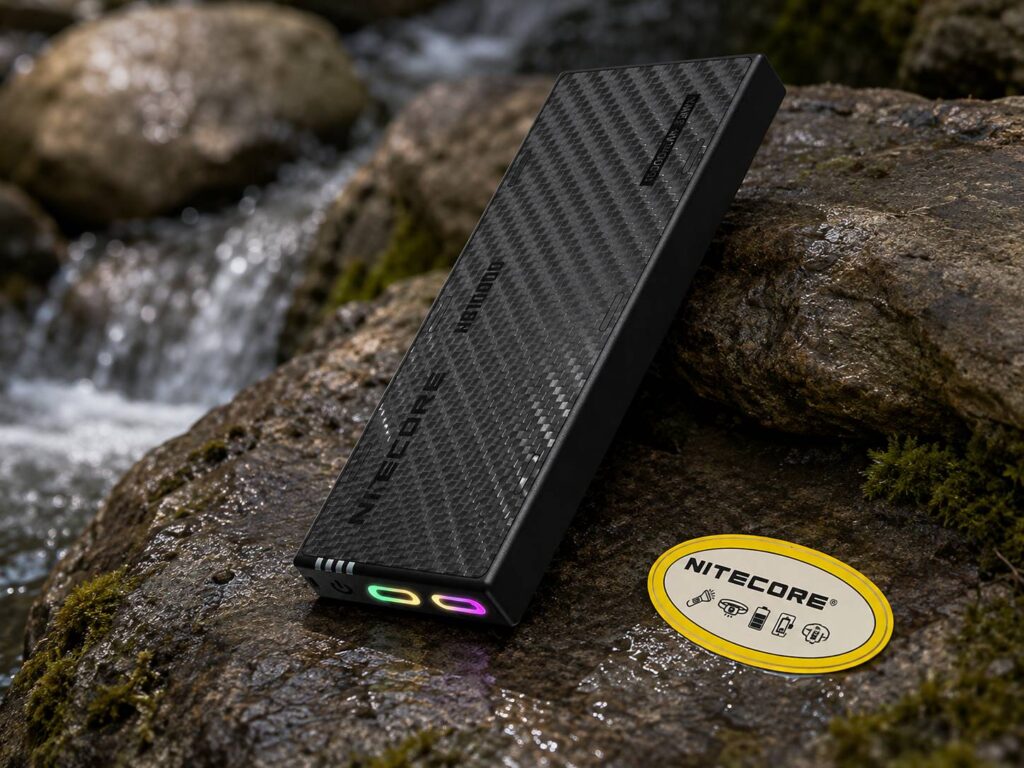
The Nitecore NB10000 Gen4 takes the lightweight power bank formula that made the NB series popular and gives it several useful upgrades for 2026. It still sits in the 10,000mAh class, but Nitecore has trimmed the weight to just 143 grams. At the same time, the company has added faster input charging, stronger water protection, two USB-C ports, and a few clever features aimed at outdoor users.
That combination makes the NB10000 Gen4 particularly interesting for hiking, trail running, cycling, camping, and travel. Still, you do not need to spend weekends in the mountains to appreciate it. Its low weight and compact shape can work just as well in a laptop bag, camera bag, sling, or everyday backpack.
More importantly, Nitecore has not chased extreme charging power with this generation. Instead, the NB10000 Gen4 focuses on portability, practical charging speeds, and resistance to outdoor conditions.
So, what has changed with the new model, and where does it make the most sense?
Nitecore NB10000 Gen4 specifications
The NB10000 Gen4 uses a battery rated at 5,000mAh at 7.8V, or 39Wh. Nitecore presents this as the equivalent of 10,000mAh at 3.9V.
Its rated output capacity reaches 6,800mAh at 5V and 3A, or 7,200mAh at 5V and 1A.
Here are the main specifications:
- Battery capacity: 10,000mAh equivalent at 3.9V
- Battery energy: 39Wh
- Rated output capacity: 6,800mAh at 5V/3A or 7,200mAh at 5V/1A
- Maximum input: 22.5W
- Maximum single-port output: 22.5W
- Dual-port total output: 15W
- Ports: 2 x USB-C
- Battery type: lithium-ion
- Dimensions: 116 x 46.8 x 14.5mm
- Weight: 143g, excluding accessories
- Water resistance: IPX7
- Included accessory: lanyard charging cable
Both USB-C ports support output. Meanwhile, the charging profiles include 5V/3A, 9V/2.22A, and 12V/1.87A.
There is one detail worth keeping in mind. A single port can provide up to 22.5W, but using both ports reduces the combined output to 15W. So, two devices can charge at once, but neither setup turns the NB10000 Gen4 into a high-powered multi-device charger.
The 143g weight is the real headline feature
Charging speeds tend to get most of the attention with new power banks. Yet the 143g weight is probably the most interesting part of the NB10000 Gen4.
Plenty of 10,000mAh power banks now support USB-C fast charging. By comparison, far fewer target people who count every gram inside a running vest or hiking pack.
For context, Nitecore lists the NB10000 Gen3 at 150g. The Gen4 cuts that down to 143g.
Seven grams will not change much inside a commuter backpack. On the trail, though, lightweight equipment adds up quickly. A lighter battery, smaller flashlight, compact cable, and trimmed first-aid kit can collectively remove a noticeable amount of weight.
The shape has changed too.
The NB10000 Gen3 measures 122 x 59.2 x 10.6mm. The Gen4 measures 116 x 46.8 x 14.5mm.
As a result, the new model is shorter and much narrower, but slightly thicker. That shape looks particularly well suited to narrow trail-running vest pockets and compact organizer compartments.
In my view, the narrower design makes more sense for an outdoor battery than copying the wide, flat shape of a smartphone.
22.5W USB-C charging covers most portable gear
The Nitecore NB10000 Gen4 supports up to 22.5W input and 22.5W output.
That puts it in a comfortable range for phones, GPS devices, wireless earbuds, action cameras, bike computers, compact lights, and other portable electronics.
For instance, charging a phone at around 20W is a major improvement over relying on an old 5W adapter. At the same time, 22.5W does not place the NB10000 Gen4 in the same category as larger 65W or 100W laptop power banks.
That distinction matters.
Some phones can accept far more than 22.5W under the right conditions. Still, maximum phone charging speed depends on the charging protocol, voltage profile, cable, battery temperature, and the phone itself.
So, the 22.5W figure should be viewed as the power bank’s maximum supported output rather than a guaranteed charging speed for every device.
For buyers comparing charging standards and wattage figures, our fast charging power bank buying guide for 2026 explains what the numbers mean and which specifications matter most.
Two USB-C ports make more sense now
Nitecore gives the NB10000 Gen4 two USB-C connections.
That choice feels right for a 2026 power bank. Phones, headphones, flashlights, cameras, handheld gaming devices, GPS units, and many other accessories have moved toward USB-C.
As a result, one USB-C cable can now cover much more of a travel kit than it did a few years ago.
For example, you can charge your phone during the day, then use the same cable for a headlamp or camera later.
The two-port design gives you more flexibility too. You can connect two devices at the same time when needed.
Still, there is a compromise. Dual-port output drops to a combined 15W, so charging two devices will be slower than charging one.
There is no USB-A port either. That is unlikely to bother people with newer electronics, but owners of older cables and accessories may need an adapter.
IPX7 protection is a useful Gen4 upgrade
One of the biggest practical changes is the move to IPX7 water resistance.
The previous NB10000 Gen3 carried an IPX5 rating. The Gen4 steps up to IPX7.
That upgrade fits the intended audience very well.
A trail runner can get caught in heavy rain. A hiker can leave a backpack open for a few seconds at the wrong time. A cyclist can spend hours riding through spray and changing weather.
For those users, better water protection is more valuable than another decorative feature.
Still, an IP rating should not be treated as permission to abuse the power bank. Water resistance is tested under defined conditions. Physical damage, heat, salt water, wear, and other factors can affect protection.
For normal outdoor use, though, IPX7 gives the Gen4 a clear advantage over the previous generation.
Knock to Wake makes battery checks easier
The NB10000 Gen4 features Knock to Wake, paired with battery indicators and RGB positioning lights.
The concept is simple. Instead of searching for a small button, you can wake the battery indicator through physical interaction with the unit.
That sounds minor at home. Out on a trail, it becomes more useful.
For instance, checking battery status with cold fingers or gloves can be annoying when a power bank uses tiny controls. The Gen4 tries to reduce that friction.
The RGB positioning lights serve a related purpose. They make the unit easier to locate in dark surroundings.
Personally, RGB lighting would not influence my decision to buy a power bank. In this case, though, the lighting has a practical role rather than existing purely for decoration.
The lanyard charging cable is surprisingly useful
Nitecore includes a lanyard charging cable with the NB10000 Gen4.
That is a small but clever idea.
Outdoor users often try to reduce the number of loose items in a pack. A cable that doubles as a carrying accessory cuts down on clutter and gives the included accessory a second job.
Trail runners are likely to appreciate the idea most. Every separate cable or adapter becomes another small item that can disappear inside a packed vest.
Travelers can benefit too. A compact charging setup is easier to manage at airports, hotels, and during day trips.
For everyday office use, the feature matters less. Still, it fits the overall design of the NB10000 Gen4 nicely.
Nitecore NB10000 Gen4 vs NB10000 Gen3
The Gen4 does not completely replace the ideas behind the Gen3. Instead, Nitecore has refined the formula.
Both models offer a 10,000mAh-class battery, dual USB-C ports, and up to 22.5W output.
The differences become clearer once you compare the details.
| Feature | Nitecore NB10000 Gen4 | Nitecore NB10000 Gen3 |
|---|---|---|
| Capacity | 10,000mAh equivalent | 10,000mAh |
| Battery energy | 39Wh | 38.5Wh |
| Weight | 143g | 150g |
| Maximum input | 22.5W | 18W |
| Maximum output | 22.5W | 22.5W |
| Ports | 2 x USB-C | 2 x USB-C |
| Water resistance | IPX7 | IPX5 |
| Dimensions | 116 x 46.8 x 14.5mm | 122 x 59.2 x 10.6mm |
The change from IPX5 to IPX7 stands out immediately.
At the same time, faster 22.5W input means the Gen4 can recharge itself faster with suitable charging hardware. The lower weight and narrower design further strengthen its outdoor focus.
So, owners of the Gen3 do not suddenly have an obsolete power bank. The Gen4 simply improves several areas that matter to people buying one today.
How much usable capacity do you actually get?
A 10,000mAh label does not mean a power bank will transfer exactly 10,000mAh into your phone.
This causes plenty of confusion.
The battery cells inside a power bank operate at a different voltage from the USB output. Power conversion creates losses too.
Nitecore helps by providing rated output figures.
The NB10000 Gen4 is rated for:
- 6,800mAh at 5V/3A
- 7,200mAh at 5V/1A
So, dividing 10,000mAh by your phone’s battery capacity will not tell you exactly how many full charges you will get.
For example, a phone with a 5,000mAh battery will not necessarily receive two complete 0 to 100 percent charges from the NB10000 Gen4.
Real charging performance changes with the phone, cable, charging speed, temperature, conversion losses, and how much power the phone uses during charging.
This is normal behavior for power banks, not a problem unique to Nitecore.
Can the NB10000 Gen4 charge a laptop?
Technically, compatibility depends on the laptop. In practical terms, the NB10000 Gen4 is not designed as a laptop power bank.
Its maximum 22.5W output sits far below what many modern laptops expect from a USB-C charger.
Some low-power devices can accept lower wattage, but charging may be slow or unavailable.
For that reason, anyone shopping mainly for laptop charging should look at a higher-output power bank with USB-C Power Delivery and enough capacity for laptop-sized batteries.
The Nitecore makes much more sense for phones, cameras, lights, GPS devices, earbuds, and other smaller electronics.
Is 10,000mAh enough for hiking and travel?
For day trips and shorter outdoor activities, 10,000mAh strikes a useful balance between battery reserve and weight.
A larger 20,000mAh power bank gives you more energy, of course. Yet it normally weighs considerably more.
That creates a simple tradeoff.
If you need several days of power away from an outlet, extra capacity can matter more than weight.
For a long day hike, marathon event, cycling trip, flight, or weekend where charging opportunities still exist, a lighter 10,000mAh model can make more sense.
This is exactly where the NB10000 Gen4 fits.
It gives you useful reserve power without turning the battery into one of the heaviest items in your bag.
Who is the Nitecore NB10000 Gen4 for?
The NB10000 Gen4 makes the most sense for people who place a high value on low weight.
Good use cases include:
- Trail running
- Hiking and trekking
- Cycling
- Camping
- Air travel
- Backpacking
- GPS and navigation devices
- Action cameras
- USB-C headlamps
- Smartphones
- Wireless earbuds
- Compact camera equipment
It can serve as an everyday phone charger too.
Still, commuters who do not care about weight have many more options. Some competing power banks offer higher wattage, built-in cables, displays, wireless charging, or larger capacities.
The Nitecore’s appeal is more focused. It packs useful capacity and charging power into a particularly light body.

What makes the NB10000 Gen4 interesting in 2026?
The Nitecore NB10000 Gen4 does not try to win a specification battle with enormous capacity or 100W charging.
Instead, it combines a 39Wh battery, 22.5W USB-C charging, dual USB-C ports, IPX7 water resistance, and a 143g body.
Then Nitecore adds smaller touches such as Knock to Wake, positioning lights, and the lanyard charging cable.
That combination gives the Gen4 a clear identity.
Plenty of power banks offer more charging power. Others provide double the capacity. Some will cost less.
The NB10000 Gen4 stands out by keeping weight low without dropping the features most phone, travel, and outdoor users need.
For a trail runner, cyclist, hiker, or light-packing traveler, that balance is likely more useful than carrying a much larger battery simply for the sake of having extra capacity.
The Gen4 is less compelling for laptop users or people who spend several days away from electricity. In those cases, a larger 20,000mAh or higher-output model makes more sense.
For portable outdoor gear, though, the NB10000 Gen4 gets many of the basics right. It is small, unusually light for its capacity class, USB-C focused, and better protected against water than the model it replaces.