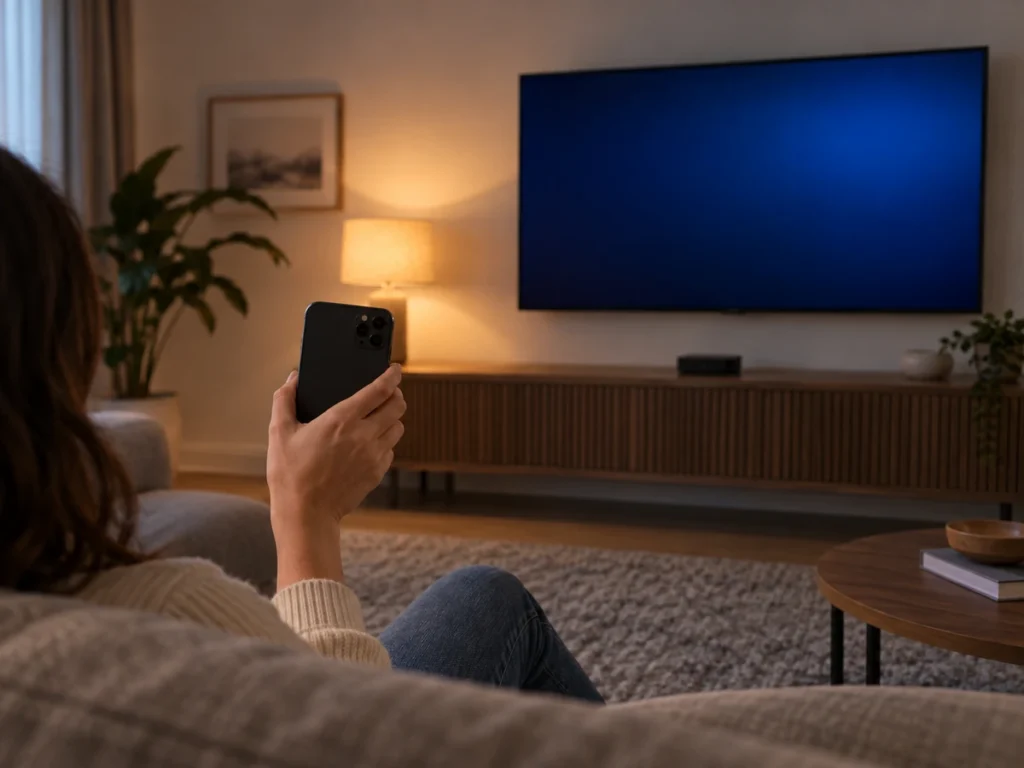
You open Disney+ on your phone, tap the cast button out of habit, and it is gone. Not grayed out. Gone, replaced by a message saying the feature is not available in your country. Nothing is wrong with your router, your TV or your phone. A court took the feature away. In early September 2026 Disney+ switched off Google Cast in Germany and the Netherlands, and by mid-September it was disabling AirPlay 2 in the same two markets. This is the clearest example yet of a feature you pay for disappearing because of a patent ruling, and it is worth understanding how it works before it happens to something you own.
What happened, and when
The Düsseldorf local division of the Unified Patent Court ruled on September 2, 2026 in cases UPC_CFI_297/2025 and UPC_CFI_651/2025. At issue is European patent EP 2 080 349, held by InterDigital, which covers a technique for viewing or transferring media between devices. The court found that Disney used the technology without a license and granted an injunction.
Disney chose removal over a license. Google Cast went first, in the opening days of September. Reporting on September 15, 2026 confirmed that AirPlay 2 was being disabled as well, based on code found in the app. The court’s order covers Disney+ web streaming through a Chrome browser as well as the Disney+ app on Android, iOS, Windows and macOS.
For scale, InterDigital’s chief legal officer, Josh Schmidt, told Bloomberg that the company has obtained eight injunctions against Disney in a dispute that began in February 2025.
Why a court can switch off a feature you already paid for
People assume a subscription is a contract about content. Mostly it is, and the content is still there. What a patent injunction targets is the method, not the movie. If a court decides that the way an app moves video from a handset to a screen infringes a valid patent, the company has three options: pay for a license, engineer around the patent, or stop doing it in that territory.
Turning the feature off is the fastest of the three and costs nothing up front. So that is usually what happens first, while appeals and licensing talks run in the background. Disney retains the right to appeal, and it has not said how long the restriction will last.
Subscribers lost casting on September 2 without any change to the subscription price.
Casting versus screen mirroring
Casting is not screen mirroring, and the difference explains why some things broke and others did not.
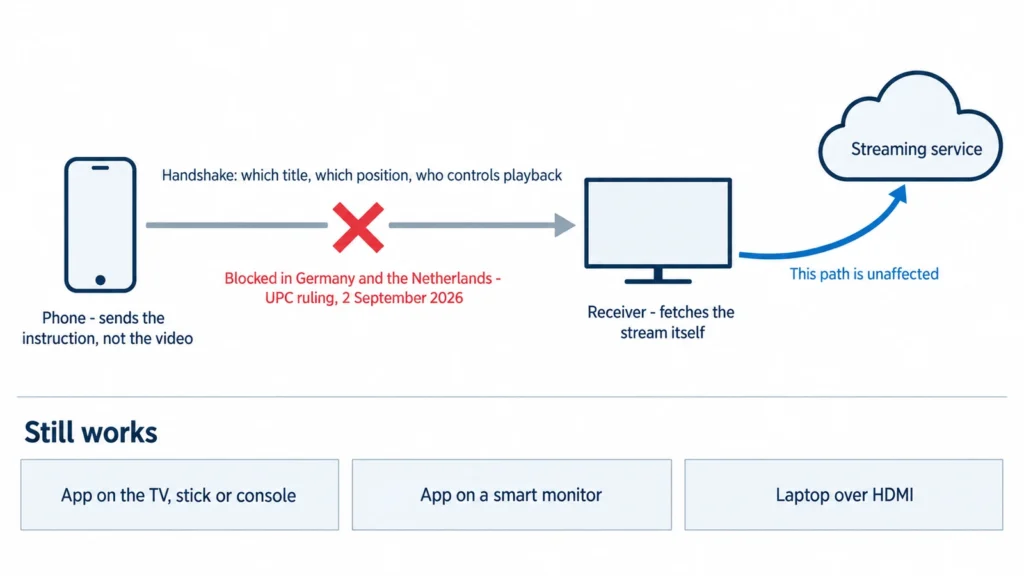
When you cast with Google Cast or AirPlay 2, your phone does not send the video. It sends an instruction. The receiver, whether that is a Chromecast, a TV with Cast built in or an Apple TV, fetches the stream itself and your phone becomes a remote control. That handshake, the part where one device tells another what to play and then hands over control, is the territory the patent covers.
Screen mirroring is different. It copies whatever your display is showing, pixel for pixel, and sends it as a video stream. It is cruder, it drains your battery, and streaming apps usually block it outright with digital rights management. So mirroring is not a workaround here.
What still works
Plenty. Apps running natively on the television or display are untouched. Open Disney+ from the app on a smart TV, a streaming stick, a games console or a smart monitor and it plays exactly as before. The injunction hit only the phone-to-screen handoff.
That distinction matters at a desk as much as on a sofa. A display that runs streaming apps on its own hardware, like the LG Smart Monitor AI U7s with its built-in webOS app layer and remote, never needed the phone in the chain to begin with. Wired output still works too. An HDMI cable from a laptop is not a patented transfer method.
Disney has not published a support notice about any of this. Its US and UK help pages still describe Chromecast and AirPlay as supported ways to watch, with only the standard caveat that video and audio quality may vary. Subscribers in the affected countries found out from an error message.
The same dispute already took 4K and HDR
This is not the first feature InterDigital has pulled out of Disney+ in Europe. Earlier rulings in the same long-running fight cost Disney+ 4K, HDR10, Dolby Vision and 3D across large parts of the EU. Some 4K came back after Disney changed the video compression format it uses, which is the engineer-around option in practice. Reporting indicates the dispute is now expanding to target that replacement as well.
So the pattern is established. A ruling lands, a feature goes, Disney rebuilds it a different way, and the rebuilt version gets challenged in turn.
Could it spread beyond two countries?
Possibly, and nobody can say with confidence. The Unified Patent Court covers participating EU member states, and its rulings can reach well beyond one national market. The earlier HDR and 4K injunctions already affected around eleven European countries. Whether the casting injunction expands depends on further filings and on whether Disney and InterDigital settle.
The United States is a separate legal system with separate patents, and there is no indication of a US casting restriction. No such removal has been reported, and Disney has published nothing suggesting one.
When casting stops working
Check the obvious first, because most broken casting is still ordinary broken casting. Both devices must sit on the same network and the same subnet, guest networks and client isolation break discovery, and 5 GHz and 2.4 GHz bands sometimes do not see each other on cheap routers. If casting works from YouTube and fails only from Disney+, the network is fine and the app is the problem.
After that the options are plain. Use the Disney+ app built into your TV, stick or console. Connect a laptop with HDMI. Or, if this changed the value of your subscription, say so in writing when you cancel, because a support ticket citing a removed feature is the only signal that reaches anyone.
Subscriptions that behave like licenses
Streaming subscriptions are sold as products and behave like licenses. Firmware and app updates can take features away as easily as they add them, and the reason is often invisible to the person paying. A court in Düsseldorf changed what a Disney+ subscriber in Rotterdam can do with their phone, and neither party sent that subscriber a message.
The practical defense is boring and it works: prefer setups where the app runs on the screen itself, keep a wired option available, and treat any feature that depends on a handshake between two companies as something that can be revoked. Nothing here suggests you should avoid casting. It does suggest you should not build your living room around it.