AOC’s spec sheet for the AGON PRO AGP257FT gives two gray-to-gray response times for one panel: 0.3 ms in the headline row and 1 ms further down, labeled “OD response (typical)”. At 1000 Hz a new frame arrives every millisecond, so the second figure decides whether a pixel finishes changing before the next frame lands. The AOC AGP257FT is a 24.5-inch Full HD IPS monitor that runs 1000 Hz natively and 1050 Hz overclocked. AOC announced it at the end of September for a European release in the first quarter of 2027, with no price yet.
Four speed figures on one page
AOC puts four numbers for speed on the product page. The marketing line and the MPRT row both say 0.1 ms, and the table also holds the two GtG figures, the typical one measured with overdrive on.
They measure different things. MPRT (moving picture response time) describes how long an image stays visible, and a backlight that flashes in short bursts can push it far below the time the liquid crystal needs to change. That is where the headline number comes from. It relies on AOC’s Motion Blur Reduction Plus, which lights the backlight zone by zone in sequence. GtG is the liquid crystal itself.
That leaves two GtG figures. AOC does not say which transitions either one covers. Our reading, and it is an interpretation, is that the lower one is the panel’s fastest transition and the typical one the average across the set AOC measured.
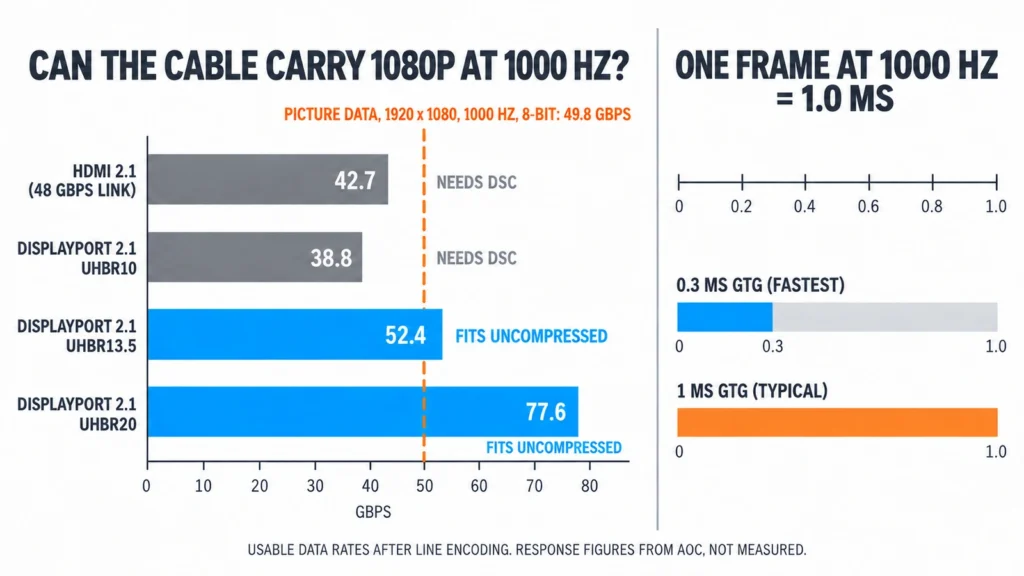
Either way, a frame at 1000 Hz lasts 1.0 ms, and at the overclock about 0.95 ms. A pixel that needs the typical millisecond spends the whole frame in transit, which shows as a faint trail behind moving targets. A pixel that settles at the faster figure is finished with more than two thirds of the frame to spare.
We have no independent measurement of this panel yet. Until a reviewer publishes transition times taken at 1000 Hz, the two lines on AOC’s sheet bracket what it will do.
Which input carries 1000 Hz
The AGP257FT has two HDMI 2.1 ports and one DisplayPort 2.1. AOC’s announcement says both reach 1000 Hz, and its spec table gives 48 to 1000 Hz for HDMI and DisplayPort alike. Neither says which DisplayPort speed tier the monitor uses, or whether it relies on Display Stream Compression (DSC), the visually lossless compression most fast monitors use to squeeze through a cable.
The arithmetic narrows it down. Full HD is 2,073,600 pixels. Sent 1,000 times a second at 24 bits per pixel, the 8-bit color this panel shows, that is about 49.8 Gbps of picture data, before the timing overhead every video signal also carries.
HDMI 2.1 at its fastest moves 48 Gbps on the wire and about 42.7 Gbps of usable data once encoding is taken out. That is short of the picture alone, so 1000 Hz over HDMI would need DSC or reduced color detail. DisplayPort 2.1 comes in tiers. UHBR10 carries about 38.8 Gbps of data, UHBR13.5 about 52.4 Gbps and UHBR20 about 77.6 Gbps. Only the top two fit the uncompressed signal, and UHBR13.5 has little room left over.
So plan on DisplayPort. LG writes that requirement down for its own 1000 Hz panel. AOC so far does not.
Against the LG UltraGear 25G590B-B
The monitor the AGP257FT will be judged against is the LG UltraGear 25G590B-B, the first to run 1000 Hz at native 1080p. On paper they are close.
| AOC AGP257FT | LG UltraGear 25G590B-B | |
|---|---|---|
| Native / overclocked refresh | 1000 Hz / 1050 Hz | 1000 Hz / 1100 Hz |
| GtG response (maker) | 0.3 ms, 1 ms typical | 1 ms |
| Brightness | 450 cd/m² | 400 cd/m² |
| Local dimming | 20 zones | none listed |
| Video inputs | 2x HDMI 2.1, DisplayPort 2.1 | 2x HDMI 2.1, DisplayPort 2.1 (UHBR20) |
| Stand | height, tilt, swivel, pivot | height, tilt, swivel |
| Price | not announced | $999.99 |
LG publishes a single GtG figure, the same millisecond AOC calls typical, so the two panels may be closer on motion than the headline rows suggest. AOC adds a USB hub with three ports and a stand that turns to portrait, which LG’s does not.
Twenty dimming zones on a 24.5-inch screen are coarse, and DisplayHDR 400 on both is an entry badge, so neither is an HDR monitor in any useful sense.
LG also states that its overclock switches off FreeSync Premium and that G-SYNC Compatible certification covers only the native rate. AOC has not said whether adaptive sync survives at 1050 Hz. Expect the same trade until it does.
Whether 1000 Hz is worth chasing at all, against 480 Hz or 720 Hz, is covered in our guide to 1000 Hz, 720 Hz and 480 Hz monitors.
When waiting for the AOC pays off
For now the AGP257FT is a spec sheet with a release quarter. Three things will decide whether to wait for it or order the LG: a European price, AOC naming its DisplayPort tier and DSC use, and a response time measured at 1000 Hz.
If independent tests put the typical transition well under a millisecond, the AOC is the faster panel and worth waiting for. If it lands near the typical figure, the two are level on motion and the choice comes down to price and the stand. LG says its panel needs DisplayPort 2.1 and a current graphics card for 1000 Hz. Until AOC publishes its own requirement, assume the same applies here.