
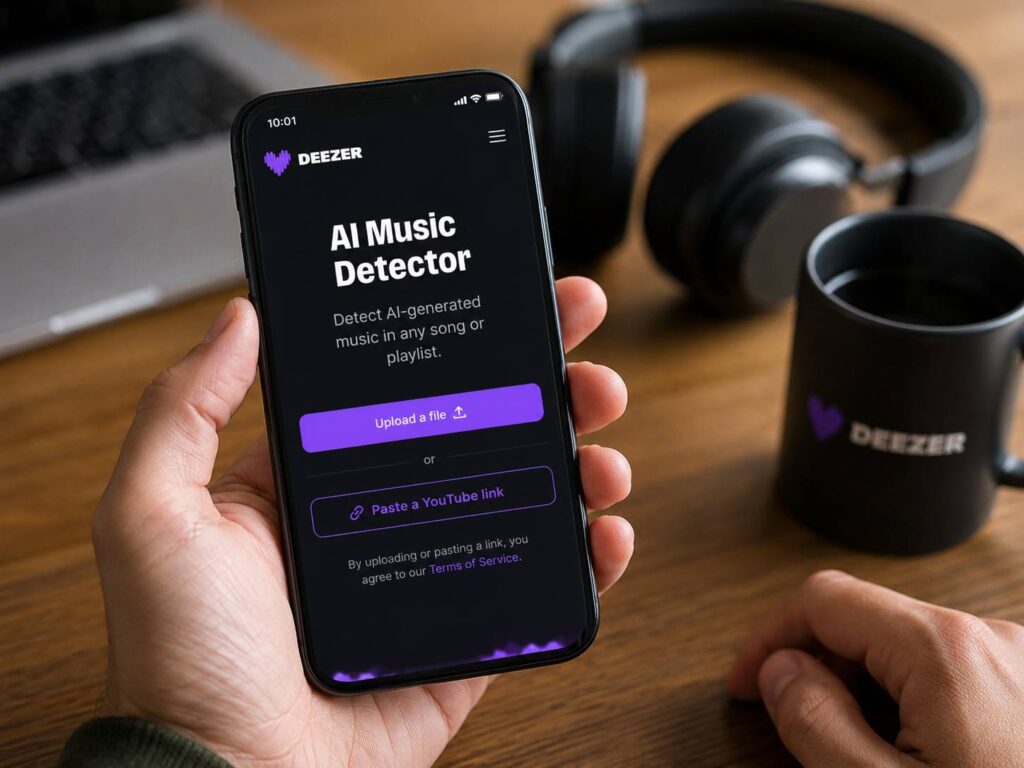
Deezer has made its AI Music Detector much more useful for everyday music fans. The tool can now scan playlists from other streaming platforms, not just Deezer. That means users can check playlists from services such as Spotify, Apple Music, YouTube Music, SoundCloud, and other major music apps.
For many listeners, this update comes at the right time. AI-generated songs are now a normal part of the streaming catalog. Some tracks are harmless experiments, and some are background music made at scale. Still, many users want to know what they are hearing.
So, Deezer’s new playlist scanner gives people a simple way to check. It helps listeners spot AI-generated tracks inside playlists they already use. It also puts more pressure on streaming platforms to be clearer about AI music labels.
What Deezer’s AI Music Detector Does
Deezer’s AI Music Detector checks playlists and flags tracks that appear to be fully AI-generated. The tool looks for audio patterns linked to generative music systems. Then, it shows users how much AI-made music appears in their playlists.
According to Deezer, the detector reaches 99.8% accuracy. The company also says its false positive rate sits below 0.01%. That means the tool should rarely flag a human-made song by mistake.
For now, users can scan up to 100 playlists. First, they select a streaming service. Next, they connect their account. Then, Deezer scans the playlist and gives a result.
That simple process matters. Most people do not want to upload tracks one by one or study audio files. They want a quick answer. Deezer now gives them that answer in a way that feels easy and direct.
Why AI Music Detection Matters Right Now
AI music is no longer a small side topic. Deezer says more than 75,000 AI-generated tracks now arrive on its platform every day. That is a huge amount of content for any music service to handle.
In fact, Deezer says AI tracks now make up around 44% of daily music uploads on its platform. That does not mean 44% of all music people hear is AI-made. It means uploads are filling up faster with synthetic tracks.
For this reason, playlist quality has become a real concern. AI-generated tracks can appear in mood playlists, sleep playlists, focus playlists, study mixes, and low-cost background music collections. A listener can add one track without noticing. Then, over time, more AI songs can slip into the same playlist.
So, a scanner like this helps users see the pattern. It does not force anyone to delete music. It simply gives clearer information.
How the New Playlist Scanner Works Across Other Platforms
The biggest change is cross-platform scanning. Deezer’s tool now checks playlists from other streaming services. That makes it more useful than a detector locked to one app.
For example, someone who mainly uses Spotify can still test a playlist through Deezer’s tool. A YouTube Music user can do the same. Apple Music users can check their own mixes too.
That matters for people with large music libraries. Many users have playlists built over several years. Some playlists hold hundreds or even thousands of songs. As AI music spreads, those playlists can change without the listener paying much attention.
Next, the tool gives users a clearer way to clean up playlists. If a playlist contains AI-generated songs, the user can decide what stays and what goes. Some people will not care. Others will want playlists made only by human artists.
Both choices are fair. The main point is transparency.
What This Means for Spotify, Apple Music, and YouTube Music Users
Deezer has taken a public stance on AI music. The company labels AI-generated tracks on its own service and removes them from algorithmic and editorial recommendations.
That puts Deezer in a different position from many larger rivals. Spotify, Apple Music, and YouTube Music serve huge audiences. Still, many users on those platforms do not get clear AI labels on every track.
So, Deezer’s scanner fills a gap. It gives users outside Deezer a way to check their own playlists. That is a smart move. It turns Deezer into a trust tool, not just another streaming app.
Plus, this feature may push bigger platforms to act faster. If users start asking how much AI music appears in their playlists, streaming services will need better answers.
Why Artists Should Care
Artists should care about this update too. AI-generated music can crowd streaming platforms at a speed human artists cannot match. A real band or solo artist needs time to write, record, mix, and release a song. An AI system can produce many tracks in a short time.
That creates a problem for discovery. Human artists already compete for attention in a crowded market. AI tracks can make that fight harder, mainly in playlists built for background listening.
For example, ambient music, lo-fi beats, sleep sounds, piano tracks, and focus music are easy targets for mass AI uploads. These genres often rely on mood rather than a known artist name. As a result, fake or low-effort releases can blend in fast.
Still, AI tools are not the enemy in every case. Some musicians use AI to test ideas, shape demos, or build sound textures. The problem starts when fully AI-generated tracks appear with no clear label.
For this reason, Deezer’s detector supports a better standard. It does not ban all AI use. It helps separate human-made music from fully synthetic tracks.
What This Means for Listeners
For listeners, the biggest benefit is control. Many people do not hate AI music. They hate feeling misled.
If someone chooses an AI ambient playlist, that is their choice. If someone follows a playlist built around real artists, they expect real artists. Deezer’s tool helps make that difference clearer.
The scanner can help in several common cases:
- Checking long Spotify playlists
- Cleaning up Apple Music libraries
- Reviewing YouTube Music mixes
- Testing sleep, focus, and workout playlists
- Checking royalty-free background music lists
- Reviewing playlists used for podcasts or videos
- Spotting AI tracks in new music discovery playlists
For people who care about sound quality and personal audio settings, playlist control is only one part of the listening experience. You can also tune how music sounds on your devices. For a related guide, read AirPods custom EQ in iOS 27.
Can Deezer’s Detector Make Mistakes?
No detection tool gets every track right. Deezer gives a very strong accuracy number, but users should still treat the result as a useful signal.
For example, a flagged track deserves a closer look. Check the artist page. Look at the release history. Read the credits. See if the artist has a real profile, social presence, and past work.
AI spam often shows common warning signs. The artist name can look generic. The album art can look bland. The same profile can publish many similar tracks in a short time. The song credits can be thin or missing.
So, the detector works best as a first check. It points users toward tracks that need review. Then, the listener can make the final choice.
Why This Update Could Shape Music Streaming
Playlist discovery drives modern music. Many people do not search for artists every day. They press play on a mood mix, workout playlist, sleep playlist, or daily recommendation.
That gives streaming platforms a lot of control. They decide what gets pushed, what gets labeled, and what gets paid. AI music makes those choices more sensitive.
Deezer’s update shows one possible path. Platforms can accept AI content but still label it clearly. They can remove AI-generated tracks from human-focused recommendations. They can block fake streams and protect artist payouts.
At the same time, users can run their own checks. That part matters. Trust should not sit only inside the platform. Listeners should have tools too.
AI Music Labels Should Become Standard
AI-generated music should carry clear labels across every major streaming service. That does not mean every AI-made track is bad. It means users deserve honest context.
Streaming apps already label explicit lyrics, remasters, podcasts, live recordings, and high-quality audio formats. AI music deserves the same clear treatment.
Deezer’s AI Music Detector is a useful step toward that future. It scans playlists from other platforms, shows users what it finds, and brings the AI music debate into a practical place.
For music fans, that is the real value. You do not need to guess. You can check your playlists and decide what belongs there.