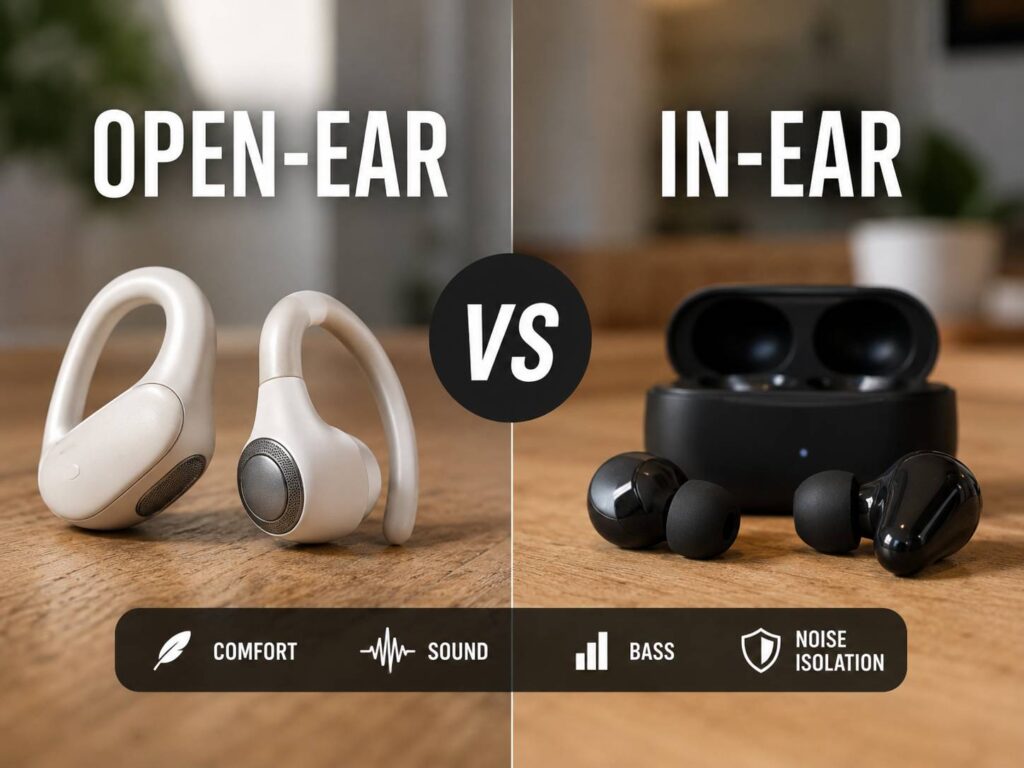
Wireless earbuds now come in two very different styles. Traditional in-ear earbuds sit inside the ear canal and usually use silicone tips. Open-ear earbuds sit outside the canal and play sound toward your ear without blocking it.
At first, that may sound like a small design change. But it affects almost everything, from comfort and bass to noise isolation and outdoor awareness.
So, which one is better?
For most people, the answer comes down to where and how they listen. In-ear earbuds are still the stronger choice for commuting, flights, deep bass, and noise cancellation. Open-ear earbuds, meanwhile, are often more comfortable for long sessions and make it much easier to hear what is happening around you.
This guide compares open-ear vs in-ear earbuds in the areas that matter most, including comfort, sound quality, bass, noise isolation, calls, exercise, office use, and everyday listening.
What Are Open-Ear Earbuds?
Open-ear earbuds leave your ear canal uncovered.
Instead of sealing the ear, the speaker sits just outside it. Some models use ear hooks, others use clip-style designs, and a few use open rings that sit around the ear opening.
The main goal is simple. You can listen to music or podcasts without shutting out the sounds around you.
For example, you can hear traffic during a walk, notice someone calling your name in the office, or listen for a child in another room.
That makes open-ear earbuds very practical for people who dislike the plugged feeling of traditional earbuds.
Still, open-ear earbuds are not the same as bone-conduction headphones. Most newer open-ear models use regular air-conduction drivers. They produce sound in the same basic way as normal speakers, but they place that sound close to your ear instead of inside the canal.
This setup often sounds fuller than older bone-conduction headphones. Yet it still has limits, mainly in bass and noise isolation.
What Are In-Ear Earbuds?
In-ear earbuds sit partly inside the ear canal.
Most models use silicone tips in several sizes. Once the correct tip is fitted, it creates a seal that blocks some outside noise and keeps more of the sound inside your ear.
That seal matters a lot.
First, it improves bass. Low frequencies stay more contained, so music sounds deeper and fuller.
Next, it helps with passive noise isolation. Even without active noise cancellation, a good ear tip can reduce background sound.
Then, premium models add ANC to reduce steady noises such as airplane engines, trains, air conditioning, and office hum.
So, in-ear earbuds have a clear advantage in noisy places.
The trade-off is comfort. Some people can wear them all day without a problem. Others start to feel pressure, warmth, itching, or soreness after an hour or two.
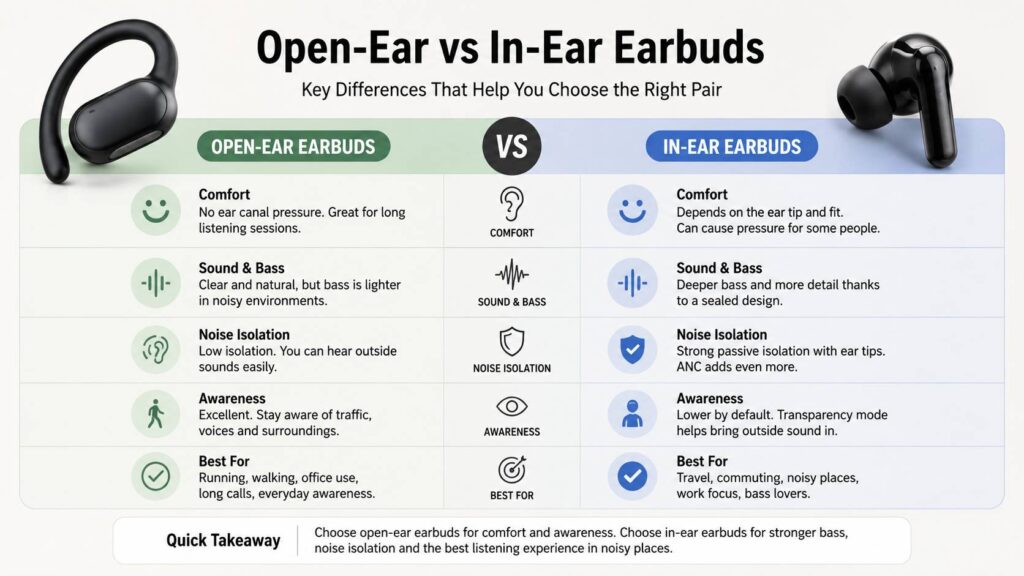
Open-Ear vs In-Ear Earbuds at a Glance
| Feature | Open-Ear Earbuds | In-Ear Earbuds |
|---|---|---|
| Long-session comfort | Often better | Depends on fit |
| Bass | Lighter | Usually stronger |
| Noise isolation | Low | Medium to high |
| ANC | Limited by open design | Usually much stronger |
| Awareness | Excellent | Lower without transparency mode |
| Outdoor use | Very good | Good |
| Flights and trains | Poorer fit | Better fit |
| Office use | Excellent for awareness | Better for focus |
| Sound privacy | Can leak at high volume | Usually better |
| Ear pressure | Very low | Can bother some users |
The table gives a quick picture, but fit and environment still make a big difference.
Comfort: Open-Ear Earbuds Often Feel Better for Long Sessions
Comfort is one of the strongest reasons to choose open-ear earbuds.
Nothing sits inside the ear canal. So, there is no silicone tip pressing against sensitive skin. The ear also feels less blocked during long listening sessions.
For people who wear earbuds for six or eight hours during work, that difference can be huge.
Still, open-ear designs are not automatically perfect.
Ear-hook models can press behind the ear. Clip-style models can pinch if the fit is too tight. At the same time, some designs may move slightly during exercise if they do not match your ear shape.
Glasses can create another issue. Thick frames and ear hooks sometimes compete for the same space behind the ear.
In-ear models have a different type of comfort problem. The wrong ear tip can feel too tight, slip out, or create pressure.
For that reason, it is worth trying every tip size included in the box. Medium is common, but it is not automatically the right size.
If you regularly remove your earbuds just to give your ears a break, open-ear models are worth considering.
Sound Quality: In-Ear Earbuds Still Have an Acoustic Advantage
Good open-ear earbuds can sound surprisingly impressive in a quiet room.
Vocals are often clear. Podcasts sound natural. Instrument separation can be good, too.
But in-ear earbuds have an easier job.
Their sealed design keeps outside noise from competing with the music. It also gives the driver a more controlled space to work with.
So, details are easier to hear at lower volume.
Open-ear earbuds can sound great at home, yet the same pair may feel much weaker on a busy street.
For example, a podcast that sounds clear in the kitchen may become harder to understand beside traffic. Music can lose some low-end weight in the same situation.
In-ear earbuds stay more consistent from one environment to another.
That is one reason they remain the better choice for people who care about sound quality above everything else.
Bass: In-Ear Earbuds Usually Win
Bass is where the difference becomes obvious.
In-ear earbuds can create strong sub-bass and punchy low frequencies since the ear canal is sealed.
That makes them better for hip-hop, electronic music, pop, movie soundtracks, and bass-heavy playlists.
Open-ear earbuds have improved a lot in recent years. Some models now use larger drivers and dedicated bass processing.
Still, physics works against them.
Without a seal, low-frequency energy escapes more easily. Outside noise can cover those frequencies, too.
So, open-ear bass usually sounds lighter.
That does not mean it sounds bad. For podcasts, acoustic music, calls, and casual listening, it can be more than good enough.
But if powerful bass is high on your list, in-ear earbuds remain the safer choice.
Noise Isolation: In-Ear Earbuds Are Much Better
Noise isolation is one of the clearest differences between these two styles.
Open-ear earbuds are designed to let sound in. That is the whole point.
So, they cannot fully block traffic, conversations, engines, or gym noise.
Some newer models use open-ear noise reduction. This can lower certain distractions, but it does not create the same isolated feeling as a sealed in-ear earbud.
In-ear earbuds work differently.
The ear tip blocks part of the outside noise before electronics even get involved. Then ANC can reduce more of the remaining low-frequency background sound.
For example, in-ear ANC earbuds are far better on planes, trains, buses, and in noisy offices.
Open-ear earbuds, meanwhile, work best in quieter places where awareness matters more than silence.
Awareness: Open-Ear Earbuds Make It Easier to Hear Your Surroundings
This is where open-ear earbuds shine.
Since your ear canal stays open, outside sounds reach you naturally.
You can hear cars during a walk. You can notice a bicycle bell. You can respond to someone in the office without taking an earbud out.
In-ear earbuds can imitate this with transparency or ambient sound modes.
Those modes use microphones to feed outside sound into your ears. Good versions sound very natural.
Still, open-ear awareness feels different since there is no physical seal.
For runners, walkers, parents, and people who need to stay aware of nearby sounds, that can be a big advantage.
Yet volume still matters.
If you turn open-ear earbuds up too high, loud music can still cover traffic and warning sounds. So, an open design does not remove the need to pay attention to your surroundings.
Hearing Comfort and Listening Volume
Open-ear earbuds are sometimes described as safer for hearing, but the design alone does not decide that.
Volume and listening time matter more.
In fact, open-ear earbuds can tempt you to raise the volume in noisy places. That happens since outside sound is not blocked.
For example, traffic may drown out a quiet podcast. A user may then increase the volume to compensate.
In-ear earbuds can have the opposite effect.
A good seal and ANC reduce background noise, so you may be able to hear your music clearly at a lower level.
For that reason, neither design should be treated as automatically safer.
Keep the volume reasonable and take breaks during long listening sessions.
Open-Ear vs In-Ear Earbuds for Running and Walking
Open-ear earbuds are a great fit for outdoor exercise.
They let you hear traffic, bicycles, people, dogs, and other sounds around you. Ear-hook models can also stay very secure during running.
Still, there are a few problems.
Wind can interfere with podcasts and calls. Busy roads can make music sound thinner. Bass may also disappear more than expected in loud surroundings.
In-ear sports earbuds offer stronger sound and better bass.
Yet they block more outside noise.
So, for road running and walking, I prefer the logic of open-ear earbuds. Awareness matters more to me in that setting.
For treadmill sessions or indoor training, in-ear earbuds make more sense, especially in a noisy gym.
Open-Ear vs In-Ear Earbuds for the Office
Open-ear earbuds work very well in offices where people speak to you often.
You can keep music playing quietly and still hear your name. Short conversations are easier, too, since you do not need to remove the earbuds every few minutes.
But open offices can get noisy.
If several people are talking nearby, podcasts become harder to follow. Music can lose detail as well.
In-ear ANC earbuds are better for concentrated work.
They reduce background chatter and constant noises such as fans or air conditioning.
So, your working style matters.
Open-ear earbuds suit people who need awareness. In-ear earbuds suit people who want isolation.
Open-Ear vs In-Ear Earbuds for Calls
Call quality depends on more than earbud style.
Microphones, wind reduction, software, and voice processing all play a role.
Open-ear earbuds can feel very natural during long calls. You hear your own voice more normally, and there is less pressure inside the ear.
At the same time, outdoor noise can make calls harder.
Wind is one of the biggest problems. Traffic can also make the other person difficult to hear.
In-ear earbuds are usually easier to use in noisy places.
The seal cuts down outside sound, and ANC helps you hear the caller more clearly.
For home-office calls, both styles can work well.
For airports, stations, and busy streets, in-ear earbuds have the advantage.
Sound Leakage and Privacy
One concern with open-ear earbuds is sound leakage.
Modern models try to direct audio toward the ear, so leakage is often lower than people expect.
Still, high volume can make your music audible to someone sitting nearby.
This matters in quiet offices, libraries, waiting rooms, and bedrooms.
In-ear earbuds usually keep sound more private.
The ear tip creates a seal, so less sound escapes. You also need less volume to get strong bass.
So, in-ear models are the safer pick if privacy matters.
Common Problems With Open-Ear Earbuds
Open-ear earbuds solve some common comfort issues, but they create new ones.
You may notice:
- Lighter bass than expected
- Podcasts becoming hard to hear near traffic
- Wind noise during running or cycling
- Sound leakage at higher volume
- Ear hooks rubbing against glasses
- A loose fit on some ear shapes
- Less immersion during movies and games
- More temptation to raise volume outdoors
The biggest mistake is expecting open-ear earbuds to sound exactly like sealed ANC earbuds.
They are built for a different purpose.
Common Problems With In-Ear Earbuds
In-ear earbuds have their own issues.
These include:
- Ear pressure after long sessions
- Soreness from the wrong ear-tip size
- Silicone tips slipping during workouts
- Itching or heat inside the ear
- Weak bass if the seal is poor
- ANC performance changing with fit
- A plugged feeling during calls
- Ear tips that need regular cleaning
Fit matters more than the spec sheet suggests.
A poor seal can make an expensive pair sound thin and reduce ANC performance.
So, spend a few minutes testing tip sizes before deciding that the earbuds sound bad.
What About Clip-Style Open-Ear Earbuds?
Clip-style open-ear earbuds have become more common.
Instead of sitting behind the ear, they clip around the outer part of it. This can feel lighter and avoids some of the problems ear hooks create for glasses users.
For example, the Sennheiser ACCENTUM Open is the kind of product shoppers may come across when comparing open-style designs with more traditional earbuds.
Clip and open-fit designs can be very comfortable, but fit still varies from one person to another.
For that reason, return policy matters more with these products than it does with many other gadgets.
Which Type Is Better for Everyday Use?
Choose open-ear earbuds if you care most about:
- Long-session comfort
- Hearing traffic and people
- Running and walking outdoors
- Office awareness
- Calls at home
- Less pressure inside the ear
- Casual music and podcasts
Choose in-ear earbuds if you care most about:
- Strong bass
- Better ANC
- Noise isolation
- Flights and commuting
- Loud gyms
- Detailed music listening
- Sound privacy
- More immersive movies and games
You may be happiest owning both.
An open-ear pair can handle work, walking, and long calls. An in-ear ANC pair can handle travel, noisy places, and focused listening.
That setup costs more, but it covers far more situations.
How to Choose the Right Earbuds
Start with the place where you listen most often.
If most of your listening happens on a train, noise isolation matters more than open-ear comfort.
If you work at home and walk outside every day, awareness may matter more than ANC.
Then check these features:
- Fit: ear hook, clip, open ring, or silicone tip
- Noise control: none, passive isolation, open-ear noise reduction, or ANC
- Water resistance: useful for rain and workouts
- Controls: buttons can be easier during exercise
- Multipoint: useful for switching between a phone and laptop
- Battery life: compare earbud runtime, not only the charging case
- Microphones: important for meetings and calls
- Wireless codecs: useful for buyers who care about audio quality
- Replacement parts: ear tips and supports may wear out over time
Fit should still come first.
A technically impressive earbud is not a good purchase if it hurts after 30 minutes.
Open-Ear vs In-Ear Earbuds: Which One Should You Buy?
Open-ear earbuds are the better choice for comfort, awareness, and long listening sessions.
In-ear earbuds are better for bass, noise isolation, ANC, and consistent sound in noisy places.
So, the decision is fairly straightforward.
Choose open-ear earbuds for walking, running, office use, long calls, and relaxed listening.
Pick in-ear earbuds for commuting, flights, noisy gyms, focused work, and music sessions where strong bass matters.
Personally, I would use open-ear earbuds during most of the day and keep an in-ear ANC pair for travel.
Open-ear models simply feel less intrusive after several hours. But once background noise gets loud, sealed in-ear earbuds are much easier to live with.
The best choice is not the model with the longest feature list. It is the one that fits your ears and the places where you actually listen.