
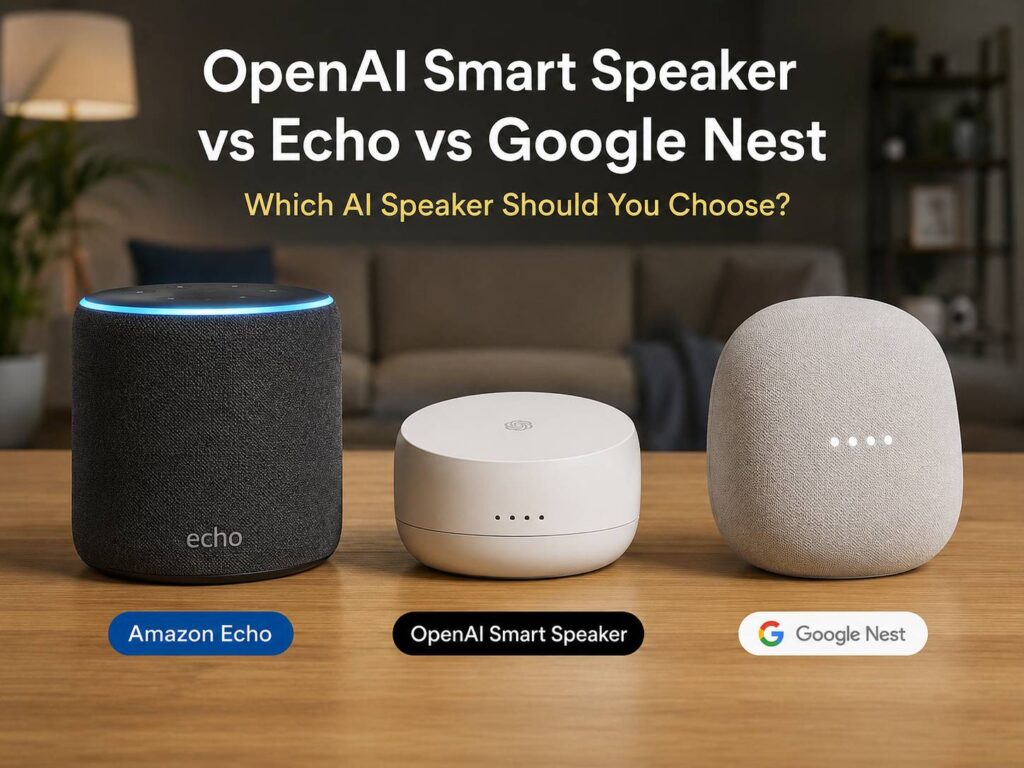
Smart speakers used to be pretty simple. You asked for the weather, played some music, set a timer, or turned off a lamp. In 2026, that feels almost old-fashioned.
Amazon is pushing Alexa+ deeper into the Echo lineup. Google is replacing the older Google Assistant experience with Gemini for Home. At the same time, OpenAI is working with Jony Ive’s team on its first consumer hardware.
That makes the OpenAI Smart Speaker vs Echo vs Google Nest comparison much more interesting than it was a few years ago.
There is one major catch, though. Amazon Echo and Google Home products are available now, but OpenAI has not officially launched a retail smart speaker. The company has confirmed its hardware work with Jony Ive’s team, yet the final product name, price, features, and release date remain unconfirmed.
Current reporting points toward a screen-free AI device that may arrive in 2027. So, for now, buyers are really choosing between an established smart speaker and waiting to see what OpenAI builds.
This guide explains where each platform stands, what each one does well, and which option makes the most sense for different types of users.
OpenAI Smart Speaker vs Echo vs Google Nest at a Glance
The three platforms are chasing a similar goal. Still, they are starting from very different positions.
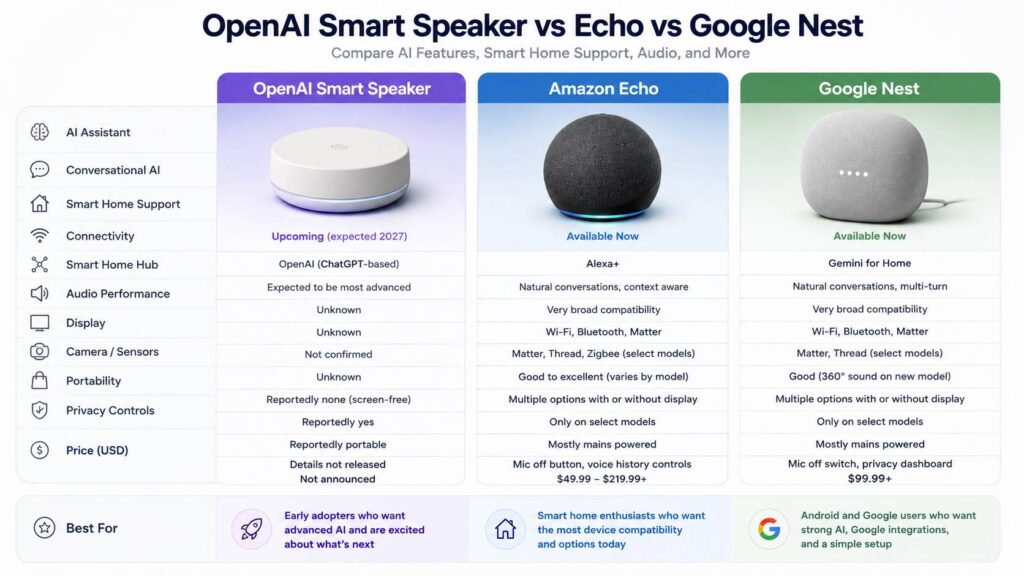
| Feature | OpenAI device | Amazon Echo | Google Home / Nest |
|---|---|---|---|
| Availability | Not officially released | Available now | Available now |
| AI assistant | Expected to use OpenAI AI | Alexa+ | Gemini for Home |
| Smart home ecosystem | Not confirmed | Very mature | Very mature |
| Matter support | Not confirmed | Yes | Yes |
| Thread support | Not confirmed | Selected Echo models | Supported on selected devices |
| Zigbee support | Not confirmed | Selected Echo models | Limited |
| Screen options | Reportedly screen-free | Speaker and display models | Speaker and display models |
| Portable design | Reportedly planned | Mostly mains powered | Mostly mains powered |
| Camera | Reportedly possible | Depends on model | Depends on model |
| Music support | Unknown | Strong | Strong |
| Long-form AI conversation | Expected to be a major focus | Alexa+ | Gemini for Home |
For most households, Amazon and Google have the clear advantage today. Both already work with thousands of smart home products.
OpenAI, in comparison, still needs to show how its hardware will connect with lights, locks, thermostats, TVs, cameras, plugs, and other devices.
What Is the OpenAI Smart Speaker?
The phrase “OpenAI smart speaker” is useful for comparison, but it may not describe the final product accurately.
OpenAI has confirmed its collaboration with Jony Ive and the io hardware team. The goal appears to be a new type of AI-first consumer device rather than another traditional screen-based computer.
Reports in 2026 have described a compact device with microphones, speakers, sensors, and possibly cameras. Some reports have compared its size to a hockey puck. Others describe a product designed to move around the home rather than stay permanently connected to a wall socket.
Still, OpenAI has not published final technical specifications.
That means details such as battery capacity, camera resolution, speaker configuration, Matter support, storage, processor choice, or subscription pricing remain unknown.
For that reason, it makes more sense to treat the OpenAI hardware as an upcoming AI device rather than a finished Echo competitor.
Why OpenAI’s Device Could Feel Different
Traditional smart speakers are built around commands.
You say:
- “Turn on the kitchen lights.”
- “Play my workout playlist.”
- “Set a timer for 20 minutes.”
- “What’s the weather today?”
That works well, but the interaction often feels mechanical.
AI assistants are now moving past that model.
For example, you could ask a newer assistant to create a dinner plan, add missing ingredients to a shopping list, set a cooking timer, and then answer follow-up questions without starting from scratch each time.
OpenAI has a natural advantage here. ChatGPT is already built around longer conversations, context, planning, explanations, and follow-up questions.
At the same time, this wider move toward AI assistants is not limited to voice devices. Adobe, for example, is bringing more AI agents into creative software, as covered in this guide to Adobe AI assistants coming to Creative Cloud.
So, the broader trend is clear. Tech companies want AI to move from a simple question-answer tool into something that can actively help with tasks.
An OpenAI home device could push that idea further.
Amazon Echo Has a Major Head Start
Amazon has been building Echo products for more than a decade. That experience matters.
Alexa+ is the company’s newer generative AI assistant. It is designed to understand more natural speech and maintain context across a conversation.
As a result, you no longer need to phrase every request like a command from a manual.
You can ask something such as, “Make the living room warmer, dim the lights, and play something relaxing.”
Alexa+ can then interpret several actions from one request.
Amazon has also built Alexa into a huge number of third-party smart home products. So, Echo already works with lights, thermostats, doorbells, cameras, locks, plugs, robot vacuums, TVs, speakers, and many other devices.
That is a major advantage over any new platform.
Echo Dot Max vs Echo Studio
Amazon now offers Echo products for several types of buyers.
The Echo Dot Max sits closer to the mainstream smart speaker category. It focuses on voice control, smart home features, and stronger audio than smaller Echo Dot models.
Meanwhile, Echo Studio targets users who care more about music quality.
It supports spatial audio and Dolby Atmos, so it works better in larger rooms or entertainment setups.
Selected Echo devices can also act as smart home hubs.
Depending on the model, you can get support for:
- Matter
- Thread
- Zigbee
- Bluetooth
- Wi-Fi devices
- Alexa routines
- Local smart home control
That gives Echo a lot of flexibility.
For example, someone building a smart home from scratch can use an Echo as both the voice assistant and part of the home’s device-control system.
Google Nest Is Moving to Gemini for Home
Google is making an equally big change.
The older Google Assistant experience is being replaced by Gemini for Home across compatible devices.
That matters since Gemini handles natural language very differently from the older Assistant.
Previously, Google Assistant worked best with fairly specific commands. Now, Gemini can understand more complex requests and follow-up questions.
For example, you can ask it to play music, change the lights, create a reminder, and answer another question in the same conversation.
That feels much closer to talking normally.
Google’s newer Home Speaker is designed around Gemini from the start. It combines voice control, music playback, smart home functions, and Google’s AI system in one device.
Google Home Is a Strong Choice for Android Users
Google’s biggest advantage is its ecosystem.
If you already use Android, Google Calendar, Google Photos, YouTube, YouTube Music, Google Tasks, or Google Keep, Gemini for Home fits naturally into that setup.
For instance, you can ask about calendar events, add something to a list, find a video, or control a connected device without switching apps.
That can save time during normal daily use.
Google Home also supports Matter, and selected hardware works as a Thread border router.
So, compatibility with newer smart home devices is already strong.
Which One Has the Best AI?
This is where the comparison gets harder.
OpenAI is very strong at natural conversation. ChatGPT can handle long discussions, planning, brainstorming, instructions, and context-heavy questions.
Still, a good chatbot does not automatically become a great smart home assistant.
A home assistant needs speed.
If you ask it to turn off a lamp, you expect the light to switch off almost instantly.
It also needs reliability.
A smart speaker that gives a brilliant answer about astronomy but turns off the wrong bedroom light will become annoying very quickly.
Amazon and Google already have years of smart home data, integrations, device relationships, and user feedback behind them.
So, OpenAI may have the strongest conversational foundation, but Alexa and Gemini have a much stronger home-control foundation today.
Which Is Better for Smart Home Control?
Amazon Echo currently has the strongest case for broad smart home control.
Alexa works with a huge range of connected devices. Selected Echo products also include built-in Zigbee support.
That is useful for people who own older smart home hardware that does not use Matter.
Google Home remains very competitive.
It supports Matter and Thread on compatible hardware, which makes it a strong choice for newer smart home setups.
Matter is particularly useful here.
A Matter-compatible smart plug or light bulb can often work across Alexa, Google Home, Apple Home, and other supported platforms.
This reduces the risk of getting locked into one ecosystem.
OpenAI’s Matter plans are still unknown.
That is one of the biggest questions surrounding its upcoming device.
Without strong smart home support, an OpenAI device may feel more like a physical ChatGPT terminal than a true Echo or Google Nest replacement.
Which Speaker Is Better for Music?
Amazon currently has more choice.
The Echo Studio is built with music and home entertainment in mind. It offers more powerful audio than smaller smart speakers and supports features such as Dolby Atmos.
The Echo Dot Max sits below it and gives buyers a cheaper option.
Google’s newer Home Speaker is aimed more at everyday listening.
It works well for podcasts, voice responses, background music, and multi-room audio.
You can also pair compatible Google speakers for stereo playback.
The OpenAI device remains a mystery here.
Reports suggest a smaller portable design. If that proves accurate, sound quality may not be the main focus.
So, anyone buying primarily for music should choose an Echo Studio, Google speaker, or another dedicated wireless speaker rather than waiting for OpenAI.
Privacy Will Matter More Than Ever
Smart speakers already raise privacy concerns.
They sit inside the home with microphones listening for a wake word. Some products also include cameras.
AI-first devices raise the stakes further.
Amazon gives users microphone controls and options for reviewing or deleting voice recordings.
Google also provides hardware microphone controls on its speakers.
OpenAI may face more scrutiny if its device includes cameras and other sensors.
A camera could make an AI assistant far more useful.
For example, you could show it a broken appliance and ask for help. You could point it toward ingredients on a table and ask for meal ideas. You could also ask it to identify an object.
Yet those same features create obvious privacy questions.
Users will want clear controls for:
- Camera access
- Microphone access
- Stored audio
- Stored images
- AI memory
- Account history
- Cloud processing
- Local processing
- Guest access
OpenAI will need to explain these controls clearly once the hardware becomes official.
Common Problems With AI Smart Speakers
AI assistants solve some old problems, but they introduce new ones.
One issue is consistency.
Older voice assistants were rigid, yet their supported commands were often predictable.
Generative AI understands much more flexible language. Still, it can interpret similar requests differently from one conversation to another.
Latency is another problem.
A two-second delay does not feel long during a normal conversation. It feels much longer when you simply want a light turned off.
Then there is the issue of accidental interruptions.
Smart speakers can still hear a word on television and think someone called their name.
Multi-user homes create another challenge.
An assistant needs to understand who is speaking, which account to use, what information should remain private, and which devices that person can control.
Subscriptions are another growing concern.
AI features cost money to run. As a result, some advanced functions are increasingly tied to paid plans.
That means the real cost of a smart speaker may eventually include more than the hardware price.
Alexa+ vs Gemini for Home
For a buyer choosing today, Alexa+ and Gemini for Home are the real competition.
Alexa+ makes more sense for people who already use Amazon services or own a large mix of smart home products.
Gemini for Home feels more natural for people invested in Google services.
Alexa has an advantage with Zigbee and its long list of compatible devices.
Gemini has a strong connection to Google’s search, productivity, Android, media, and AI services.
Neither choice is bad.
The better one depends mostly on the products and accounts already in your home.
Should You Wait for the OpenAI Smart Speaker?
For most people, no.
If you need a smart speaker now, buy a product that already exists.
Amazon Echo and Google Home devices have mature ecosystems, tested hardware, established app support, and broad smart home compatibility.
OpenAI’s device is still developing.
Its final price is unknown. Its smart home features are unknown. Audio quality is unknown. Battery life is unknown. Matter support is unknown.
So, waiting only makes sense for someone who is more interested in OpenAI’s hardware experiment than in buying a practical smart home speaker today.
That could still be worth doing.
OpenAI appears to be aiming for something different from a standard Echo Dot.
The company may focus more on conversational AI, visual understanding, portable use, and contextual awareness.
If that works well, the device could create a new category rather than compete directly with existing speakers.
Which AI Smart Speaker Should You Buy?
Choose an Amazon Echo if smart home compatibility is your main priority.
Alexa already works with a huge range of devices, and selected Echo models support Matter, Thread, and Zigbee. Amazon also offers several speaker sizes and price points.
Choose Google Home with Gemini if you use Android and Google services heavily.
Gemini works naturally with Google’s wider ecosystem, and the newer Home hardware supports modern smart home standards.
Wait for the OpenAI device if conversational AI interests you more than traditional smart home functions.
OpenAI may produce the most interesting device of the three. Still, Amazon and Google offer the more practical choices today.
The biggest question for OpenAI is not whether it can make an AI that talks well. ChatGPT has already shown that.
The real challenge is building hardware that responds quickly, controls the home reliably, respects privacy, sounds good, and earns a permanent place on a kitchen counter or bedside table.
If OpenAI gets those parts right, the smart speaker market could become much more competitive in 2027.