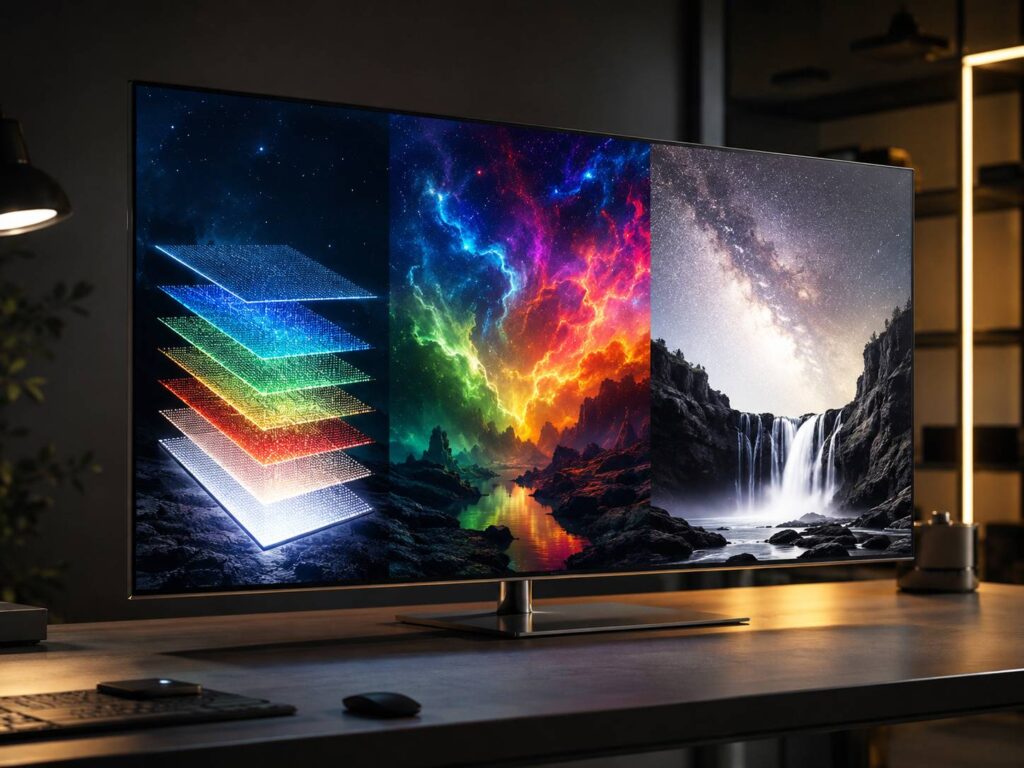
Tandem OLED is showing up more often in premium tablets, laptops, monitors, and TVs. At the same time, terms such as QD-OLED and WOLED are still widely used, which makes the whole topic more confusing than it needs to be.
The main thing to understand is that these names do not all describe the same part of an OLED display.
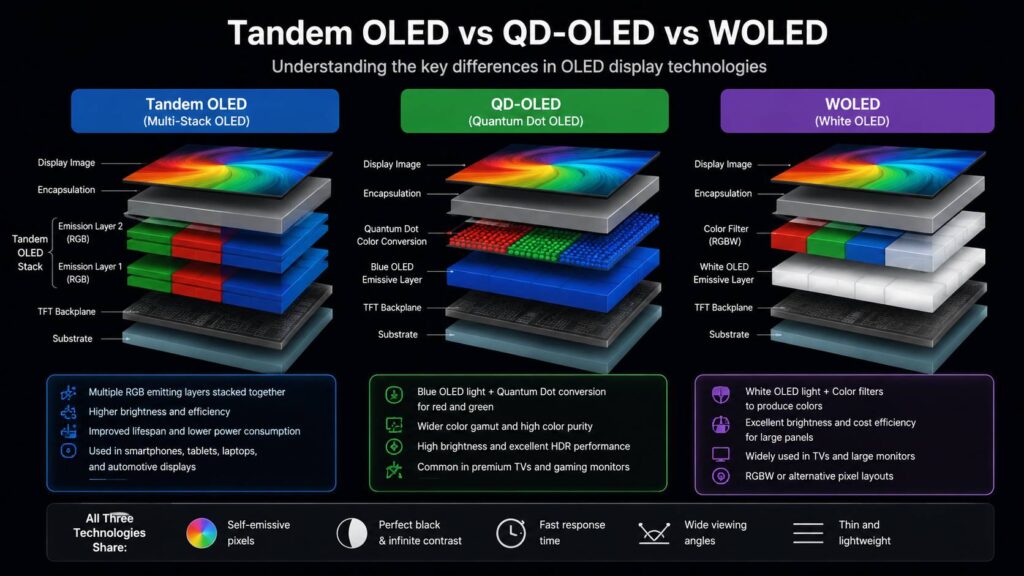
QD-OLED and WOLED mainly refer to how a panel creates its final colors. Tandem OLED describes the way several OLED light-emitting layers are stacked inside the panel.
That difference is important because modern OLED technologies increasingly overlap. A display can use a tandem structure and still be WOLED. It can also combine a tandem structure with QD-OLED.
So rather than treating Tandem OLED, QD-OLED, and WOLED as three completely separate technologies, it makes more sense to look at what each one actually does.
What Is Tandem OLED?
Tandem OLED uses multiple OLED light-emitting units stacked together instead of relying on a single emitting structure.
A relatively simple implementation might use two OLED emitting layers. Both layers contribute to the final light output of the display.
That gives manufacturers more flexibility. They can use the extra emitting capacity to increase brightness, reduce the electrical load on each layer, improve power efficiency, extend panel life, or balance several of those goals.
LG Display first commercialized its Tandem OLED technology for automotive displays in 2019. Since then, the idea has expanded into laptops, tablets, monitors, and other display categories.
Apple helped bring the term into the mainstream with the 2024 iPad Pro. Its Ultra Retina XDR display combines light from two OLED panels, allowing the tablet to reach up to 1,000 nits of full-screen brightness and 1,600 nits of peak HDR brightness.
The basic idea is fairly straightforward:
- Conventional OLED: one main emitting structure produces the required light.
- Tandem OLED: multiple emitting structures share the workload.
Because the workload is spread across more organic material, each individual layer may not need to work as hard to produce the same brightness.
Tandem OLED Is Not Really a Direct Rival to QD-OLED or WOLED
This is probably the biggest source of confusion.
It is easy to think of the comparison like this:
- Tandem OLED
- QD-OLED
- WOLED
Technically, though, that is not quite right.
QD-OLED and WOLED describe different ways of generating color in OLED displays. Tandem OLED describes the structure of the light-emitting layers underneath.
A better comparison looks like this:
| Technology | What it mainly describes |
|---|---|
| Tandem OLED | Multiple stacked OLED emitting layers |
| QD-OLED | OLED light combined with quantum-dot color conversion |
| WOLED | White OLED light used to create the final colors |
| Tandem WOLED | WOLED built around a multi-layer tandem light source |
| QD-OLED Penta Tandem | QD-OLED using Samsung Display’s five-layer emitting structure |
So asking if Tandem OLED is better than QD-OLED is not always a clean comparison. In some cases, a QD-OLED panel may already use a tandem-style structure.
How Does Tandem OLED Work?
OLED displays create their own light at the pixel level. Unlike LCD panels, they do not need a separate backlight behind the screen.
That gives OLED its familiar strengths, including very deep blacks, high contrast, fast pixel response, and thin panel construction.
Brightness and material aging are harder problems.
Increasing the electrical load on OLED material can increase brightness, but it also places more stress on the organic compounds producing that light.
A tandem structure gives the display more light-emitting material to work with.
Instead of forcing one emitting unit to produce all the required luminance, the panel can distribute the workload across several layers.
Depending on how the manufacturer tunes the panel, this may provide:
- higher peak brightness
- lower power consumption
- improved efficiency
- longer expected panel life
- stronger HDR performance
Still, the Tandem OLED label alone does not tell you how bright or efficient a display will actually be.
Two tandem OLED panels can behave very differently depending on the number of layers, panel size, cooling, power limits, firmware, and intended use.
What Is QD-OLED?
QD-OLED is Samsung Display’s OLED technology that combines an OLED light source with quantum dots.
The OLED structure generates blue light. Quantum-dot materials then convert some of that blue light into red and green.
That creates the three primary colors needed by the display:
- red
- green
- blue
This approach differs from traditional large WOLED panels, which generate a broader light source and then use filtering and subpixel structures to produce the final colors.
One of QD-OLED’s main strengths is color purity.
Samsung Display states that its QD-OLED technology exceeds 99% coverage of DCI-P3 and 90% of BT.2020. That makes the technology particularly attractive for HDR content, gaming, video editing, and other situations where saturated colors at higher brightness levels matter.
QD-OLED is also common in premium gaming monitors, including high-refresh-rate 4K models and very fast QHD panels.
But QD-OLED itself does not tell you how many light-emitting layers are used beneath the quantum-dot structure.
That part has changed considerably over the last few generations.
QD-OLED Can Use Tandem Technology Too
This is where the terminology gets more interesting.
Samsung Display has introduced QD-OLED Penta Tandem, a newer five-layer organic light-emitting structure.
The word “Penta” refers to the five emitting layers.
Previous generations used four blue emitting layers. The newer structure adds another layer along with updated organic materials.
The idea is to distribute the electrical load more effectively while improving brightness, efficiency, durability, and pixel density.
That means modern QD-OLED can also use tandem principles.
So a simple “Tandem OLED vs QD-OLED” comparison can be misleading. In newer panels, the technologies may actually exist together.
What Is WOLED?
WOLED stands for White OLED.
LG Display has used WOLED technology extensively in OLED televisions and gaming monitors.
Instead of relying on quantum dots to convert blue OLED light into the final primary colors, WOLED creates a broader light source from OLED materials. The panel then uses its subpixel and filtering system to produce the colors you see on screen.
Many WOLED panels use red, green, blue, and white subpixels, although the exact layout can vary between generations and applications.
Because of that, it is better to check the panel used in a specific display rather than assuming every WOLED product has exactly the same subpixel arrangement.
WOLED became popular partly because it works well for manufacturing larger OLED panels while still delivering OLED’s core strengths, such as true black levels and pixel-level brightness control.
Modern versions have also improved considerably in peak brightness and color performance.
If you are looking at current large-screen OLED products, including models designed for both TV use and desktop gaming, guides such as this overview of the LG C6 48 OLED can also help show how modern OLED panel improvements translate into real product specifications.
What Is Tandem WOLED?
LG Display now directly uses the term Tandem WOLED for its newer large-screen OLED technology.
Its Primary RGB Tandem architecture separates the light-producing materials into several red, green, and blue emitting stacks.
Earlier LG OLED generations used a three-stack structure that relied on blue, yellow, and blue light-emitting layers.
The newer Primary RGB Tandem design moved to four stacks. It uses separate red and green emitting components alongside two blue layers.
LG Display has since continued developing this architecture with Primary RGB Tandem 2.0.
This matters because modern WOLED is much more sophisticated than the old idea of a simple white OLED layer sitting underneath color filters.
Current high-end WOLED panels use complex multi-stack structures to improve brightness and efficiency.
In gaming monitors, recent Tandem WOLED panels can reach around 1,500 nits of peak brightness under LG Display’s specified measurement conditions.
TV panels can reach even higher short-duration peak figures in small HDR windows.
Still, brightness numbers need context. A 1%, 3%, or 10% test window can produce a very different result from full-screen brightness.
Picture mode, panel temperature, firmware, and power management also matter.

Tandem OLED vs QD-OLED vs WOLED
Here is a simpler breakdown of how the technologies differ.
| Feature | Tandem OLED | QD-OLED | WOLED |
|---|---|---|---|
| Main concept | Multiple OLED emitting layers | OLED plus quantum-dot color conversion | White OLED-based color generation |
| Self-emissive | Yes | Yes | Yes |
| Pixel-level black | Yes | Yes | Yes |
| Main goal | Better brightness, efficiency, and durability | Strong color purity and color volume | High-quality OLED performance across large panels |
| Can use tandem layers | Yes, by definition | Yes | Yes |
| Common products | Tablets, laptops, automotive displays | Monitors and TVs | Monitors and TVs |
| Current direction | More layers and improved materials | Penta Tandem and higher refresh rates | Primary RGB Tandem and higher brightness |
There is no single winner because these technologies are not mutually exclusive.
Is Tandem OLED Brighter?
Tandem OLED makes higher brightness easier to achieve, but it does not automatically make every tandem display brighter than every QD-OLED or WOLED panel.
Manufacturers can use the extra efficiency in different ways.
A laptop maker may use tandem technology to keep brightness similar while lowering display power consumption.
A gaming monitor manufacturer may use the same type of improvement to increase HDR highlights instead.
Another display might prioritize lower temperatures and longer panel life.
So peak brightness, sustained brightness, and full-screen brightness still need to be compared on the actual product.
The Tandem OLED label is useful, but it does not tell the whole story.
Does Tandem OLED Last Longer?
Improved longevity is one of the most practical reasons for using a tandem structure.
Because multiple emitting layers share the workload, each individual layer can operate under less stress.
LG Display has repeatedly highlighted longer lifespan and better efficiency as key benefits of Tandem OLED technology.
That said, tandem construction does not make OLED immune to permanent image retention.
OLED still relies on organic compounds that gradually age during use. Static interface elements, high brightness, long usage hours, and uneven pixel wear can still affect the panel over time.
Modern OLED displays use several techniques to reduce those risks, including:
- pixel shifting
- logo brightness reduction
- compensation cycles
- automatic panel maintenance
- thermal management
A tandem structure can improve the underlying durability of the panel, but it does not remove OLED aging altogether.
Which Has Better Color?
Tandem OLED does not directly determine color quality.
QD-OLED has a natural advantage in this area because quantum dots create highly pure red and green light from the blue OLED source.
That helps QD-OLED preserve strong saturation even as brightness increases.
Tandem RGB OLED displays can also offer excellent color reproduction, particularly in tablets and professional displays.
Modern Tandem WOLED has improved color brightness as well, narrowing some of the gaps seen in earlier generations.
For color-sensitive work, it makes more sense to compare the actual display specifications.
Look at:
- DCI-P3 coverage
- BT.2020 coverage
- factory calibration
- Delta E accuracy
- peak HDR brightness
- sustained brightness
- color volume
- viewing-angle consistency
- available reference modes
The OLED type matters, but calibration and panel tuning can matter just as much.
Which OLED Technology Is Better for Gaming?
QD-OLED and Tandem WOLED are both excellent choices for gaming.
Modern QD-OLED monitors combine very fast pixel response with refresh rates that can reach 500Hz on some QHD panels.
Tandem WOLED gaming panels can also reach extremely high refresh rates, sometimes by using dual-mode operation that lowers resolution while increasing refresh rate.
For most buyers, the panel technology should come after the important gaming specifications.
Check:
- resolution
- refresh rate
- response time
- VRR support
- HDMI and DisplayPort capabilities
- HDR brightness
- screen coating
- text clarity
- burn-in warranty coverage
A 4K 240Hz QD-OLED and a similarly fast Tandem WOLED can both deliver excellent gaming performance.
The better choice depends on what you value most.
Which Is Better for Productivity?
Tandem OLED is particularly interesting in laptops and tablets because efficiency matters more in battery-powered devices.
If the panel can reach the same brightness using less power, battery life can improve. Manufacturers can also use the added efficiency to provide higher sustained brightness without dramatically increasing energy consumption.
For desktop monitors, text clarity deserves more attention.
Some OLED panels use non-standard subpixel layouts that do not perfectly match the RGB stripe expected by certain desktop font-rendering systems.
At lower pixel densities, this can sometimes create slight color fringing around text.
Higher-resolution OLED panels make the issue less noticeable because individual subpixels are much smaller.
For office work, programming, or long sessions in spreadsheets, pixel density and subpixel layout are worth checking alongside brightness and HDR performance.
What Has Changed With Newer OLED Panels?
The biggest change is that tandem technology is becoming less of a separate OLED category.
LG Display uses tandem structures in both smaller OLED products and its newer WOLED panels.
Samsung Display has also moved toward a five-layer QD-OLED Penta Tandem structure.
As a result, manufacturers are increasingly combining multiple technologies instead of keeping them in separate categories.
That makes simple comparisons less useful.
A modern OLED display may be:
- QD-OLED with a tandem emitting structure
- WOLED with a Primary RGB Tandem structure
- RGB Tandem OLED in a tablet or laptop
So the panel architecture matters, but the final implementation matters even more.
Which One Should You Choose?
Do not buy a display just because the specification sheet says Tandem OLED.
Instead, look at the complete panel and how it performs in the areas you actually care about.
QD-OLED remains a strong option if wide color gamut, strong color volume, fast response, and high refresh rates are priorities.
Modern Tandem WOLED is highly competitive for gaming, HDR, and large-screen use, with much higher brightness than older WOLED generations.
Tandem RGB OLED is especially attractive in laptops and tablets, where lower power consumption and strong brightness can make a noticeable difference.
The biggest point to remember is that Tandem OLED, QD-OLED, and WOLED are no longer cleanly separated technologies.
A premium OLED display can combine several of them at once.
For that reason, the most useful comparison is not simply Tandem OLED vs QD-OLED vs WOLED. Look at the emitting structure, color-generation method, brightness, refresh rate, efficiency, pixel layout, and actual product tuning together.