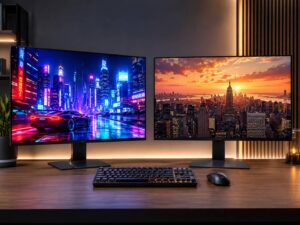
IJP OLED is starting to appear in real laptops and monitors after years of prototypes and trade-show demonstrations. It promises the deep blacks and fast response of OLED, but with a manufacturing process that could waste less material and cost less at scale.
Still, IJP OLED is not simply another version of QD-OLED or WOLED. The names describe different parts of display technology. IJP mainly refers to how manufacturers produce certain OLED layers. QD-OLED and WOLED describe how a panel creates red, green, and blue light.
That distinction sounds small, but it explains most of the differences between these displays.
What Is IJP OLED?
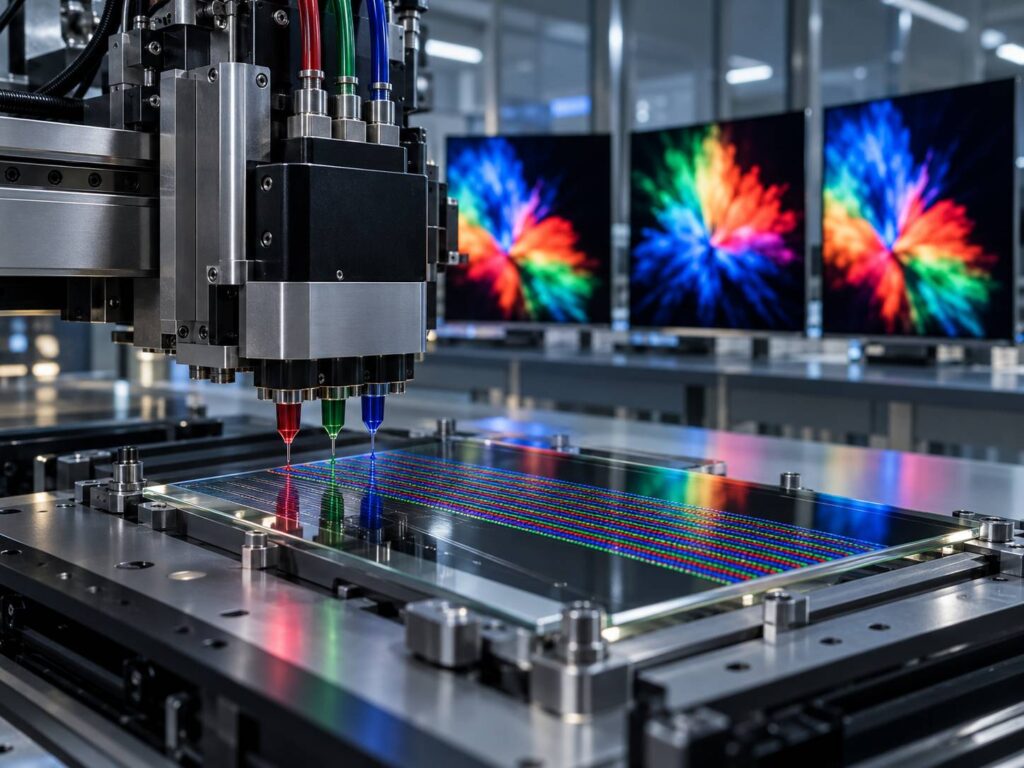
IJP stands for inkjet printing. An IJP OLED panel uses industrial print heads to place tiny droplets of liquid organic material onto a display substrate.
This is far more precise than ordinary printing. The equipment must control the position, size, viscosity, and drying behavior of every droplet. Even a minor inconsistency can affect brightness, color accuracy, or panel uniformity.
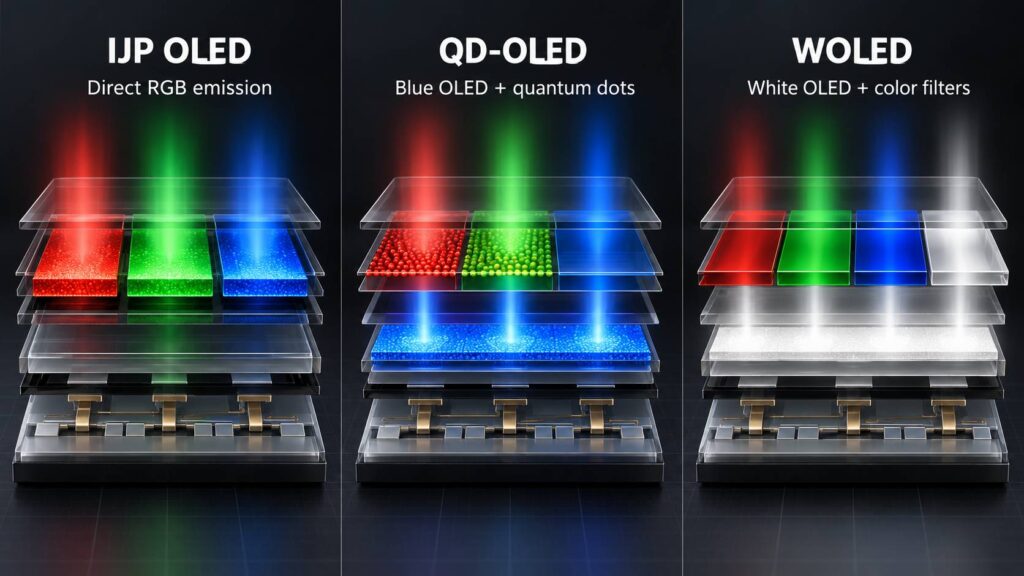
Current commercial IJP OLED panels from TCL CSOT use separate red, green, and blue light-emitting materials. Each colored subpixel produces its own light directly. The panel does not need a white subpixel or a quantum-dot layer to create the final colors.
As a result, IJP OLED can support a familiar vertical RGB stripe. That layout is especially useful in monitors and laptops because most operating systems render text with a traditional RGB pixel structure in mind.
How Does Inkjet-Printed OLED Work?
Every OLED panel contains several microscopic layers. Some transport electrical charges, while others emit light when those charges meet.
The IJP process usually starts with a thin-film transistor backplane. This backplane controls the brightness of each pixel. Manufacturers then create small partition walls, often called pixel banks, across the substrate.
Next, the print heads deposit organic materials inside those banks. The factory dries and heats each printed layer before adding the next one. Red, green, and blue materials can go into their corresponding subpixels without using a fine metal mask.
The main steps look like this:
- Create the transistor backplane.
- Form the pixel banks on the substrate.
- Print the required organic materials.
- Dry and heat-treat each layer.
- Add the remaining electrical layers.
- Seal the panel against oxygen and moisture.
Despite the name, manufacturers do not print every part of the display. They may print the injection, transport, and light-emitting layers, then use vacuum deposition for the cathode and other components.
So a printed OLED is not made by one giant printer in a single pass. Inkjet printing replaces several complicated production stages, but it remains part of a much larger manufacturing process.
IJP OLED, QD-OLED, and WOLED Are Not Direct Equivalents
The terminology can get confusing rather quickly.
IJP OLED mainly describes a production method. QD-OLED describes a blue OLED panel that uses quantum dots for color conversion. WOLED describes an OLED architecture that creates white light before passing it through color filters.
Current IJP OLED products combine inkjet printing with direct RGB emission. That gives them a different pixel structure from most existing QD-OLED and conventional WOLED displays.
Here is the practical comparison.
| Feature | Current IJP OLED | QD-OLED | Conventional WOLED |
|---|---|---|---|
| What the name describes | Manufacturing method | Color-conversion architecture | White OLED architecture |
| Main light source | Separate red, green, and blue OLED emitters | Blue OLED emitter stack | White or broad-spectrum OLED stack |
| How colors are created | Direct RGB emission | Quantum dots convert blue into red and green | Color filters separate white light into RGB |
| Typical pixel layout | Vertical RGB stripe | Triangular RGB or newer vertical RGB | Often RGBW or an RGWB-based arrangement |
| White subpixel | No | No | Common on conventional large panels |
| Strongest potential benefit | Clear text and lower-cost manufacturing at scale | Strong color volume and mature gaming performance | Wide availability and mature production |
| Main concern | Limited product history | Pixel layout varies between generations | Color brightness and text clarity vary by panel |
| Current market position | Early commercial rollout | Established in premium TVs and monitors | Widely available across TVs and monitors |
IJP OLED vs QD-OLED
QD-OLED starts with a blue OLED light source. A quantum-dot conversion layer changes part of that blue light into red and green. The untouched blue light forms the blue subpixel.
Quantum dots produce narrow and highly saturated colors. Because of this, QD-OLED displays can maintain strong color volume at high brightness. They also offer wide viewing angles, fast response times, and per-pixel light control.
IJP OLED uses separate red, green, and blue emitting materials instead. It does not need to convert blue light into the other two primary colors. Each subpixel creates its intended color from the start.
Text clarity used to be a clearer advantage for IJP OLED. Earlier QD-OLED monitors arranged their subpixels in a triangular pattern. Fine text and high-contrast interface elements could show faint colored fringes, especially at lower pixel densities.
That difference has narrowed. Newer QD-OLED panels now use Samsung Display’s V-Stripe arrangement, which places the RGB subpixels vertically. These panels render text more cleanly than earlier triangular designs.
QD-OLED remains the more established choice, particularly for gaming monitors and premium televisions. IJP OLED looks competitive, but there are still too few independently tested products to declare it better for brightness, efficiency, or lifespan.
IJP OLED vs WOLED
Conventional WOLED panels generate broad-spectrum white light. Color filters then divide that light into red, green, and blue. Many WOLED panels also include an unfiltered white subpixel that helps increase brightness.
This design allowed manufacturers to produce large OLED television panels without patterning separate RGB emitters through a fine metal mask. It proved reliable enough to support a wide selection of screen sizes and price levels.
However, color filters absorb some of the generated light. The white subpixel can raise overall luminance, but it does not contribute as much to saturated colors. As a result, very bright colored highlights may not remain as vivid as equally bright white highlights.
IJP OLED takes a more direct route. Its red, green, and blue subpixels create their own light, so the panel does not need color filters or an extra white subpixel. This can help preserve color saturation as brightness changes.
The regular RGB stripe also suits desktop work. Text, icons, spreadsheets, and thin interface lines should look cleaner than they do on some older OLED monitor layouts.
WOLED has improved a lot, though. New tandem structures stack several light-emitting layers to increase brightness and reduce the load on each layer. Some 2026 Tandem RGB OLED monitors have also removed the white subpixel and adopted a true RGB stripe.
This means buyers cannot judge every new panel by the WOLED name alone. Product implementation now matters more than ever. For an example of how current panel technology translates into an actual television, this overview of the LG C6 48-inch OLED provides more model-specific detail.
Why Are Manufacturers Interested in IJP OLED?
Traditional direct RGB OLED production often relies on vacuum thermal evaporation. The factory heats organic materials until they become vapor, then deposits them through a fine metal mask.
The process works, but it can waste expensive material. Some of the vapor coats the mask or manufacturing chamber instead of reaching the display. Large, high-precision masks are also costly and difficult to handle.
Inkjet printing deposits material only where the panel needs it. TCL CSOT reports material-use efficiency above 90% for its IJP process. That number refers to factory material usage, not the electricity consumed by the finished display.
Potential manufacturing benefits include:
- Less wasted organic material
- No fine metal mask for the printed layers
- Fewer vacuum-processing stages
- Easier production on large glass substrates
- Precise digital control over material placement
- More flexibility for different panel sizes and shapes
In theory, these advantages should reduce production costs. In practice, the final price still depends on manufacturing yields, production volume, electronics, cooling, warranty coverage, and product positioning.
Early IJP OLED devices may remain expensive simply because production is still limited. Cost savings become more realistic after factories reach higher volumes and consistently produce usable panels.
What Are the Drawbacks of IJP OLED?
Printing an OLED layer sounds easier than vacuum deposition. In reality, it introduces a different set of problems.
Each nozzle must release the same amount of material at exactly the right moment. The droplets also need to spread evenly inside the pixel bank. If the solvent dries unevenly, organic material can collect around the edges and create variations in film thickness.
Manufacturers must carefully control:
- Ink viscosity
- Solvent evaporation
- Surface tension
- Nozzle stability
- Layer thickness
- Drying temperature
- Dust and contamination
Printable OLED materials have also historically struggled to match evaporated materials in efficiency and durability. Blue OLED remains the hardest part because blue emitters require more energy and usually age faster than red or green ones.
Commercial panels show that manufacturers have made real progress. Still, long-term consumer data remains limited. There is not enough evidence to say that IJP OLED lasts longer than QD-OLED or WOLED.
IJP OLED is also vulnerable to burn-in. Its organic subpixels gradually lose brightness as they operate. Static logos, taskbars, menus, and game interfaces can cause uneven aging if they remain on-screen for long periods.
Pixel compensation and automatic protection features can reduce the risk. They cannot remove it completely.

Is IJP OLED Better for Picture Quality?
The printing method alone does not determine picture quality. Emitter materials, pixel layout, calibration, panel coating, brightness management, and cooling all affect the final result.
Current direct RGB IJP OLED panels offer several attractive qualities:
- True black from self-emissive pixels
- Fast OLED response times
- Wide viewing angles
- Direct RGB color reproduction
- No white subpixel
- A conventional RGB stripe
- Wide color-gamut coverage
Even so, IJP OLED is not automatically faster than other OLED types. Refresh rate comes from the panel design and electronics, not the printing process.
Current IJP products include a 120Hz desktop monitor and a 240Hz laptop display. Meanwhile, QD-OLED and other OLED technologies already support much higher refresh rates in gaming monitors.
Power consumption requires the same caution. High material efficiency at the factory does not guarantee low electricity use at home. Actual power use depends on screen size, brightness, content, refresh rate, and power settings.
What Has Changed Recently?
TCL CSOT moved IJP OLED beyond prototypes in November 2024. Its Gen 5.5 production line in Wuhan entered mass production and delivered a 21.6-inch 4K professional panel.
The technology reached laptops in July 2026. Lenovo announced the Legion R9000P with a 16-inch, 240Hz IJP OLED display from TCL CSOT. The panel uses a Real RGB Stripe layout and covers more than 99% of the DCI-P3 color gamut.
Then, in August 2026, TCL CSOT and MSI unveiled the MSI PRO MAX OLED 271UPJW12. It pairs a 27-inch 4K panel with a 120Hz refresh rate, vertical RGB pixels, and VESA DisplayHDR True Black 500 certification.
TCL CSOT is also preparing a much larger Gen 8.6 production line in Guangzhou. The company completed the main factory structure in May 2026, but equipment installation and production preparation still had to follow.
This larger facility targets laptops, monitors, tablets, automotive displays, and other medium-size products. It could help IJP OLED reach far more devices once full production begins.
For now, though, QD-OLED and WOLED offer more screen sizes, more finished products, and much more independent test data.
Should You Buy an IJP OLED Display?
IJP OLED makes sense for buyers who want OLED contrast without giving up clear desktop text. The direct RGB stripe should work particularly well for office applications, coding, web browsing, and content creation.
Still, the panel type should not make the decision by itself. Before buying, compare:
- Resolution and pixel density
- Refresh rate
- Full-screen brightness
- Small-window HDR brightness
- Color accuracy
- Screen coating
- Reflection handling
- Variable refresh support
- OLED protection features
- Port selection
- Burn-in warranty coverage
QD-OLED remains a proven choice for gaming and wide-gamut HDR content. WOLED offers a much broader selection, especially among televisions. Recent tandem panels have also closed several performance gaps associated with older WOLED generations.
IJP OLED is a promising third option. Its direct RGB structure offers real visual benefits, while its production method could become even more important over time.
Frequently Asked Questions
Does an IJP OLED screen contain liquid ink?
The organic materials begin as liquid solutions during manufacturing. After printing, drying, and heat treatment, they form solid microscopic layers inside the sealed panel.
Can an IJP OLED display run out of ink?
No. Inkjet printing only happens at the factory. The finished display has no cartridge, liquid tank, or consumable ink.
Is IJP OLED the same as RGB OLED?
Not quite. IJP describes how manufacturers deposit certain panel layers. RGB OLED describes a pixel structure with separate red, green, and blue emitters. Current commercial IJP OLED panels use both technologies.
Does IJP OLED suffer from burn-in?
Yes. IJP OLED still relies on organic emitters that degrade with use. Built-in protection can slow uneven wear, but it cannot make the panel immune to burn-in.
Will IJP OLED make OLED monitors cheaper?
It could lower manufacturing costs by reducing material waste and removing fine metal masks from key production stages. Lower retail prices will depend on production volume, yields, and competition.
Is IJP OLED better than QD-OLED or WOLED?
Not in every situation. IJP OLED offers direct RGB pixels, clear text, and promising manufacturing advantages. QD-OLED has mature color performance, while WOLED provides broad availability and several established panel generations.
The quality of the individual monitor, laptop, or television matters more than the technology label printed on the box.
What IJP OLED Means for Buyers
IJP OLED offers a believable new direction for OLED manufacturing. It keeps the main strengths people expect from OLED, including perfect black, fast response, and per-pixel light control. At the same time, it introduces a more targeted way to deposit organic materials.
The technology has finally reached commercial laptops and monitors, which is a major step. Yet claims about dramatically lower prices, superior durability, or better efficiency still need more real-world evidence.
For now, IJP OLED is best viewed as a promising direct RGB alternative to QD-OLED and conventional WOLED. Its long-term success will depend on panel yields, reliability, product availability, and, of course, what these displays actually cost once production expands.