No monitor on sale in October 2026 can use an HDMI 2.2 Ultra96 cable's extra bandwidth, because none has an HDMI 2.2 port. The first certified Ultra96 cables went on sale in September, rated for 96 Gbps, twice the 48 Gbps of the Ultra High Speed cable that HDMI 2.1 monitors use. The HDMI Licensing Administrator expects the first HDMI 2.2 products in 2027. Until a monitor and a graphics card both have the new port, a certified Ultra High Speed cable carries everything the link can, and the Ultra96 cable earns its price only on a run you will not get to again, such as one inside a wall.
What HDMI 2.2 adds
The HDMI Forum released version 2.2 of the specification on June 25, 2025. It raises the ceiling to 96 Gbps with a new generation of Fixed Rate Link signaling, and it supports 4K at 240 Hz and 8K at 60 Hz uncompressed with full 4:4:4 chroma at 10 and 12 bits, plus formats up to 12K at 120 Hz and 16K at 60 Hz. It also adds Latency Indication Protocol, which keeps sound in step with the picture when the signal passes through a receiver or a soundbar. The specification is backward compatible, so an Ultra96 cable works in an HDMI 2.1 port at HDMI 2.1 speed.
Ultra96 is a feature name, not a version number. HDMI LA encourages makers to print it on a product that supports a maximum of 64, 80 or 96 Gbps under HDMI 2.2, and such a product needs the Ultra96 cable to reach its maximum. The Ultra High Speed cable remains the one for systems that top out at 48 Gbps, which is every HDMI monitor on sale.
The bandwidth a monitor asks for
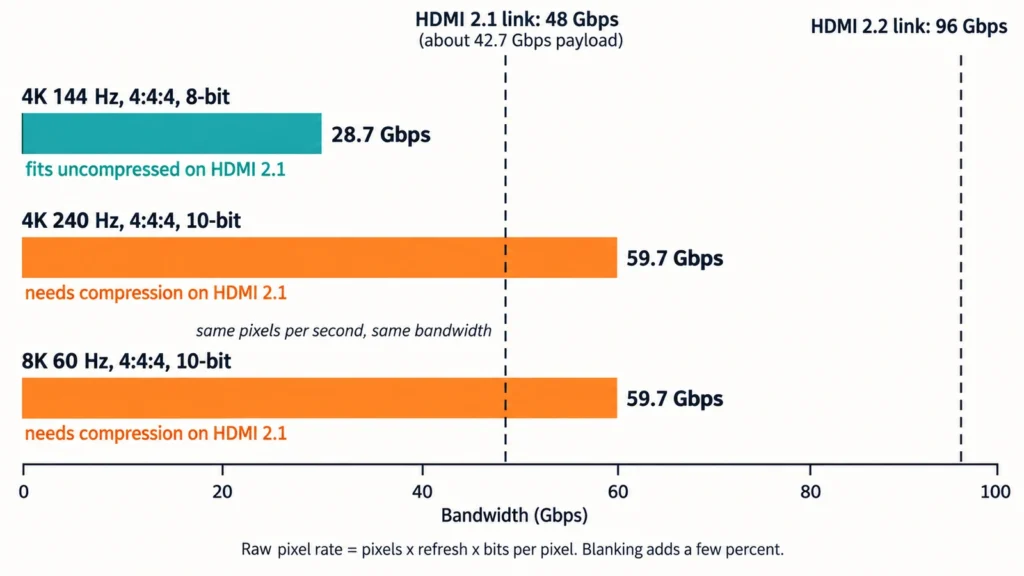
The raw video rate is the pixel count times the refresh rate times the bits per pixel. A 4K picture at 240 Hz with 10 bits per color channel works out to about 59.7 Gbps before the blanking intervals add a little more. HDMI 2.1's 48 Gbps link loses part of its rate to 16b/18b coding and carries about 42.7 Gbps of data, so that format does not fit. A monitor built for that format, such as the ASUS ROG Swift OLED PG27UCDM, reaches its top rate over its HDMI 2.1 port only with Display Stream Compression.
One result catches buyers out. A 1440p screen at 540 Hz moves exactly as many pixels a second as 4K at 240 Hz, because 4K has 2.25 times the pixels and 540 is 2.25 times 240. So the ROG Swift OLED PG27AQWP-W, a 1440p monitor, needs the same 59.7 Gbps at 10 bits as a 4K flagship. ASUS lists its HDMI port at 48 Gbps and its DisplayPort 2.1a UHBR20 port at the full 80 Gbps, which carries about 77 Gbps of data, enough for that format without compression. On today's fastest monitors, DisplayPort already offers more than HDMI 2.2 will at its lowest tier.
At the other end, 4K at 144 Hz with 8 bits per channel needs about 28.7 Gbps, well inside an HDMI 2.1 link. Samsung's 2027 Odyssey OLED G8, announced in August 2026 with 4K at 360 Hz, needs about 89.6 Gbps at 10 bits, more than DisplayPort UHBR20 carries, so it will rely on compression whatever cable feeds it.
Three speeds behind one Ultra96 label
The tier printed beside Ultra96 decides which formats fit. HDMI LA's public overview does not give the data rate after coding for the new links. If HDMI 2.2 keeps HDMI 2.1's 16b/18b coding, a 64 Gbps link would carry about 56.9 Gbps, short of the 59.7 that the 4K format above needs, while an 80 Gbps link would carry about 71.1 and fit it. So a future monitor spec sheet that says Ultra96 without a number leaves the main question open, the same way a DisplayPort 2.1 port without a UHBR rate does.
Samsung's 2027 G8 shows how thin the labeling still is. Its announcement names the DisplayPort port as 2.1 UHBR20 and lists two HDMI ports with no version or speed.
An HDMI 2.1 label can mean 18 Gbps
HDMI LA's rule is that version numbers are not feature sets. A product may claim HDMI 2.1 while supporting only the older TMDS signaling at 18 Gbps, as long as the maker lists the features it does support next to the claim. Dell does this on the Dell SE2726HG and the Alienware AW2726DM, whose spec sheets read "HDMI 2.1 (TMDS)".
TMDS uses 8b/10b coding, so an 18 Gbps link carries about 14.4 Gbps of data. That covers 1080p at 240 Hz with 8-bit color, about 11.9 Gbps, which is why the SE2726HG reaches its full refresh rate over HDMI, as the SE2726HG review sets out. The AW2726DM's 1440p at the same refresh rate needs about 21.2 Gbps at the same depth, so its full rate needs DisplayPort. Expect the same with HDMI 2.2: the Ultra96 name and its Gbps figure will tell you more than the number 2.2.
Buying a cable for a monitor today
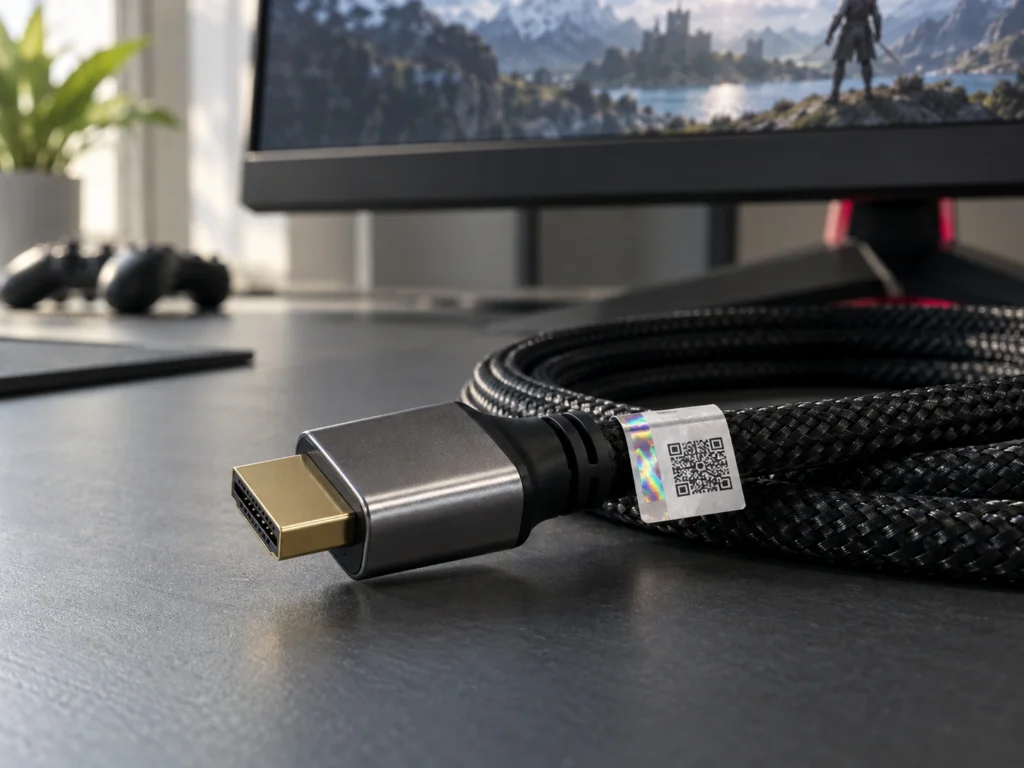
A certified Ultra High Speed cable covers any HDMI port on a monitor sold today. HDMI LA requires every length of a certified cable to pass testing at an HDMI Forum authorized test center, and the package carries a certification label that any standard QR code app can scan to check the certification. A cable bag printed with "8K" and no label gives no proof that it passed.
The Ultra96 program works the same way. Silkland announced its H96 series on September 14, 2026 as the first certified Ultra96 cables on sale, in 2 and 3 meter lengths (about 6.6 and 9.8 feet) from $32.99, and a later release on September 25 listed four lengths from 1 to 3 meters starting at $31.99. Each carries an Ultra96 label with a QR code for checking on HDMI's website. Elecom has also certified Ultra96 cables, with sales planned for mid-November, according to FlatpanelsHD.
Length is part of the certification, so a certified 2 meter cable says nothing about the same model at 5 meters. Pick the shortest certified length that reaches. Silkland itself expects 96 Gbps sources from 2027, which is the earliest point at which the extra rating does anything on a desk.
What would make an Ultra96 cable worth buying
Two things have to appear together: a graphics card whose HDMI output goes beyond the HDMI 2.1 rate, and a monitor that lists Ultra96 with a tier. Rob Tobias, who runs HDMI LA, said in June 2026 that chipmakers would start sampling their new link chips that year and that products using the new rates should follow in 2027. Until the devices at both ends carry the label, buy the certified Ultra High Speed cable, and use DisplayPort for anything a 1440p 540 Hz or 4K 240 Hz monitor can do uncompressed.