Samsung Display spent the middle of September 2026 showing a phone panel that reaches 10,000 nits. The same panel manages 2,800 nits when every pixel turns white at once. Both figures describe one piece of glass. The distance between them also explains why the OLED monitor on your desk never looks as bright as its specification sheet suggests. This guide sets out how the industry measures peak brightness and full screen brightness, what VESA tests, and which of the two numbers predicts what you will see in a game, a film or a spreadsheet.
What Samsung Display showed, and what remains unsettled
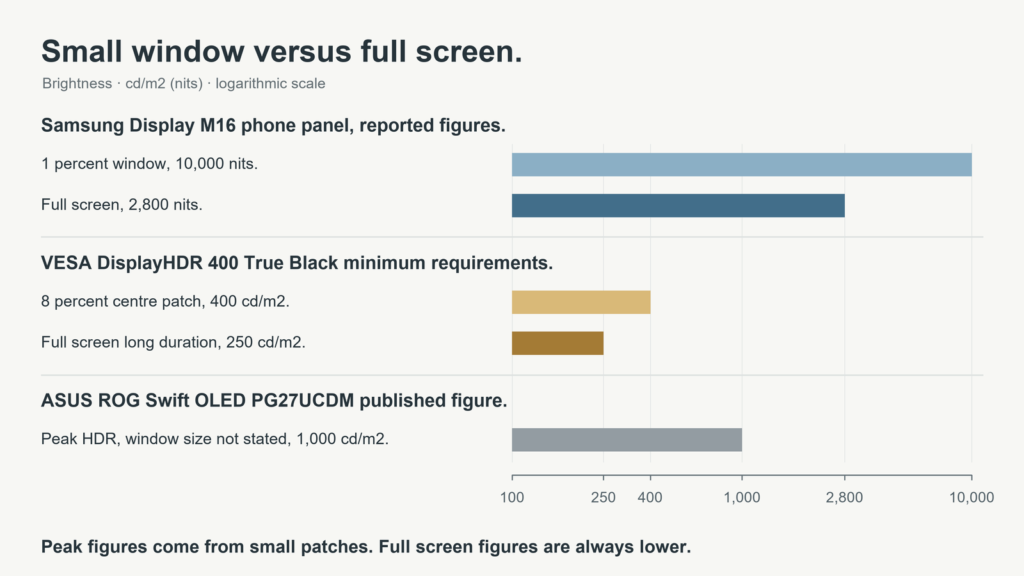
The panel carries the name M16, and it is a smartphone OLED stack rather than a monitor panel. Reports give it a WQHD resolution of 2,560 by 1,440, an LTPO refresh range of 1 Hz to 165 Hz, PWM dimming at 3,300 Hz and up to 30 percent lower power draw than the previous generation. The headline claim is 10,000 nits on a 1 percent window, against 2,800 nits across the full screen.
Coverage does not agree on every detail. Outlets dated the reveal anywhere between September 13 and September 17, 2026, and most tied it to the launch of the iQOO 16 in China. They also disagree about which Apple phones use the stack. None of the material available gives a single official announcement date or a definitive device list. Those two brightness figures, though, appear consistently, and they are the numbers that matter here.
Why one screen carries two brightness numbers
An OLED pixel makes its own light, so the panel draws current in proportion to how much of the screen is lit. Light up 1 percent of the pixels and the power budget concentrates on a tiny area. Light up everything and the same budget spreads out. Panel firmware then limits current to protect the emitters and to keep heat under control. Engineers call that limiter an automatic brightness limiter, and it is why average picture level decides what a screen can do.
So a small white highlight against a dark background gets the full treatment. A white document page does not. Neither result is a defect. They are two points on the same curve.
Inside the VESA DisplayHDR tests
The DisplayHDR program publishes its test conditions, and reading them removes most of the confusion. VESA measures peak luminance on an 8 percent center patch against a 2 percent average picture level background, and the tiers ask for 400, 500, 600, 1000 and 1400 cd/m2 across DisplayHDR 400 through 1400. A full screen flash test uses the same minimum values for the standard tiers.
The interesting column sits further along. For the standard tiers, the full screen long duration test asks for only 320, 320, 350, 600 and 900 cd/m2. For the True Black tiers that OLED panels use, both full screen tests, the flash and the long duration one, ask for 250, 300, 350, 500 and 700 cd/m2. A dual corner box test adds 300, 375, 450, 750 and 1050 cd/m2 with both white corners lit.
Read that carefully and a pattern appears. A DisplayHDR 400 True Black panel has to hit 400 cd/m2 on a small patch and only 250 cd/m2 when the whole screen stays bright. The certification itself builds in the gap.
A monitor whose own paperwork shows the gap
Take a current desktop example. ASUS publishes a peak HDR brightness of 1,000 cd/m2 for the ROG Swift OLED PG27UCDM, a 26.5 inch tandem QD-OLED running 4K at 240 Hz. The footnote attached to that figure says only that peak brightness may vary due to color pre-calibration. No window size appears anywhere on the specification page.
The certification line still tells you something useful. That monitor carries VESA DisplayHDR 400 True Black, so its sustained full screen output needs to clear just 250 cd/m2 to qualify. You can read the published specification and the rest of the panel data on our specification page for the ASUS ROG Swift OLED PG27UCDM. One number describes a highlight. The other sets a floor for everything else.
The arithmetic behind the gap
Area explains most of it. ASUS gives the active area of that 26.5 inch panel as 589.97 by 332.93 mm, which works out to about 0.196 square meters. A 6.9 inch phone screen covers roughly 0.012 to 0.013 square meters, depending on whether the panel is shaped 16:9 or closer to 19.5:9. The monitor therefore lights something like fifteen to seventeen times the area.
Full screen light output costs power in proportion to that area, so the comparison is not a fair fight. Treat it as a rough proportion:
full screen power demand is proportional to luminance multiplied by lit area
Ask a 27 inch panel for the phone’s full screen brightness across its whole surface and you are asking for roughly sixteen times the light output of a phone doing the same thing. Desktop panels also sit in a sealed chassis with no hand wrapped around them, which changes the thermal picture, and not always in the monitor’s favor.
Why the phone figure does not transfer to your desk
Phone panels and monitor panels come off different production lines, with different stacks, different lifetimes and different duty cycles. A phone shows a bright map for two minutes in sunlight. A monitor shows a bright spreadsheet for seven hours. Manufacturers tune the two products for those jobs, so a record set on a 1 percent window in a demonstration room says little about sustained desk work.
There is one honest comparison worth making. A panel that holds that full screen level would outrun the small patch figure quoted for most desktop OLED monitors today. That tells you the materials keep improving. It does not tell you a monitor with those numbers exists, because none currently does.
What to check before you buy an HDR monitor
Start with the window size. A peak figure printed without a stated window cannot be compared with one that names it. Next, read the DisplayHDR tier as a minimum rather than a measurement, because a certified panel may comfortably beat its tier or may sit right on the line. Then ask what the screen does at 100 percent white, since that case decides how a bright web page or a document looks.
Two more checks help. Treat SDR brightness as a separate specification, because most desk work never touches HDR at all. And ignore any comparison between a phone specification and a monitor specification, however tempting the larger number looks.
The number worth trusting
Peak brightness tells you how a small highlight will look. Full screen brightness tells you how a bright page will look. Buyers who mostly play games in dark scenes care about the first. Buyers who stare at white documents care about the second. Samsung Display’s 10,000 nit figure is real under its own test, yet it still says almost nothing about the monitor you will put on your desk this year.