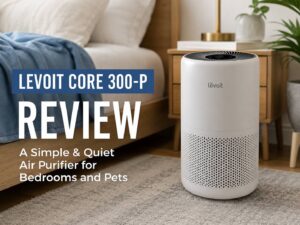
If you bought a Levoit Core purifier or a replacement filter in the US between late August 2019 and early August 2023, you can claim $10 from a class action settlement until November 3, 2026. The case, Sen v. Vesync (US) Corp. in Brooklyn’s Kings County Supreme Court, challenged the “True HEPA,” “HEPA” and “H13” wording on Levoit’s Core and EverestAir purifiers and filters. Vesync, the company behind Levoit, denies all the allegations and settled without the court deciding who was right. The dispute was about the filter’s wording, while the room-size figure a buyer should rely on comes from a different test.
Who the Levoit settlement covers
The class is anyone who bought a Levoit-branded Core or EverestAir purifier, or a replacement filter for one, with “True HEPA,” “HEPA” or “H13” on it, in the United States between August 29, 2019 and August 4, 2023. The Core line includes the Core 200S, Core 300, Core 300S, Core 400S, Core 600S and the Core Mini. Levoit’s Vital and Eleva purifiers are not named, so a Vital 100S bought in the same years does not qualify.
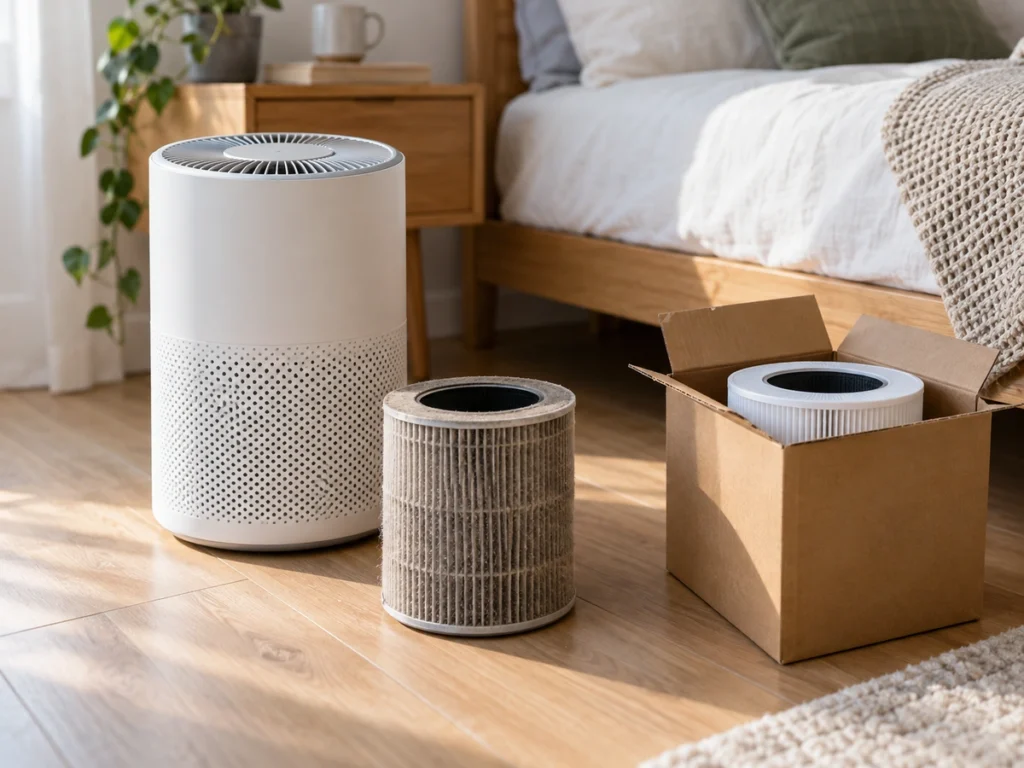
Filters are covered as well as purifiers, so a replacement cartridge bought in 2022 for a Core 300 from 2018 can qualify on its own.
One exclusion is easy to miss. Settlement Insight, a site that tracks class actions and read the signed agreement, reports that section I.GG leaves out people who bought directly from Levoit’s own website or app, because those buyers agreed to arbitration and a class action waiver. The class notice on the settlement website does not repeat that line. According to the same report, the agreement says most sales in the period went through Amazon.com, which is how the parties expect to find most class members.
What the filter labels promised
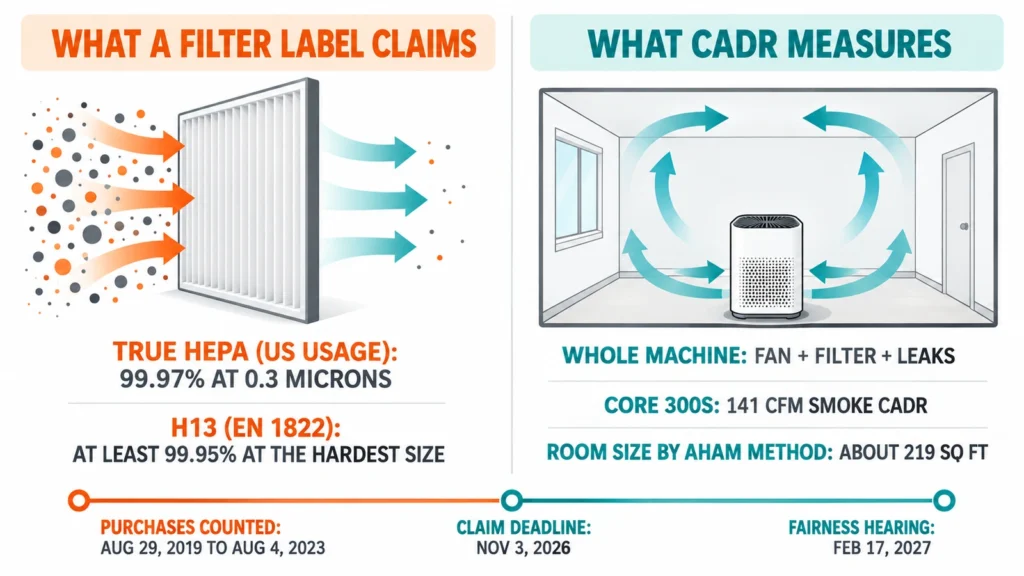
“True HEPA” is a marketing phrase, but buyers read it against a familiar figure: a filter that removes 99.97 percent of particles at 0.3 microns, the definition the US Department of Energy uses for HEPA. H13 is a European class under the EN 1822 standard, which requires at least 99.95 percent at the particle size a filter finds hardest to stop.
According to the plaintiffs, testing arranged by their lawyers found that Levoit’s filters do not meet HEPA standards and do not capture 99.97 percent of particles at 0.3 microns, as its advertising promised. That is the plaintiffs’ account, and the court has not ruled on it.
Levoit’s US store now sells the Core models with a -P suffix, such as the Core 300S-P. Where its replacement filter listings describe the filter media, they call it “HEPA-grade,” and none of them says True HEPA or H13. The Levoit Core 300S uses a sealed three-stage cartridge that Levoit now describes the same way.
Room size comes from CADR
The figure that decides how big a room a purifier can handle is the clean air delivery rate, or CADR, which AHAM measures on the whole machine running in a test chamber. The result already includes whatever the filter really catches, along with how much air the fan pushes and how much leaks around the cartridge. A filter that misses its efficiency label shows up in that number, and the CADR does not depend on what the box says about the filter.
The Core 300S has a smoke CADR of 141 CFM, which AHAM’s method turns into a room of about 219 square feet. Levoit’s marketing gives 1,051 square feet, a figure based on one air change an hour. For allergies, plan around the AHAM size.
So the settlement changes nothing about how a Core purifier performs in your room today. If yours has kept a bedroom comfortable, the settlement is no reason to replace it.
What the claim pays, and when
Each valid claim is a $10 digital payment, sent to the email address or phone number on the form. The fund for payments is capped at $15 million. At $10 a claim, that covers 1.5 million valid claims before any payment shrinks, and if more come in, every payment is cut by the same proportion.
The lawyers’ fees, up to $5,244,500, and $11,500 in awards to the four named plaintiffs are paid by Vesync on top of the fund, so they do not reduce the $10.
Nothing is paid before the fairness hearing on February 17, 2027, and the settlement notice warns that appeals after approval can take “potentially more than one year.” The claim form, as quoted in coverage of the settlement, asks for evidence of purchase showing the original date. Your Orders page on Amazon can be filtered by year, which is the quickest way to find a 2020 or 2021 order. File before November 3 and keep a copy of the order you submit.
Choosing a purifier after the settlement
Read the CADR before the filter label. A purifier with an AHAM-verified smoke CADR tells you what it does to a room, whatever its filter is called. Compare the AHAM room size against your floor area rather than the maker’s air-change figure, and price a year of replacement filters before you buy, because the filters are the running cost.