Noise decides whether an air purifier gets used. A machine that cleans a bedroom beautifully at full speed but sounds like a hairdryer will spend its life on setting one, or switched off at the wall. Manufacturers know this, which is why quiet operation now leads the marketing. The catch is that the reassuring decibel figure and the impressive room-coverage figure almost never describe the same fan speed. Understanding that gap is the difference between a purifier that works in your bedroom and an expensive ornament.
The two numbers come from different places
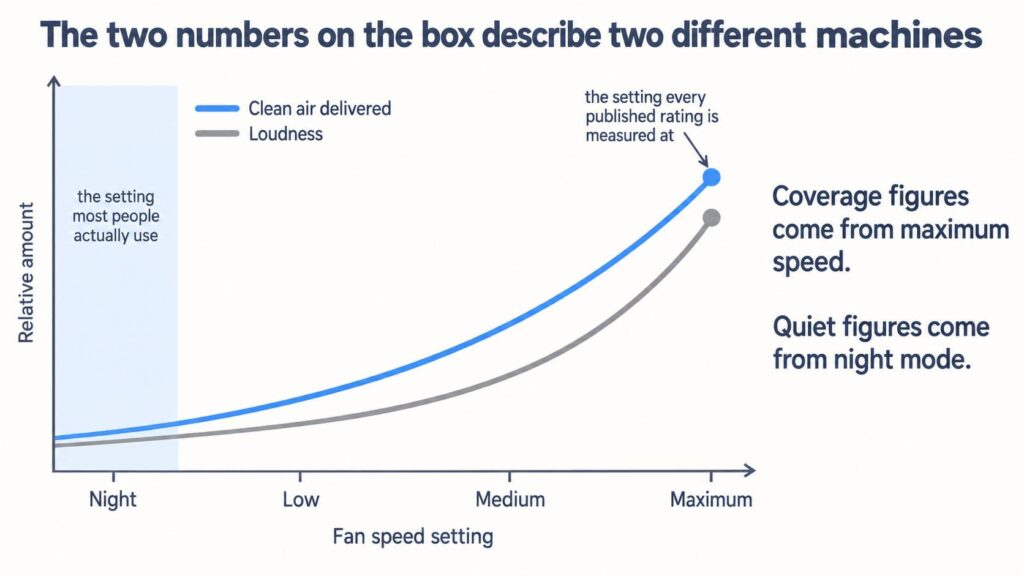
Coverage and clean air delivery rate come from a standardized test. The United States Environmental Protection Agency, in its Guide to Air Cleaners in the Home, states the point directly: the rating is typically measured at the air cleaner’s highest speed. The same guide notes that coverage areas are calculated on an eight-foot ceiling.
Noise figures come from somewhere else entirely. The AHAM seal that appears on many purifiers carries three clean air delivery numbers, one each for tobacco smoke, pollen and dust. A sound level is not among them. Each brand publishes its own noise measurement instead, taken at a distance and in a chamber of its own choosing, usually at the quietest setting the machine offers.
So the box tells you how much air the purifier moves when it is loud, and how quiet it is when it is barely moving any. Both statements are true. Neither describes the machine as you will run it.
A real example of the mismatch
Dyson’s own published specification for the HushJet Purifier Compact makes the pattern easy to see. The company lists a clean air delivery rate of 131 cubic feet per minute, a maximum room size of 203 square feet, and operation at 24 dBA in night mode.
Read in order, those look like one coherent description of a machine. They are not. The 131 figure and the 203 figure belong to full speed. The noise figure belongs to night mode, where the fan is turning far more slowly and moving far less air. Cover a 203 square foot room at night-mode airflow and the number of air changes you get is well below the number the coverage rating assumes.
This is not a criticism of one brand. Almost every purifier data sheet in the category is assembled the same way, and Dyson is unusual in publishing a full specification block at all. If you want the underlying sizing arithmetic, our guide to CADR and air changes per hour works through it properly.
What a decibel figure actually means
Decibels sit on a logarithmic scale. An increase of ten decibels represents ten times the sound intensity, and most listeners perceive it as roughly twice as loud. So a jump from 24 dBA to 34 dBA is a much bigger change than the small-looking gap between the numbers suggests.
The A-weighting in dBA matters too. It discounts very low and very high frequencies to approximate how human hearing responds, which is sensible for comparing machines but hides something relevant at night. A low-frequency hum that measures modestly can still be the thing that keeps you awake, because tonal noise is far more noticeable than broadband hiss at the same level.
That is why two purifiers rated within a decibel of each other can feel completely different in a quiet room.
Where the noise comes from
Fan noise has two main sources. The motor or compressor produces tonal noise at frequencies related to its rotation. The airflow itself produces broadband noise wherever it becomes turbulent, which happens at blade tips, at grilles, and at any sharp change in the shape of the air path.
Engineers can design against that second source. It is the stated approach behind Dyson’s recent purifiers, where the company describes a star-shaped nozzle that reduces turbulence while attenuating the sound waves the high-speed compressor produces. Whether the result justifies the price is a separate question, but the mechanism is the right one. Smoother air paths are how you move more air for the same noise.
Dyson extended that approach across its range at its Dyson Unveiled event in Berlin on September 3, 2026, announcing a new flagship purifier built around a directional version of the same nozzle and stating that the nozzle will be introduced across its air purifiers, heaters and coolers.
How to buy a purifier you will actually leave running
The practical answer follows from the first section. Buy for the speed you intend to use, not the speed the rating was measured at.
- Choose a machine rated for a noticeably larger room than yours. Oversizing lets you run a lower, quieter setting and still move enough air.
- Ask whether the brand publishes airflow or clean air delivery per speed setting. Very few do, and the ones that do are worth rewarding.
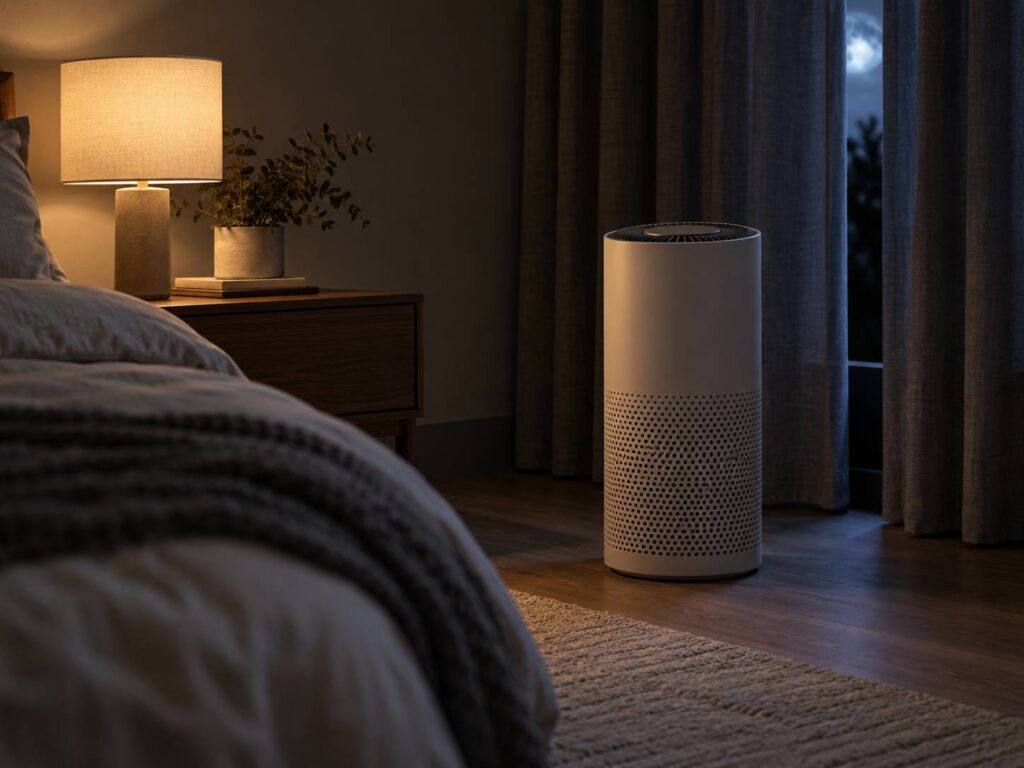
- Check the sleep or night mode behavior. Some machines cap the fan low and stay there. Others lock the fan low but keep the display and sensors active, which defeats the purpose in a dark bedroom.
- Look for a display that switches fully off.
- Prefer a physically larger filter. More filter area means less resistance, and less resistance means less noise for the same airflow.
Two things that change the noise after you buy
Filters load up. As particles fill the media, resistance rises, airflow falls and the fan works harder for the same result. On an automatic machine that shows up as the unit spending more time at higher speeds, which readers often mistake for a fault. It is usually a filter approaching the end of its life.
Placement has a real effect on perceived loudness. A purifier pushed into a corner or against a hard wall reflects its own noise back into the room and restricts its intake at the same time. Pulling it out by a foot or so, and keeping it off a resonant surface such as a hollow cabinet, is free and often more effective than paying for a quieter model.
The honest summary
A quiet purifier is not one with a small number printed on the box. It is one that delivers the air changes your room needs at a speed you are willing to live with. Match the machine to the setting you will really use, and the decibel figure stops being marketing and starts being useful.