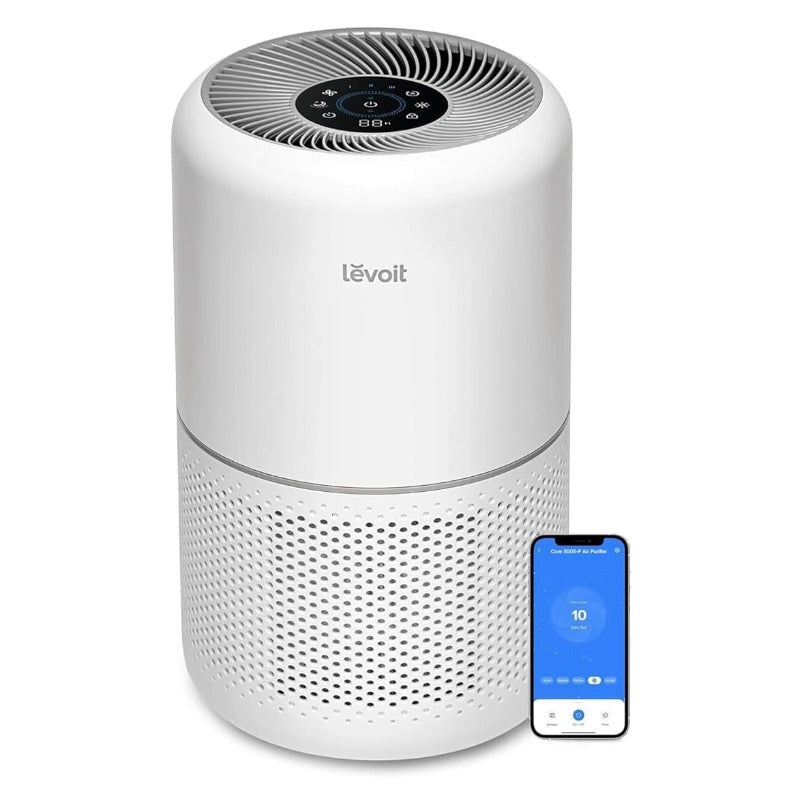
Levoit Core 300S: Specs, Features, Pros & Cons
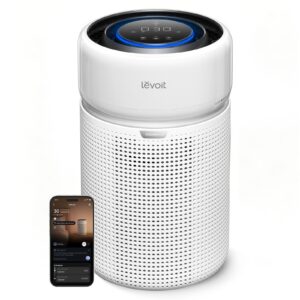
Levoit's Core 300S is the connected member of its small Core line: the VeSync app, voice assistant support and schedules, in a round purifier compact enough to sit on a bedroom floor without being noticed. It also carries a laser dust sensor, and that sensor decides more about living with it than the app does.
The sensor, which Levoit calls AirSight Plus, reads airborne particles, colors a ring on the control panel from blue for clean air to red for bad air, and drives an Auto mode that raises or lowers the fan to match. A burnt slice of toast or a dusty afternoon gets a faster fan without anyone reaching for the button. The app adds Quiet Auto, which never uses fan speed III, and Efficient Auto, which runs at speed III for a room size you choose and then steps down, along with live PM2.5 readings and a week of history. The sensor reads particles only and cannot detect gas, so a cooking smell with no smoke behind it will not move the fan.
The filtering happens in one sealed three-stage cartridge: a pre-filter for hair and lint, a main layer for fine particles and a high-density activated carbon layer for gases and odors. Levoit describes it as HEPA-grade in Sleep Mode and does not use the True HEPA label. The pre-filter is part of the cartridge, so it gets brushed or vacuumed rather than washed, and a check-filter light plus a filter-life percentage in the app say when a new cartridge is due.
At night, Sleep Mode drops the fan below its lowest regular speed, and Auto mode sits at that same quiet setting while the air is clean. The app and voice control need a VeSync account. Levoit's plain Core 300 skips Wi-Fi and runs from its buttons alone.
Category strengths
Where the Levoit Core 300S beats the median
- A much lower power consumption ?23 W vs 45 W (median)
- A much lighter build ?2.7 kg vs 5.26 kg (median)
- A slightly lower min noise level ?22 dB vs 23 dB (median)
- A slightly lower max noise level ?50 dB vs 52 dB (median)
Where the Levoit Core 300S trails the median
- A lower coverage area ?219 sq ft vs 354 sq ft (median)
- No washable pre-filter ?
- A lower filter life ?7 months vs 12 months (median)
- A lower CADR (smoke) ?141 CFM vs 161 CFM (median)
How this VS Score was computed
Score 49: each known spec is measured against the median of all air purifiers (41 products), then weighted; 50 means level with that median. In classes of six or more, a value beyond the class’s 10th–90th percentile range counts as that limit, so one extreme product cannot set the scale. 68% of the scoreable weight could be used; unknown values, features not applicable to this class and proxies (battery capacity where a rated life exists) add or remove nothing.
| Specification | This product | Cohort median | Score weight | Points moved |
|---|---|---|---|---|
| Coverage area | 219 | 354 | 2 | −38.0 |
| App control | Yes | 70% of the class have it | 0.5 | +25.0 |
| Washable pre-filter | No | 54% of the class have it | 0.5 | −24.0 |
| Power consumption | 23 | 45 | 0.5 | +24.0 |
| Filter life | 7 | 12 | 1 | −21.0 |
| Voice assistant | Yes | 64% of the class have it | 0.3 | +15.0 |
| Weight | 2.7 | 5.26 | 0.3 | +14.1 |
| CADR (smoke) | 141 | 161 | 2 | −12.0 |
| Min noise level | 22 | 23 | 1.5 | +3.0 |
| Max noise level | 50 | 52 | 0.5 | +1.0 |
| Air changes per hour | 4.8 | 4.8 | 1 | +0.0 |
| Filtration stages | 3 | 3 | 0.5 | +0.0 |
Not scored: True HEPA filter (unknown: not scored); Activated carbon filter (standard for the class (100% have it)); Sleep mode (standard for the class (95% have it)); Air quality sensor (standard for the class (93% have it)); Auto mode (standard for the class (90% have it)); Filter replacement indicator (standard for the class (97% have it)); Timer (standard for the class (88% have it)).
Editor’s note
Levoit rates the smoke CADR at 141 CFM and lists 219 square feet at 4.8 air changes an hour. Plan an allergy room around that second number. Its headline room size of 1,051 square feet is calculated at one air change an hour, a room the purifier can only slowly influence.
That sizing makes it a bedroom machine, and the hardware agrees. It stands 36 centimeters tall and is rated from 22 dB at its quietest setting, and it joins 2.4 GHz Wi-Fi only.
Levoit says the main filter layer removes 99.97 percent of particles down to 0.3 microns. The cartridge is the running cost. The pre-filter needs a brush or a vacuum every two to four weeks, and the whole cartridge is due every six to eight months, so up to two cartridges a year is the figure to price in before buying. Levoit's manual also lists Pet Allergy and Toxin Absorber cartridges for the same housing, each with a stronger carbon layer, the second aimed at cigarette and wildfire smoke.
Specifications
Quality bars show where each figure sits between the lowest and highest of the 41 air purifiers this VS Score is measured against.
Performance
Filtration
Noise & power
Design
Smart features
Sources and verification
Where the specifications come from
- Official product pagelevoit.com
- Datasheet or manuallevoit.com
- Independent testingrtings.com
Verification
- First published
- Specifications last checked
- Sheet completeness
- 20 of 22 specifications verified; the rest show as Unknown and are never estimated or scored
- Page type
- Product specification page — Compiled from the manufacturer’s published specifications and the cited sources; this is not a hands-on test.
- Basis
- Research-based: specifications and editorial text were compiled from the documents listed here and the manufacturer’s published data. We have not tested this unit ourselves; where independent measurements are mentioned they belong to the linked publication.
Air Purifiers with similar specs to the Levoit Core 300S
Ratings & reviews
No reviews yet. Be the first to share your experience.
The bottom line
The Levoit Core 300S earns a VS Score of 49, below the median of the 41 air purifiers it is measured against (a score of 50 is level with that median).
- Who it’s for
- Bedrooms, nurseries and home offices within its rated area, where Auto mode can follow dust and smoke without anyone touching the controls.
- Who should look elsewhere
- Kitchens and busy living rooms, where the rated area runs out quickly and cooking smells without smoke never register on the particle sensor.
- The trade-off that matters
- A small footprint and hands-off Auto mode against modest airflow and a pre-filter that cannot be washed.
- The main alternative
- Levoit Vital 200S: more airflow for a larger room, plus a washable pre-filter if there are pets in the house.
The VS Score is calculated from the weighted specifications above, each measured against the median of comparable air purifiers — a shortlisting guide, not a substitute for your own priorities. See how we score.