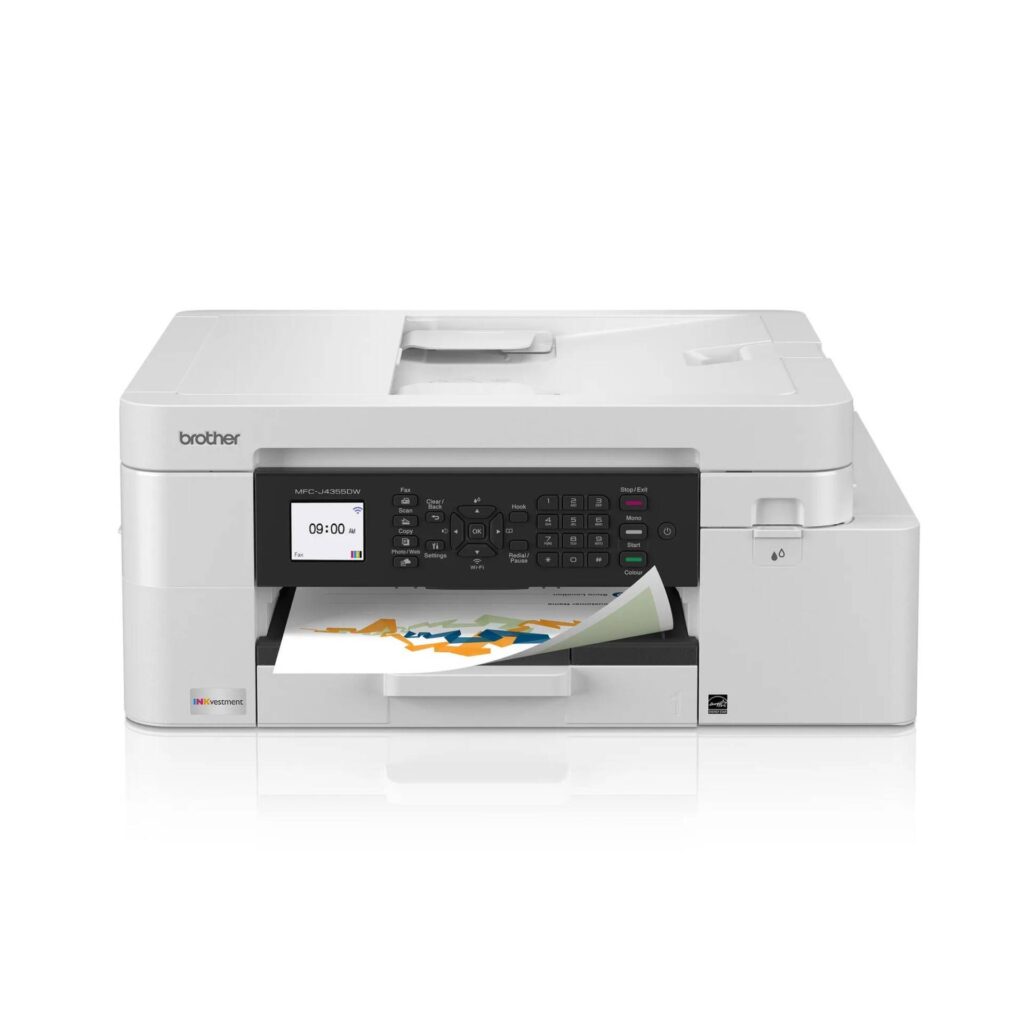
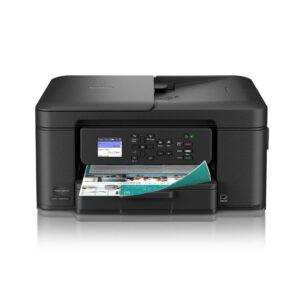
Brother MFC-J4355DW: Specs, Features, Pros & Cons
The J4355DW is the model Brother still lists as current in the middle of its INKvestment family, a set of home-office inkjets whose cartridges feed an internal reservoir. Its older sibling below it has been discontinued, which leaves this one as the everyday pick for buyers who want tank-like ink costs in a compact all-in-one.
Its strength is mixed printing. Color pages print nearly as fast as black ones, so a report with charts takes about as long as one without, and the monthly duty cycle is rated for steady office use. Automatic two-sided printing, a fax modem and a document feeder make up the office side, and most laptops and phones in a house can print to it without extra software.
Next to its discontinued sibling the gain is in the wireless and the memory. Both models print at the same speed and to the same resolution, and this one adds dual-band Wi-Fi and more onboard memory for large jobs, while the printed page itself does not change.
It gives up the fittings a busier office would expect. There is no Ethernet port, the document feeder is smaller than most and scans one side only, and the control panel is a small screen driven by buttons. The body is heavy for its size, so it needs a shelf or a cabinet of its own.
This printer fits a home where color and black pages are mixed and printed every week, and where nobody wants to refill bottles. Its reservoir cartridges keep the look and handling of an ordinary inkjet, which is the reason to choose it over a supertank of similar running cost.
Category strengths
Where the Brother MFC-J4355DW beats the median
- A much higher print speed (color) ?19 ppm vs 9 ppm (median)
- A much higher monthly duty cycle ?30,000 pages vs 10,000 pages (median)
- A higher print speed (black) ?20 ppm vs 16 ppm (median)
- Has fax ?
- A much higher output tray capacity ?100 sheets vs 67.5 sheets (median)
Where the Brother MFC-J4355DW trails the median
- No ethernet ?
- A lower ADF capacity ?20 sheets vs 35 sheets (median)
- A heavier build ?8.9 kg vs 7.98 kg (median)
How this VS Score was computed
Score 60: each known spec is measured against the median of all printers (65 products), then weighted; 50 means level with that median. In classes of six or more, a value beyond the class’s 10th–90th percentile range counts as that limit, so one extreme product cannot set the scale. 66% of the scoreable weight could be used; unknown values, features not applicable to this class and proxies (battery capacity where a rated life exists) add or remove nothing.
| Specification | This product | Cohort median | Score weight | Points moved |
|---|---|---|---|---|
| Print speed (color) | 19 | 9 | 1 | +50.0 |
| Automatic duplex printing | Yes | 73% of the class have it | 1 | +50.0 |
| Automatic document feeder | Yes | 55% of the class have it | 1 | +50.0 |
| Print speed (black) | 20 | 16 | 2 | +26.0 |
| Supertank / refillable ink | No | 30% of the class have it | 0.5 | −24.0 |
| Duplex scanning | No | 23% of the class have it | 0.5 | −24.0 |
| Ethernet | No | 54% of the class have it | 0.5 | −24.0 |
| Touchscreen display | No | 45% of the class have it | 0.5 | −24.0 |
| Monthly duty cycle | 30,000 | 10,000 | 0.3 | +15.0 |
| ADF capacity | 20 | 35 | 0.5 | −10.5 |
| Fax | Yes | 35% of the class have it | 0.2 | +10.0 |
| Output tray capacity | 100 | 67.5 | 0.3 | +7.2 |
| Weight | 8.9 | 7.98 | 0.3 | −1.5 |
| Print resolution | 4,800 | 4,800 | 0.5 | +0.0 |
| Input tray capacity | 150 | 150 | 1 | +0.0 |
Not scored: Color printing (standard for the class (88% have it)); All-in-one (standard for the class (85% have it)); Wi-Fi (standard for the class (97% have it)); Wi-Fi Direct (standard for the class (90% have it)); USB (standard for the class (100% have it)); Apple AirPrint (standard for the class (97% have it)); Mobile app printing (standard for the class (100% have it)).
Editor’s note
If you have decided the INKvestment approach makes sense (cartridges that feed an internal reservoir, roughly a year of ink in the box, and replacement costs closer to a tank printer than a normal inkjet), this is the model in the family I would buy. It sits in the middle of three, and it is worth being precise about what the premium over the J4335DW below it buys. Both machines are rated at 20 ppm black and 19 ppm color and both top out at 1200 x 4800 dpi, so it is not speed or print quality. It is dual-band Wi-Fi, more onboard memory, and a model Brother still lists as current rather than discontinued.
It is a competent, unglamorous machine. Automatic duplex printing is standard, the tray holds 150 sheets, and the software side covers what you would expect: AirPrint, Mopria, Chromebook support, WPA3 on the wireless.
The omissions are consistent and worth taking seriously. There is no Ethernet port on an office all-in-one at this price, which still surprises me. A wired socket at the desk is no use to it. The 20-sheet feeder scans one side only, so double-sided originals are a manual job. The display is a 1.8-inch non-touch panel. Duplex printing is limited to Letter size, so two-sided legal work is out. The fax modem is 14.4 kbps.
None of that matters much to the audience this fits: a household or one-person business printing a few hundred mixed pages a month, mostly documents with occasional color, that wants the ink bill to stay boring.
Where I would steer you away is volume and format. If you print mostly black text in real quantity, a mono laser will be faster, cheaper over time and far less bothered by sitting idle. Inkjets that go weeks between jobs are the ones that clog, and no ink system fixes that.
Specifications
Quality bars show where each figure sits between the lowest and highest of the 65 printers this VS Score is measured against.
Printing
Scanning & copying
Paper handling
Connectivity
Design
Sources and verification
Where the specifications come from
- Official product pagebrother-usa.com
- Independent testingrtings.com
Verification
- First published
- Specifications last checked
- Sheet completeness
- 24 of 24 specifications verified; the rest show as Unknown and are never estimated or scored
- Page type
- Product specification page — Compiled from the manufacturer’s published specifications and the cited sources; this is not a hands-on test.
- Basis
- Research-based: specifications and editorial text were compiled from the documents listed here and the manufacturer’s published data. We have not tested this unit ourselves; where independent measurements are mentioned they belong to the linked publication.
Printers with similar specs to the Brother MFC-J4355DW
Ratings & reviews
No reviews yet. Be the first to share your experience.
The bottom line
The Brother MFC-J4355DW earns a VS Score of 60, above the median of the 65 printers it is measured against (a score of 50 is level with that median).
- Who it’s for
- A household or one-person office printing a few hundred mixed pages a month that wants predictable, low ink costs without moving to a bulky supertank.
- Who should look elsewhere
- Desks that need a wired network connection, anyone scanning double-sided originals in quantity, and high-volume black text work, which belongs on a laser.
- The trade-off that matters
- Low running costs and a compact body against missing office fundamentals: no Ethernet, no duplex scanning, and two-sided printing that stops at Letter size.
- The main alternative
- Brother MFC-L2820DW costs about the same and answers the document-volume case instead: 34 ppm laser output, wired Ethernet and a touchscreen, if you can live without color.
The VS Score is calculated from the weighted specifications above, each measured against the median of comparable printers — a shortlisting guide, not a substitute for your own priorities. See how we score.