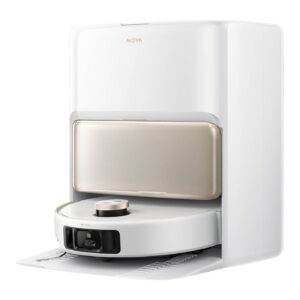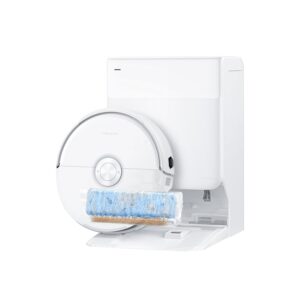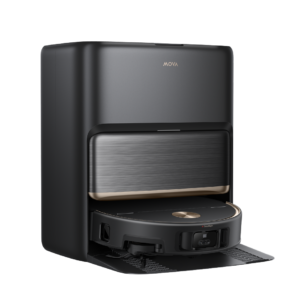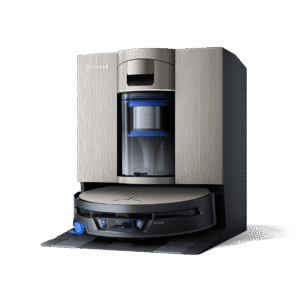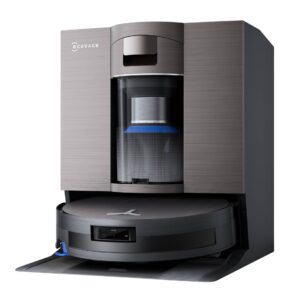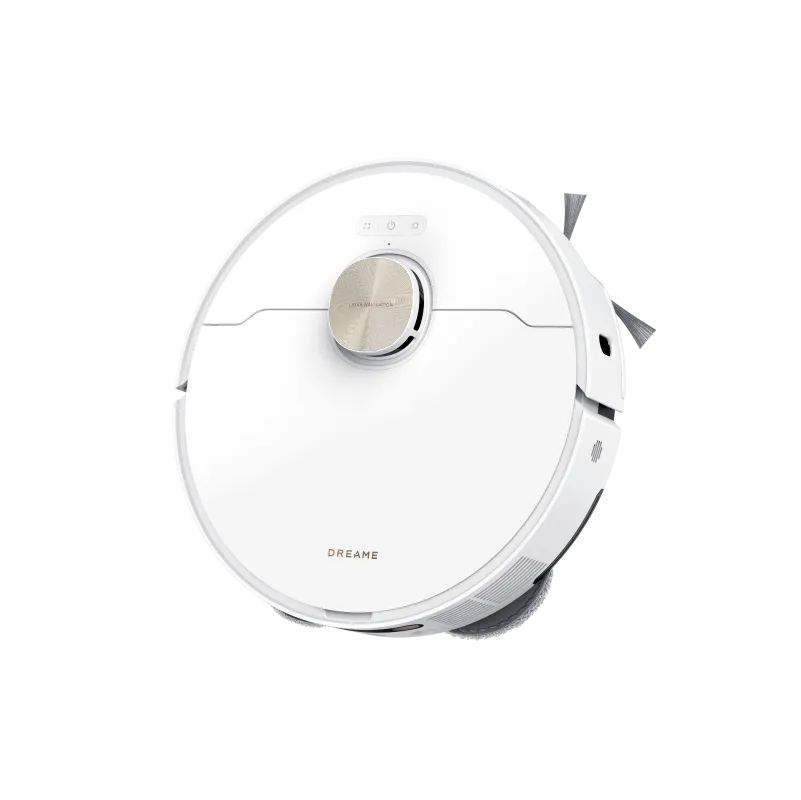
Dreame L50 Ultra: Specs, Features, Pros & Cons
Most robot vacuums deal with a raised threshold by having a slightly bigger wheel. The L50 Ultra deals with it by standing up.
Dreame calls the mechanism ProLeap, and it is retractable legs in the literal sense: the chassis lifts itself over an obstacle instead of trying to roll across it. The figure that matters in an ordinary home is 1.65 inches, roughly 42 mm, over a single vertical step, at a point where most capable machines give up around 20 mm. The 2.36 inches in the advertising is a different measurement. It applies to a double threshold with a gap between the steps, or to a single obstacle when you also buy Dreame's climbing mat, which is sold separately.
Everything else is conventional flagship equipment, competently done. Suction is quoted at 19,500 Pa, navigation uses a laser turret rather than a camera, and obstacle avoidance combines an RGB camera with 3D structured light. The dock empties the bin, refills the water tank, doses its own detergent, washes the mop pads in hot water and dries them with warm air. Pads lift 10.5 mm clear of carpet and come off entirely when the work is vacuuming only.
The battery is 6,400 mAh, rated for about 200 minutes and roughly 2,000 square feet in the quietest mode, so floor area is not the limiting factor here, reach is.
Two things are worth checking before buying. At 97 mm tall this is not a low-profile robot, and the clearance under a sofa or a bed frame decides whether it can go there at all. And unlike the lower-tier L40 Ultra, it carries no built-in voice control, only third-party assistants. That is a minor loss, but a strange one on the more expensive model. In a flat, open apartment, most of what you are paying for never gets used.
Category strengths
Where the Dreame L50 Ultra beats the median
- Has automatic mop removal ?
- A much higher threshold clearance ?42 mm vs 24 mm (median)
- A bigger dustbin ?395 ml vs 300 ml (median)
- A bigger battery ?6,400 mAh vs 5,200 mAh (median)
- More cleaning modes ?
- A slightly longer runtime per charge ?200 min vs 194 min (median)
Where the Dreame L50 Ultra trails the median
- A smaller cleaning area ?186 m² vs 226 m² (median)
- Slightly weaker suction ?19,500 Pa vs 19,750 Pa (median)
How this VS Score was computed
Score 63: each known spec is measured against the median of all robot vacuums (58 products), then weighted; 50 means level with that median. In classes of six or more, a value beyond the class’s 10th–90th percentile range counts as that limit, so one extreme product cannot set the scale. 54% of the scoreable weight could be used; unknown values, features not applicable to this class and proxies (battery capacity where a rated life exists) add or remove nothing.
| Specification | This product | Cohort median | Score weight | Points moved |
|---|---|---|---|---|
| Mopping | Yes | 79% of the class have it | 0.6 | +30.0 |
| Edge-cleaning extension | Yes | 79% of the class have it | 0.4 | +20.0 |
| Automatic mop removal | Yes | 37% of the class have it | 0.4 | +20.0 |
| Dirt detection & re-mop | Yes | 79% of the class have it | 0.4 | +20.0 |
| HEPA filter | No | 29% of the class have it | 0.4 | −19.2 |
| Automatic detergent dispenser | Yes | 76% of the class have it | 0.3 | +15.0 |
| Threshold clearance | 42 | 24 | 0.3 | +11.4 |
| Dustbin capacity | 395 | 300 | 0.4 | +6.4 |
| Battery capacity | 6,400 | 5,200 | 0.5 | +6.0 |
| Cleaning modes | 5 | 4 | 0.3 | +3.9 |
| Max cleaning area | 186 — capped at the class’s lower range (200) | 226 | 0.6 | −3.6 |
| Runtime | 200 | 194 | 0.8 | +1.6 |
| Suction power | 19,500 | 19,750 | 1.2 | −1.2 |
| Mop lift | 10.5 | 10.5 | 0.3 | +0.0 |
| Navigation | LiDAR | LiDAR | 1 | +0.0 |
| Mop wash temperature | 75 | 75 | 0.3 | +0.0 |
| Height | 97 | 96.8 | 0.5 | +0.0 |
Not scored: Carpet detection (standard for the class (98% have it)); Mapping (standard for the class (98% have it)); Multi-floor maps (unknown: not scored); Obstacle avoidance (standard for the class (100% have it)); No-go zones (standard for the class (100% have it)); Recharge & resume (standard for the class (95% have it)); Self-empty dock (standard for the class (91% have it)); Auto-refill mop (standard for the class (87% have it)); Mop self-cleaning (standard for the class (92% have it)); Warm-air drying temperature (unknown: not scored); Water tank (unknown: not scored); Noise level (unknown: not scored); App control (standard for the class (100% have it)); Voice assistant (standard for the class (100% have it)); Scheduling (standard for the class (100% have it)); Zone / room cleaning (standard for the class (100% have it)); Washable filter (standard for the class (88% have it)); Anti-tangle brush (standard for the class (98% have it)); Removable mop pads (standard for the class (90% have it)).
Editor’s note
The legs are the entire argument for this machine, so it is worth being blunt about when they earn their price.
If your home has raised door saddles, a bathroom lip, a step down into a living room or thick rug edges, this is one of very few robots that will finish the whole floor instead of mapping a room it cannot enter. That is a real problem being solved. If your floors are flat, the mechanism will never engage, and a cheaper Dreame with the same dock will clean your house to the same standard for noticeably less money.
I would read the climbing claims with some care. Both the single-step and the double-step figures come from Dreame's own lab, and the headline one depends on conditions most homes do not have. The legs are rated for 30,000 cycles, which is reassuring, though it remains a moving part on a machine that could have been designed without one.
The rest is hard to fault. Laser navigation means it works in an unlit house, which camera-only robots cannot do. The dock does everything a dock currently can, including dosing its own detergent and sending the robot back to rewash the mop and remop the floor when it detects dirt. The DuoBrush handles long hair without wrapping.
The compromises are small but worth knowing: the robot's height rules out some low furniture, and there is no HEPA claim on the filter.
The obvious rival is the Roborock Qrevo Curv 2 Flow, which attacks the same problem with a lifting chassis rather than legs. Compare their threshold figures directly, because very little else separates them.
Specifications
Quality bars show where each figure sits between the lowest and highest of the 58 robot vacuums this VS Score is measured against.
Cleaning
Navigation
Battery & dock
Design
Smart features
Maintenance & filtration
Sources and verification
Where the specifications come from
- Official product pagedreametech.com
- Independent testingrtings.com
Verification
- First published
- Specifications last checked
- Sheet completeness
- 34 of 39 specifications verified; the rest show as Unknown and are never estimated or scored
- Page type
- Product specification page — Compiled from the manufacturer’s published specifications and the cited sources; this is not a hands-on test.
- Basis
- Research-based: specifications and editorial text were compiled from the documents listed here and the manufacturer’s published data. We have not tested this unit ourselves; where independent measurements are mentioned they belong to the linked publication.
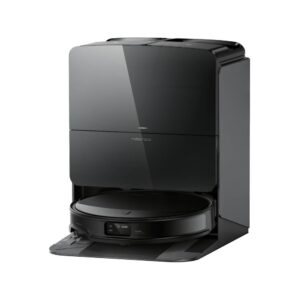
Robot Vacuums with similar specs to the Dreame L50 Ultra
Ratings & reviews
No reviews yet. Be the first to share your experience.
The bottom line
The Dreame L50 Ultra earns a VS Score of 63, above the median of the 58 robot vacuums it is measured against (a score of 50 is level with that median).
- Who it’s for
- Homes with raised door saddles, a bathroom lip or a step between rooms. The retractable legs clear thresholds that stop most robots, and that decides whether the whole floor gets cleaned.
- Who should look elsewhere
- Flat single-level apartments, where the climbing mechanism never engages and a cheaper Dreame with the same dock does identical work. Also anyone whose sofa or bed frame sits lower than the robot is tall.
- The trade-off that matters
- You are paying flagship money for a moving mechanism most robots do without. On awkward floors it is transformative, and on flat ones it is weight and complexity you never use.
- The main alternative
- Roborock Qrevo Curv 2 Flow, for the same threshold problem solved with a lifting chassis in place of legs.
The VS Score is calculated from the weighted specifications above, each measured against the median of comparable robot vacuums — a shortlisting guide, not a substitute for your own priorities. See how we score.