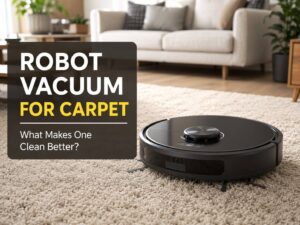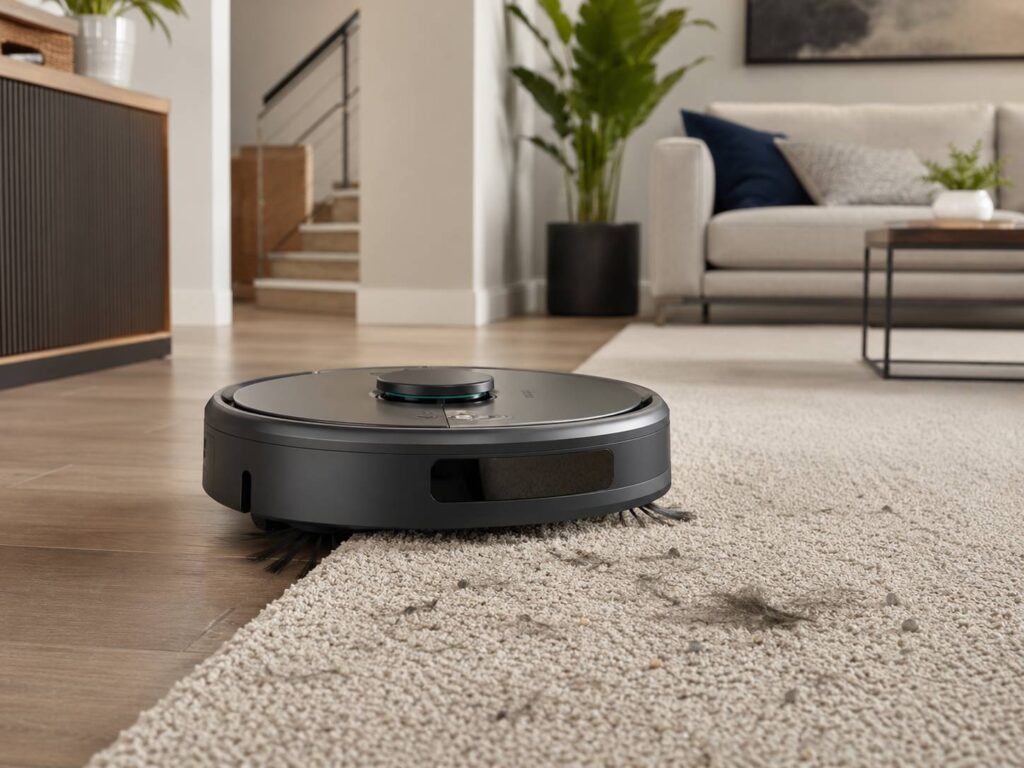
Robot vacuum suction numbers keep climbing. One model may advertise 10,000 Pa, while another claims 18,000 Pa, 20,000 Pa, or even more. At first glance, it seems logical to assume that the robot with the highest number will clean carpets best.
Real-world carpet cleaning is more complicated than that.
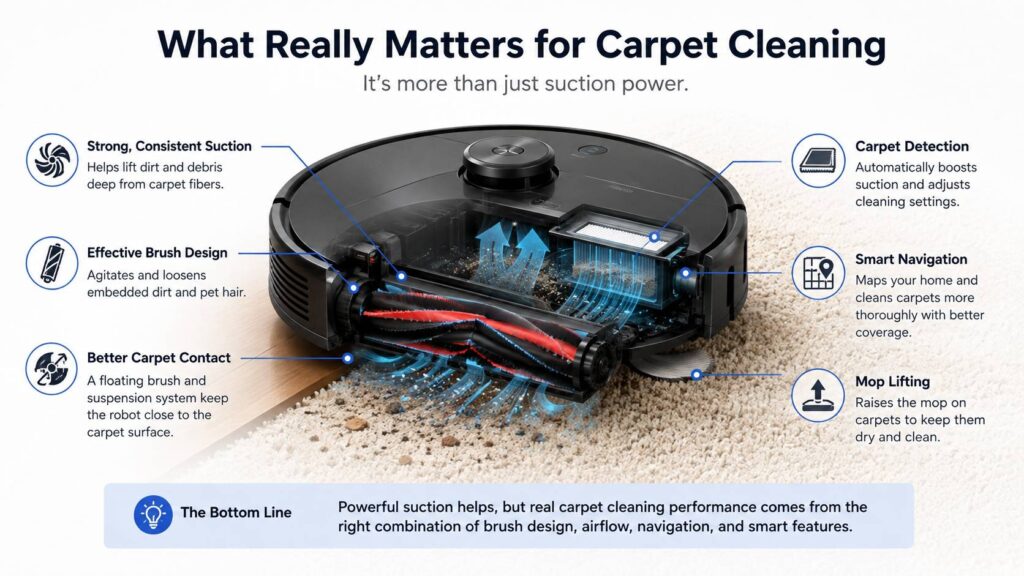
Strong suction certainly helps remove dust, crumbs, pet hair, and other debris. Still, a robot vacuum also needs an effective brush system, good contact with the carpet, steady airflow, accurate navigation, and smart carpet detection.
Those parts need to work together. A robot with impressive suction but a weak brush design may leave more dirt behind than a less powerful model with better agitation and carpet-specific cleaning modes.
What Robot Vacuum Suction Power Actually Means
Robot vacuum manufacturers usually express suction pressure in pascals, or Pa. A higher number means the vacuum system can create a greater pressure difference under the conditions used for that measurement.
That specification is useful, but it does not tell you everything about carpet-cleaning performance.
A suction rating does not reveal:
- How well the main roller agitates carpet fibers
- How closely the cleaning head follows the floor
- How much airflow moves through the intake
- Whether hair quickly wraps around the roller
- How fast the robot travels over carpet
- How many passes it makes
- How accurately it detects rugs and carpet
- How much airflow drops when the filter becomes dirty
- Whether the robot can move properly over thick carpet
In practical terms, suction is only one part of the cleaning system.
Carpet-cleaning performance depends on how effectively the robot loosens debris first and then moves that debris into the dustbin.
Brush Agitation Makes a Big Difference on Carpet
Carpet traps dirt differently from tile, laminate, or hardwood.
On a smooth floor, crumbs and dust usually sit on the surface. The robot mainly needs to sweep those particles toward the intake and vacuum them up.
Carpet creates a tougher challenge. Fine dust can settle between fibers, pet hair may become intertwined with the pile, and heavier particles can work their way below the visible surface.
This is where the main brush becomes especially important.
A rotating roller physically disturbs the carpet fibers and loosens debris. Once that material moves, the vacuum system has a much better chance of pulling it into the dustbin.
Robot vacuum manufacturers use several brush designs. Common options include rubber rollers, bristled brushes, hybrid rollers, and dual-roller systems.
Dual rollers can provide more mechanical interaction with the surface, while rubber designs can reduce certain types of hair tangling. Neither design is automatically superior in every home, though.
What matters most is how effectively the roller reaches the carpet and moves trapped debris toward the intake.
Cleaning Head Contact Is Easy to Overlook
A powerful motor cannot compensate fully for a cleaning head that sits too far away from the carpet.
Carpet height varies considerably. A thin, low-pile rug creates a very different cleaning surface from a thick bedroom carpet or deep-pile rug.
To handle these differences, many robot vacuums use movable or floating brush assemblies. The cleaning head can adjust as floor height changes instead of remaining completely fixed.
Better contact helps in two ways.
First, the roller can reach the carpet fibers more effectively. Second, the intake can maintain a better airflow path around loosened debris.
This explains why simply increasing motor power eventually has diminishing benefits. If the brush and intake cannot interact properly with the carpet, some of that extra suction potential may be wasted.
Suction and Airflow Are Not the Same Thing
Suction pressure receives most of the marketing attention, but airflow also matters.
The vacuum system needs enough pressure to lift debris. At the same time, moving air needs to carry that debris through the intake and into the dustbin.
Anything that restricts this path can reduce cleaning performance.
A clogged filter is one common problem. Packed dust around the intake can also interfere with airflow, while an overfilled bin gives debris less space to collect.
Hair creates another issue.
Long hair and pet fur can wrap around traditional rollers. As the buildup grows, the brush may rotate less effectively and stop making proper contact with the carpet.
That is why anti-tangle rollers, comb systems, redesigned roller ends, and hair-cutting mechanisms have become increasingly common.
These features might not look as impressive on a specifications page as a huge Pa number. For everyday carpet cleaning, though, they can make a noticeable difference.
Carpet Boost Helps Put Extra Power Where It Matters
Many current robot vacuums can automatically increase suction after detecting carpet.
Instead of running at full power across the entire house, the robot uses stronger suction where it provides the most benefit. Once the machine returns to hard flooring, it can reduce power again.
This approach has several advantages.
Carpet generally benefits more from increased suction than a smooth floor does. Lower power on hard flooring can also reduce battery use and noise.
Carpet detection works differently depending on the manufacturer. Some robots rely on ultrasonic sensing, while others detect changes in floor conditions using different sensor systems.
More advanced robots can do far more than increase suction.
Depending on the model, carpet detection may trigger:
- Higher suction
- Slower movement
- Additional cleaning passes
- Different cleaning patterns
- Mop lifting
- Mop removal
- Carpet avoidance
That wider set of behaviors tells you more about carpet performance than the suction figure alone.
Multiple Passes Can Matter More Than Maximum Power
Consider two robots cleaning the same rug.
One crosses the area once using maximum suction. The second slows down, boosts suction, and cleans the carpet twice from different directions.
The second robot gets more chances to loosen and collect debris hidden between carpet fibers.
Many newer robot vacuums now include deeper carpet-cleaning modes that work this way. Some perform a second pass, while others use a cross-pattern to approach the carpet from another direction.
Navigation software makes this possible.
A robot that understands where rugs and carpeted zones are located can adjust its behavior instead of treating the entire home as one continuous floor.
Navigation Directly Affects Cleaning Quality
Smart navigation is sometimes treated as a convenience feature, but it also affects how well a robot cleans.
A vacuum cannot remove dirt from places it repeatedly misses.
Modern mapping systems allow robots to follow organized routes through rooms rather than relying entirely on random movement. Better maps also make carpet-specific cleaning possible.
For example, a capable robot may be able to:
- Identify individual rugs
- Boost suction only on carpet
- Vacuum carpets before starting wet mopping
- Perform additional carpet passes
- Avoid delicate rugs
- Apply separate settings to different rooms
These options become especially useful in homes that combine several flooring types.
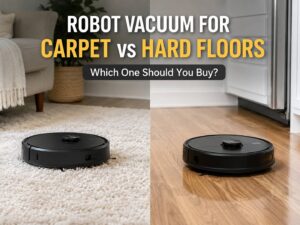
If your home has both rugs and hard flooring, it is also worth understanding the broader differences between a robot vacuum for carpet vs hard floors. Brush design, mop behavior, suction settings, and floor detection can all become more important in mixed-surface homes.
A thin living-room rug, for example, may handle aggressive cleaning without trouble. A lightweight bathroom mat could fold underneath the same robot.
Simply increasing suction will not solve that difference. Better detection and more flexible cleaning controls usually help more.
More Suction Can Sometimes Create New Problems
There are situations where very strong suction is not ideal.
Lightweight rugs may get pulled upward toward the main brush. Their edges can fold underneath the robot, interfere with the roller, or cause the machine to stop.
Reducing suction can sometimes solve this problem. Securing the rug or creating a restricted zone may also help.
Thick carpets bring another set of challenges.
Long fibers can interfere with the main roller, side brush, wheels, or mop-lifting mechanism. Some robots simply cannot move reliably over deep-pile or shag-style rugs.
That is why carpet compatibility deserves attention before buying.
A robot can have an extremely powerful motor and still be a poor choice for a thick rug.
Mop Lifting Has Become Part of Carpet Cleaning
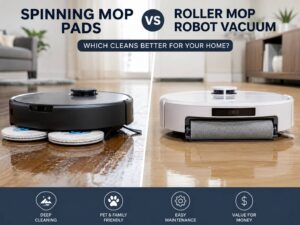
Combination robot vacuums introduce one more problem. They need to vacuum carpet without dragging wet mop pads across it.
Basic vacuum-and-mop robots may require you to remove the mop manually before cleaning carpeted areas.
More advanced designs can raise their mop pads automatically when carpet is detected. Some robots go further and return to the dock to remove their mops before vacuuming certain areas.
Both approaches can be useful, but mop lifting has physical limits.
A raised mop may clear a low-pile carpet without trouble. Thick carpet fibers can still reach the mop pad if the lifting height is not sufficient.
For higher carpets, vacuum-only cleaning, automatic mop removal, or carpet avoidance may provide a safer option.
This is especially relevant if you use scheduled cleaning and expect the robot to work without supervision.
Carpet-First Cleaning Can Reduce Mop Problems
Some robot vacuums can clean carpet before starting the wet-mopping portion of a cleaning cycle.
The idea is fairly simple.
The robot vacuums rugs and carpet while the mop system is still dry. Once carpet cleaning is finished, it can move on to wet cleaning on suitable hard floors.
This reduces the chance of moisture reaching carpeted surfaces.
It also gives the robot more freedom to use stronger carpet settings before beginning the mopping stage.
For homes with mixed flooring, the order of cleaning can matter almost as much as raw suction.
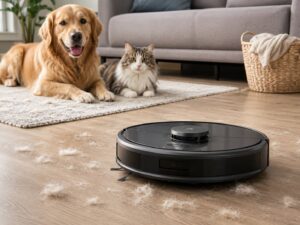
Pet Hair Needs Good Agitation and Hair Management
Pet hair is one of the best examples of why suction alone can be misleading.
Hair resting on hardwood or tile is relatively easy to collect. Once it becomes pressed into carpet fibers, the job becomes harder.
The roller needs to grab and loosen the hair before airflow can carry it away.
Brush maintenance also becomes more important.
If pet hair constantly wraps around the roller, performance can slowly decline between cleaning sessions. Anti-tangle designs can reduce this problem and cut down the amount of manual maintenance required.
For a carpeted home with pets, look at the entire brush system.
Carpet boost, dual rollers, anti-tangle features, repeated passes, and reliable navigation can matter just as much as the advertised maximum suction.
Low-Pile and High-Pile Carpet Need Different Treatment
Robot vacuums generally have the easiest time with low-pile carpet.
The wheels can move across it more easily, while the cleaning head stays relatively close to the surface. Automatic mop lifting is also more likely to keep wet pads safely above shorter fibers.
Medium-pile carpet can create more rolling resistance and place greater demands on the brush.
High-pile carpet and shag rugs are harder still.
Long fibers may catch rotating brushes, interfere with the wheels, or reach a raised mop pad. Thick carpet can also affect obstacle detection and navigation.
Before choosing a robot specifically for carpet, check the manufacturer’s guidance for supported carpet types.
Rug tassels deserve attention too. They can wrap around side brushes or the main roller. Folding tassels underneath the rug or creating a restricted cleaning zone can prevent problems.
Maintenance Has a Bigger Impact Than It Seems
Even an excellent robot vacuum will lose performance if basic maintenance gets ignored.
A dirty filter restricts airflow. Hair around the main roller reduces agitation. Packed debris around the intake can interfere with pickup, while a full dustbin leaves less room for new dirt.
Carpet often makes these issues more noticeable because embedded debris requires more effort to remove.
Regular maintenance usually includes:
- Emptying the dustbin when necessary
- Cleaning or replacing filters as recommended
- Removing hair from the main roller
- Checking the brush housing for trapped debris
- Cleaning wheels and side brushes
- Keeping carpet-detection sensors clean
A properly maintained midrange robot may easily outperform a more powerful machine that has a blocked filter and tangled roller.
What to Look for in a Robot Vacuum for Carpet
If carpet cleaning matters in your home, avoid choosing a robot based only on the largest suction number.
Look at the complete cleaning system instead.
Effective main brush: The roller should make good contact with carpet and loosen trapped debris.
Automatic carpet detection: Reliable floor recognition allows the robot to apply stronger settings where needed.
Carpet boost: Higher suction on carpet can improve pickup without wasting battery across the entire home.
Multiple cleaning passes: A second pass gives the robot another opportunity to remove embedded dirt and hair.
Accurate navigation: Good mapping reduces missed areas and supports carpet-specific routines.
Anti-tangle design: This is especially useful for pet owners and households with long hair.
Suitable mop management: Mop lifting, mop removal, or carpet avoidance can prevent wet pads from touching rugs.
Carpet compatibility: Check whether the robot can handle your rug thickness and floor transitions.
Easy maintenance: Accessible rollers and filters make it much easier to keep performance consistent.
Suction still matters. It just works best as part of a well-designed cleaning system.
Does Higher Pa Mean Better Carpet Cleaning?
Not automatically.
If two robot vacuums were completely identical except for suction power, additional suction could improve debris pickup under certain conditions.
Real products are rarely identical.
Different robots use different brushes, intake designs, wheels, carpet sensors, airflow paths, cleaning speeds, and navigation software.
Because of those differences, a higher maximum Pa rating does not guarantee better carpet cleaning.
Actual debris pickup gives a much clearer picture.
This also explains why a robot can perform extremely well on hard floors but only moderately well on carpet. Each surface requires a different balance of agitation, airflow, and contact.
Can a Robot Vacuum Deep-Clean Carpet?
A capable robot vacuum can do an excellent job of routine carpet maintenance.
Frequent automated cleaning removes loose dust, crumbs, pet hair, and dry debris before large amounts accumulate.
Still, robot vacuums are not direct replacements for every type of carpet-cleaning machine.
A standard robot performs dry vacuuming. It cannot replace a carpet extractor that applies cleaning solution and removes dirty water from the carpet.
A full-size upright or canister vacuum may also provide stronger mechanical agitation on some carpet types.
The biggest strength of a robot vacuum is frequency.
Because it can clean regularly with very little effort from you, it helps prevent debris from building up between deeper manual cleaning sessions.
Why the Whole Cleaning System Matters
Robot vacuum carpet cleaning depends on much more than motor power.
Strong suction can help remove material trapped below the top layer of carpet. For that suction to work properly, though, the robot also needs an effective roller, good carpet contact, steady airflow, reliable navigation, and suitable carpet-specific settings.
Modern machines increasingly combine these features with automatic carpet boost, anti-tangle rollers, repeated passes, mop lifting, mop removal, and smarter cleaning routes.
Those features rarely produce one huge number that looks impressive on a product page. Together, though, they can have a much larger effect on everyday carpet cleaning.
So, when comparing robot vacuums for a carpeted home, treat suction power as one useful specification rather than the final answer.
A robot that cleans carpet intelligently will often be the better choice.