Robot vacuum mops have changed a lot in a short time. Older models often dragged a damp cloth across the floor and called it mopping. That helped with light dust, but it did not do much for dried coffee, muddy paw marks, sticky juice, or greasy kitchen film.
Newer robot vacuum and mop combos are much more useful. Many now wash their mop pads at the dock, dry them with warm air, lift the mop over carpets, refill their water tanks, and clean by room. Some premium models even use hot water, edge mopping, and separate clean and dirty water systems.
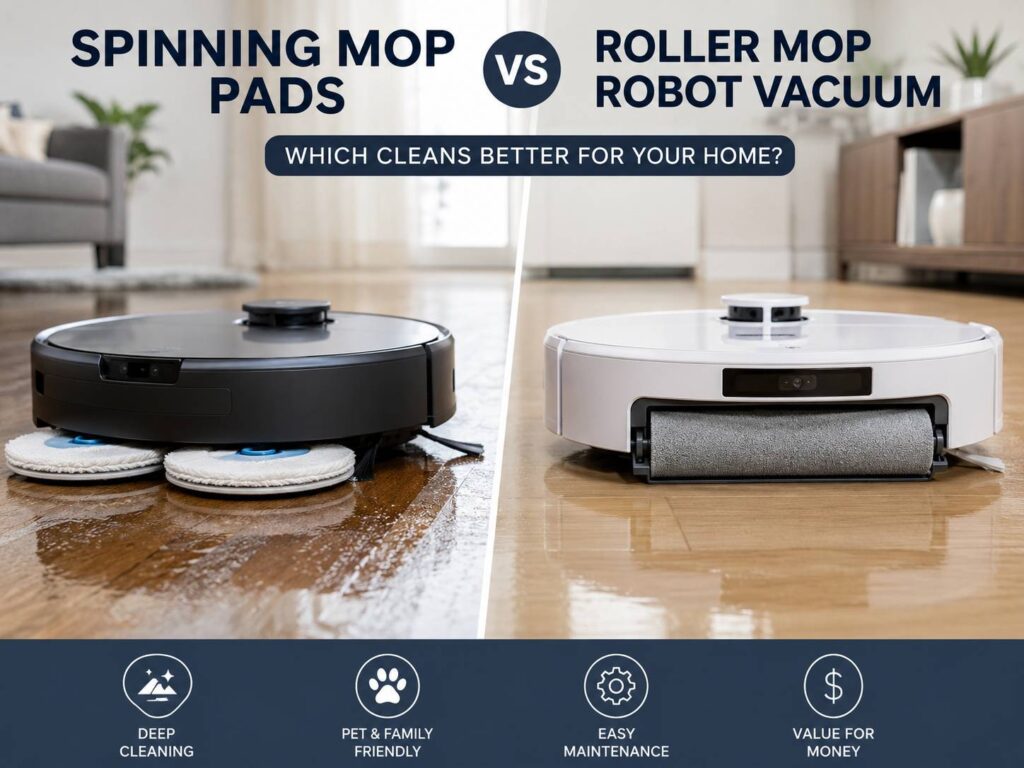
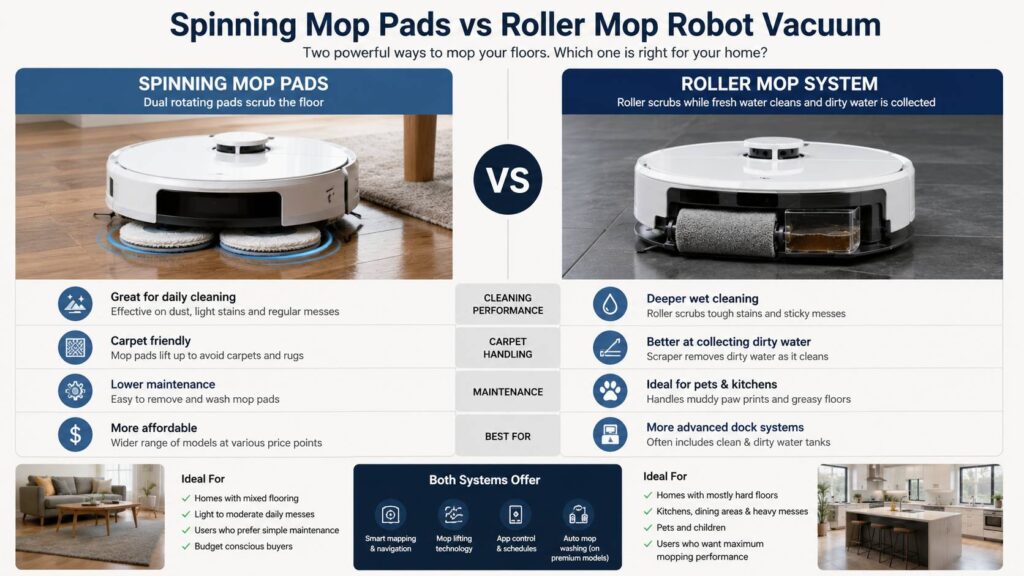
The two mop styles that get the most attention are spinning mop pads and roller mop systems. Both can clean hard floors, yet they work in very different ways. Spinning mop pads use two round pads that rotate under the robot. A roller mop uses a long rotating cylinder that scrubs the floor and pulls dirty water away during the cleaning run.
So, which one should you pick? The answer depends on your floors, mess level, pets, carpets, budget, and patience for maintenance. For daily cleaning, spinning mop pads still make sense for many homes. For deeper wet cleaning, roller mop robot vacuums feel more powerful and more advanced.
What Are Spinning Mop Pads on a Robot Vacuum?
Spinning mop pads are usually two round microfiber pads fitted under the back of the robot. They rotate against the floor and add more scrubbing force than a flat cloth. Most models wet the pads first, then press them lightly against the floor as they spin.
This system works well for common daily marks. Footprints, pet paw prints, light kitchen stains, dust film, and small dried spots often come off after one or two passes. Better models can return to the dock during a clean, wash the pads, refill the onboard water tank, then continue the job.
The main benefit is balance. Spinning mop pad robots are easy to find, and they come at many price levels. Replacement pads are usually affordable. Cleaning them is simple too. You remove the pads, rinse them, wash them, or let the dock handle most of the work.
Still, spinning pads have limits. They can smear greasy dirt if the pads get too dirty. They can leave circular streaks on shiny floors. They also need regular washing, or the floor may smell less fresh after cleaning.
Spinning pads are the safe choice. They clean well enough for daily upkeep, and they do not add too much extra maintenance.
What Is a Roller Mop Robot Vacuum?
A roller mop robot vacuum uses a rotating cylinder instead of two round pads. Think of it like a small powered floor washer built into a robot. The roller spins across the floor, scrubs the surface, and carries dirty water away from the contact area.
This design matters. A mop pad collects dirt as it cleans. It can go back to the dock for washing, but during the run, it still holds some of that mess. A roller mop tries to keep the cleaning surface fresher during the job.
That makes roller mop systems stronger for sticky kitchen spills, dried mud, sauce marks, pet food residue, and greasy film. They feel more serious than standard robot mops, especially in homes with lots of tile, vinyl, or sealed hard flooring.
The trade-off is maintenance. Roller systems have more parts. You need to think about the roller, scraper, dirty-water tank, water path, filters, and dock tray. If you ignore them, smells and residue can build up faster than expected.
A roller mop is a better fit for busy homes with pets, kids, and frequent wet messes. For a quiet apartment with mostly light dust, it may be more machine than you need.
Cleaning Performance: Which One Scrubs Better?
A roller mop usually wins for deeper wet cleaning. The roller applies a more focused scrubbing action, and better systems keep feeding clean water into the mop. At the same time, they collect dirty water instead of letting the mop surface stay soaked with grime.
That makes a real difference in kitchens and dining areas. Dried food, sticky drink marks, and light grease are the type of messes where roller mops start to pull ahead.
Spinning mop pads still perform well for normal home cleaning. They are great for dust, light stains, shoe marks, and regular floor care. Many premium models can run a second pass over dirtier rooms. Some can extend one mop pad outward to clean closer to walls and furniture legs.
Here is the simple way to look at it:
- Spinning mop pads are better for daily cleaning and mixed homes.
- Roller mop systems are better for sticky messes and heavier floor grime.
- Spinning pads cost less to maintain.
- Roller mops can reduce dirty-water spreading.
- Both systems still struggle with thick spills, heavy mud, and old stains.
No robot mop replaces a proper manual deep clean. Still, a good roller mop gets closer than older pad-based systems.
Edge and Corner Cleaning
Edge cleaning can be frustrating with robot mops. Most robot vacuums are round, so they cannot reach tight corners perfectly. That problem affects both spinning pads and roller systems.
Spinning mop pad robots have improved here. Some models now extend one pad outward. This helps along baseboards, under cabinet edges, and around furniture legs. It is not perfect, but it can reduce the dusty strip that cheaper robot mops leave behind.
Roller mop systems can clean edges well too. The result depends on the roller width and the robot design. Some models move the roller or mop system closer to the side. Others still leave a narrow dry strip near walls.
The mop type is only part of the story. Navigation, robot shape, side brush design, and object detection matter too. A well-made spinning-pad robot can clean edges better than a poorly designed roller model.
Carpet Safety and Mop Lifting
Carpet protection is one of the most important details to check before buying. A robot that drags wet pads over rugs can leave damp patches, smells, or stains.
Many spinning-pad robots now lift their mop pads when they detect carpet. Some premium models can even leave the mop pads in the dock before vacuuming carpets. This is useful in homes with mixed flooring.
Roller mop robots handle carpet in different ways. Some lift the roller. Some avoid carpets during mopping. Others use smart route planning to keep wet parts away from rugs. The quality depends heavily on the exact model.
For homes with many rugs, spinning mop pads often feel simpler. Mop lifting is common, and the system is easier to understand. For homes with mostly hard floors and only a few rugs, a roller mop makes more sense.
If your home has both hard floors and carpets, read this comparison before buying: robot vacuum and mop vs vacuum-only robot. It helps explain when a combo robot is worth it and when a vacuum-only model is the cleaner choice.
Maintenance: Which System Is Easier to Live With?
Spinning mop pads are easier to manage. You remove the pads, rinse them, wash them, and put them back. If the robot has a self-cleaning dock, it handles most of that job for you. You still need to clean the dock tray, empty tanks, and replace worn pads over time.
Roller mop systems can clean better, but they ask for more care. Dirty water, hair, detergent residue, and food particles can collect around the roller and scraper. The dirty-water tank can smell if it stays full too long. The roller can also wear down or collect grit.
For daily life, the difference is clear:
- Spinning pads need regular washing.
- Roller mops need roller checks and dirty-water care.
- Spinning pads are cheaper to replace.
- Roller parts often cost more.
- Spinning pads feel simpler.
- Roller mops feel more powerful but less forgiving.
People who want low-maintenance cleaning will usually prefer spinning pads. People who want stronger wet cleaning and accept extra dock care will get more from a roller mop.
Water Use, Streaks, and Floor Types
Both systems can leave streaks. Glossy tile, dark laminate, polished stone, and sealed hardwood show marks more easily than matte floors. Water level, mop material, detergent, drying time, and floor finish all play a role.
Spinning mop pads can leave round marks if the pads are too wet or too dirty. Roller mops can leave lines if the scraper is dirty or the roller wears unevenly.
For tile and vinyl, both systems work well. For sealed hardwood and laminate, use a lower water setting. Too much water can damage sensitive floors. For unsealed wood, robot mopping is not a good idea.
A common user complaint is streaking after the dock has washed the mop. The dock may be clean, but the water level may still be too high. Lower the water setting first. Then clean the mop, rinse the dock tray, and run a second pass only in the rooms that need it.
Noise, Dock Size, and Daily Comfort
Spinning mop pad robots are usually easier to live with. The robot itself is often quiet during mopping. The loudest moments come from auto-emptying, mop washing, and drying at the dock.
Roller mop robots can sound more mechanical. The roller, pump, scraper, and washing system can add extra noise. This does not make them bad, but it changes how they feel in daily use.
Dock size is another detail to check. Premium robot vacuum mops often come with large stations. These docks may hold clean water, dirty water, dust bags, detergent, wash trays, and drying systems.
Measure your space before buying. Place the dock on hard flooring, not carpet. Leave open space in front of it and on both sides. A cramped dock area can cause failed parking, water marks, and poor mop washing.
Best Choice for Pet Owners
Pet homes need strong vacuuming before good mopping. Hair pickup, anti-tangle brushes, filter care, dustbin size, and obstacle detection matter a lot. A great mop system will not help much if the robot spreads hair clumps across wet tile.
For daily paw marks, spinning mop pads work well. They are useful near entry doors, food bowls, and litter areas. Run them often, and the floor stays fresher with little effort.
For muddy tracks, dried drool, and sticky food residue, roller mops are stronger. They keep the cleaning surface fresher during the run and handle heavier messes with less smearing.
One serious warning: no robot mop should run through pet accidents. Use no-go zones, smart obstacle detection, and careful schedules. A robot that spreads a pet accident can create a much bigger problem.
Best Choice for Families With Kids
Family homes often deal with crumbs, juice spots, cereal dust, sauce marks, craft mess, and sticky footprints. A roller mop can be very useful in kitchens and dining rooms. It handles wet grime better and makes the floor feel cleaner after meals.
Spinning pads still make sense if you clean often. Run the robot daily, then use a deeper mop mode a few times per week. This routine keeps most hard floors in good shape.
For large dried messes, clean by hand first. Robot mops are great for maintenance, not for rescuing a floor after a major spill.
If you are still unsure about the value of robot cleaning, this guide on are robot vacuums worth it in 2026 can help you decide before spending money on a premium mop model.
Price and Value
Spinning mop pad robots usually offer better value. You get more choices, more discounts, cheaper pads, and proven dock systems. Many mid-range models with dual spinning pads already clean well enough for normal homes.
Roller mop robots cost more. You pay for stronger wet cleaning, more water control, and a more advanced dock. That price makes sense in homes with large hard-floor areas.
A roller mop is less convincing in carpet-heavy homes. If half your home is carpet, the mop system will not work often enough to justify the cost.
Buy based on your floors, not only the feature list. A high-end roller mop in a rug-heavy home may feel wasted. A good spinning-pad robot in a normal mixed home can be the smarter purchase.
Spinning Mop Pads vs Roller Mop: Quick Comparison
Spinning mop pads are best for:
- Daily floor care
- Light stains and footprints
- Homes with carpets and hard floors
- Lower upkeep costs
- Easier pad replacement
- Quieter cleaning routines
- Buyers who want more model choices
Roller mop robot vacuums are best for:
- Sticky kitchen messes
- Dried stains and greasy film
- Homes with lots of tile, vinyl, or sealed hard floors
- Families with kids
- Pet paw marks and heavier grime
- Deeper wet cleaning
- Buyers who accept more maintenance
Common Problems With Spinning Mop Pads
Spinning mop pads are practical, but they have real flaws.
- Pads get dirty during the run.
- Greasy floors may need two passes.
- Edge cleaning depends on mop extension.
- Dirty pads can cause smell.
- Cheap pads wear down fast.
- Shiny dark floors can show round streaks.
- Heavy stains still need manual cleaning.
The fix is simple. Wash pads often. Use the right water level. Replace worn pads before they get thin. Run the robot more often, so dirt does not build up.
Common Problems With Roller Mop Robot Vacuums
Roller mop systems solve some pad problems, but they bring new ones.
- Dirty-water tanks can smell.
- Rollers need cleaning after messy runs.
- Scrapers can collect residue.
- Water paths can clog.
- Replacement rollers can cost more than pads.
- Docks are often larger.
- Some models sound louder.
- Carpet protection varies by model.
The fix is regular care. Empty dirty water often. Rinse the tank. Clean the roller path. Check the dock tray each week. A roller mop works best when you keep its wet parts clean.
Which One Should You Buy?
Buy a spinning mop pad robot vacuum if you want a reliable all-rounder. It is the better fit for many mixed homes, especially with rugs, carpets, light dirt, and normal weekly cleaning. It gives you a strong mix of price, comfort, and cleaning power.
Pick a roller mop robot vacuum if your hard floors get messy often. It is better for kitchens, dining rooms, pet areas, and family spaces. It costs more and needs more care, but it can clean wet grime better.
My honest pick is simple. For most homes, a good dual spinning mop robot is still the best value. For large hard-floor homes with sticky daily messes, a roller mop robot vacuum is the better upgrade.
Final Verdict: Roller Mops Clean Deeper, Spinning Pads Fit More Homes
Spinning mop pads and roller mop systems both have a clear purpose. Spinning pads are easier, cheaper, quieter, and strong enough for daily floor care. Roller mops clean deeper, manage dirty water better, and feel closer to a real floor washer.
The right choice comes down to your home. Light daily dirt points toward spinning mop pads. Sticky spills, muddy tracks, and greasy kitchen marks point toward a roller mop.
Start with your floor type. Count your rugs. Think about pets, kids, and kitchen traffic. Then choose the mop system that matches the mess you actually deal with.