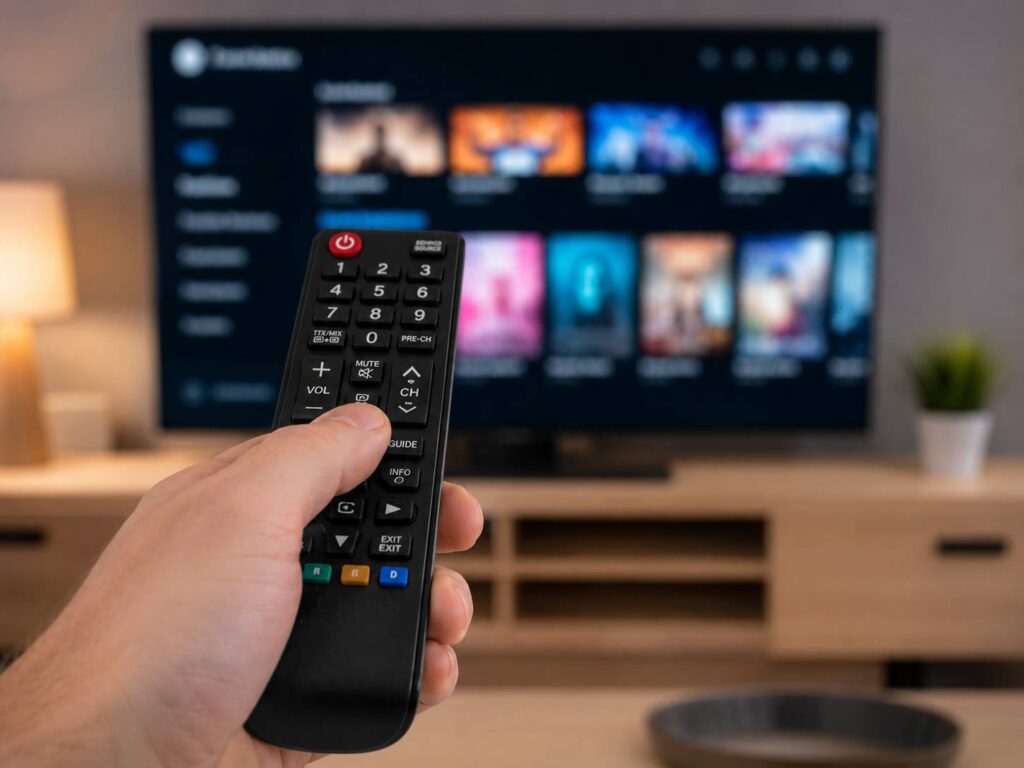
Modern televisions can stream games, respond to voice commands, connect with smart homes, and display sharp 4K or 8K video. Yet the small remote beside the sofa often relies on technology that has existed for decades.
Infrared still handles many basic TV commands in 2026. At first, that choice can seem outdated. Bluetooth, Wi-Fi, mobile apps, and HDMI-CEC all offer newer ways to control a screen.
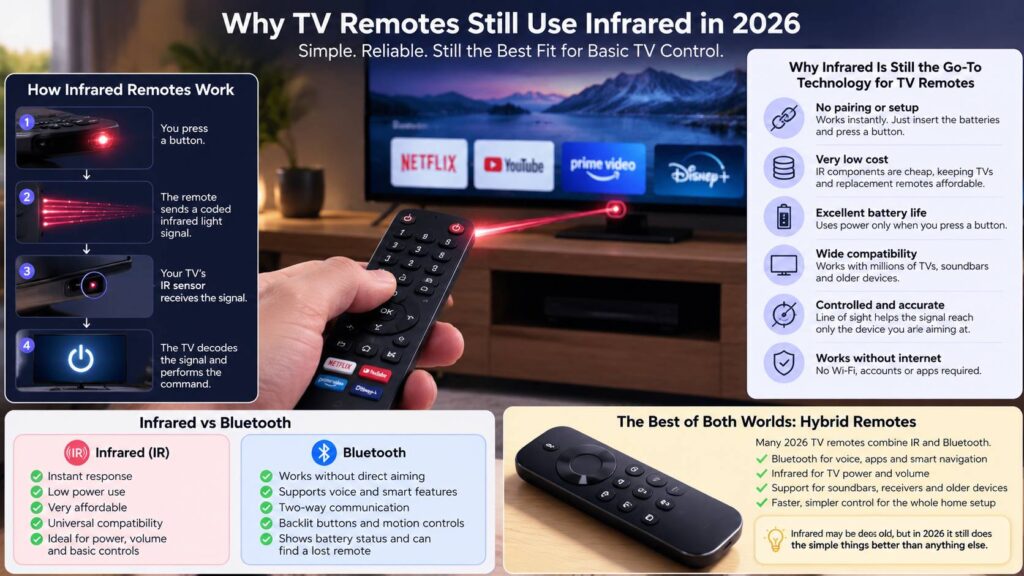
Still, infrared remains popular for practical reasons. It costs little, uses very little battery power, works without pairing, and supports a huge range of televisions and home cinema devices.
Newer remotes often combine several technologies rather than choosing only one. Bluetooth handles voice control and navigation, for example, then infrared manages power and volume. That mix gives users modern features without losing the reliability of a traditional TV remote.
How an Infrared TV Remote Works
An infrared remote sends short pulses of invisible light toward a sensor on the television. Each button creates a different coded signal.
Pressing the volume button sends one code. The power button sends another. Once the television receives that code, its processor performs the requested action.
This process happens almost instantly. More importantly, it does not require an internet connection, user account, mobile app, or wireless pairing process.
Basic infrared remotes contain only a few parts:
- Physical buttons
- A small controller
- An infrared light-emitting diode
- A battery compartment
- A simple circuit board
The television has a matching infrared receiver. Together, these parts form a direct and predictable control system.
Infrared Works Without Pairing or Setup
Bluetooth remotes usually need to connect with a specific television or streaming device. That pairing process often takes only a few seconds, but problems can still appear after a reset, battery change, software update, or factory restore.
Infrared avoids that entire process.
A compatible IR remote can start working as soon as batteries are inserted. In many cases, users only need to point it at the television and press a button.
This simplicity matters in several situations. Hotels need remotes that guests can use without instructions. Older family members often prefer controls that work instantly. Repair shops and installers need quick access to power, input, volume, and menu commands.
Replacement remotes benefit too. A basic universal remote can operate many television brands after the user enters a short device code. As a result, losing the original remote does not always lead to an expensive replacement.
Low Cost Remains a Major Advantage
Television makers ship millions of remotes every year. Even a small production cost difference can become substantial across a large product line.
Infrared components remain inexpensive and easy to produce. Manufacturers have used them for decades, so the parts, command standards, and assembly processes are mature.
A more advanced wireless remote needs extra hardware. It can include a Bluetooth radio, microphone, motion sensor, rechargeable battery, speaker, or backlight. Those additions raise the production price.
Premium televisions can justify that cost. Entry-level TVs often cannot.
For a remote with only power, volume, channel, input, and navigation buttons, infrared does the job well. Adding a complex radio system to such a simple controller can increase the price without improving the daily experience.
Battery Life Is Usually Excellent
Traditional TV remotes can often run for months or years on one pair of batteries. Their low power demand helps explain that long life.
Most of the time, the remote remains inactive. It uses power only for a brief moment after someone presses a button.
Infrared signals are short. No constant connection needs to remain open, and the remote does not need to exchange background data with the television.
Bluetooth Low Energy can provide good battery life too. Yet a Bluetooth remote often powers extra features such as voice input, motion detection, lighting, or location tracking. Those tools naturally consume more energy.
For simple controls, infrared remains hard to beat.
Line of Sight Is Both a Weakness and a Strength
Infrared needs a relatively clear path between the remote and the television sensor. A soundbar, cabinet door, decoration, or piece of furniture can block the signal.
Bright sunlight can interfere in some rooms too. Users may need to aim more carefully or move closer to the screen.
That limitation can feel frustrating. Still, direction offers a few advantages.
The remote usually controls the device it faces. It is less likely to activate a second television in another room. It does not remain connected across the house, and it does not depend on the quality of a wireless network.
Most living rooms are well suited to infrared. The viewer faces the television, and the distance usually stays within a few meters. Under those normal conditions, IR control feels natural.
Bluetooth Handles Smarter Remote Features
Bluetooth becomes more useful once the remote needs to do more than send simple button commands.
Voice search is a good example. A microphone must send audio data to the television or streaming box. Infrared is not designed for that type of continuous data transfer.
Bluetooth can support:
- Voice commands
- Motion-based pointers
- Touch controls
- Rechargeable batteries
- Backlit buttons
- Remote-finder features
- Battery level reporting
- Control without direct aiming
These extras appear on many premium smart TV remotes. LG’s Magic Remote, for example, uses wireless communication for its on-screen pointer and voice tools. Selected Sony remotes pair through Bluetooth for voice commands. Roku and other streaming platforms use similar systems on higher-end models.
Even then, infrared often stays inside the same remote.
Hybrid Remotes Combine IR and Bluetooth
Many current remotes use a hybrid design. This means they can communicate through more than one method.
Bluetooth may control menus, apps, voice search, and cursor movement. At the same time, infrared may send power or volume commands to a television, soundbar, receiver, or older device.
This setup solves several compatibility problems. A streaming box may understand Bluetooth, yet the connected soundbar may only accept IR. One hybrid remote can manage both.
Apple’s streaming remote follows this type of model. Bluetooth controls the Apple TV box, then infrared can control compatible televisions or audio equipment.
Roku voice remotes can use IR or HDMI-CEC for television functions, depending on the setup. As a result, users gain modern navigation without giving up basic device control.
HDMI-CEC Has Not Fully Replaced Infrared
HDMI-CEC lets connected devices send control commands through an HDMI cable. It can turn on a television, adjust soundbar volume, switch inputs, or wake a streaming box.
In a compatible setup, CEC can reduce the need for several remotes. One controller may operate the television, streaming device, and audio system.
Yet CEC is not always consistent.
Manufacturers sometimes use different names for the feature. Samsung calls it Anynet+, LG uses SIMPLINK, Sony uses BRAVIA Sync, and other brands apply their own labels.
Supported commands can vary too. One device may allow power control but not volume control. Another may respond slowly or stop communicating after a software update or cable change.
Infrared gives users a direct fallback. The remote sends the command straight to the device, without relying on an HDMI connection or shared control settings.
Smartphone Apps Are Helpful but Less Immediate
Most large TV platforms now offer mobile remote apps. These apps can provide a keyboard, touchpad, voice search, app launcher, or full button layout.
They are useful after the physical remote disappears between sofa cushions. They can help with text entry too, since typing on a phone is faster than selecting letters on a television screen.
Yet a phone is not always the most convenient remote.
The device must have battery power. Users need to unlock it, find the correct app, and connect to the same network. Notifications or incoming calls can interrupt control.
A physical remote stays ready on the table. Anyone in the room can pick it up, including guests or children.
That preference for dedicated controls appears across many home-office and entertainment products. A physical device often feels faster than an app, whether someone is selecting a TV remote or comparing the best mouse for working from home in 2026.
Universal Remotes Still Depend Heavily on IR
Universal remotes remain useful in homes with several devices. One controller can replace separate remotes for a TV, soundbar, DVD player, receiver, or set-top box.
Infrared makes that broad support possible.
Manufacturers have used thousands of documented IR command sets over the years. Universal remote makers can store these codes in a built-in database or mobile setup app.
Users select the television brand, test a few commands, and save the working profile. The process is not perfect, but it supports far more older equipment than Bluetooth pairing alone.
Bluetooth remotes usually connect to a smaller set of approved devices. Infrared is less restricted, so it remains better suited to broad compatibility.
Why Manufacturers Keep Infrared as a Backup
A smart remote can fail for several reasons. The Bluetooth connection may drop. Software can freeze. The television may return to its setup screen after a reset.
Infrared gives the manufacturer a simple recovery path.
Basic commands can still work before Bluetooth pairing finishes. Users can often turn on the TV, change the input, or control the volume during troubleshooting.
Service technicians benefit from this fallback too. A direct IR command can work without opening an app or connecting to the owner’s network.
For that reason, removing infrared can create more support problems than it solves.
Will Infrared TV Remotes Disappear Soon?
Infrared will probably lose more advanced functions to Bluetooth, Wi-Fi, voice systems, and HDMI-CEC. Yet it is unlikely to disappear from television control in the near future.
Millions of existing TVs, soundbars, receivers, projectors, and set-top boxes still depend on IR commands. Replacement remotes need to support those devices for many years.
New equipment benefits from IR too. Manufacturers value its low price, low power use, simple setup, and dependable basic control.
The future remote will likely keep using several technologies together:
- Bluetooth for voice and smart navigation
- HDMI-CEC for connected devices
- Wi-Fi for mobile apps and smart-home systems
- Infrared for direct power, volume, and fallback commands
Infrared may look old next to the latest smart TV features. Yet age does not make a technology useless. In this case, the older system still handles its main job with very little fuss.
That is why so many TV remotes still use infrared in 2026. It remains affordable, familiar, compatible, and dependable. Newer systems add useful features, but IR still provides the quickest path from pressing a button to seeing the television respond.