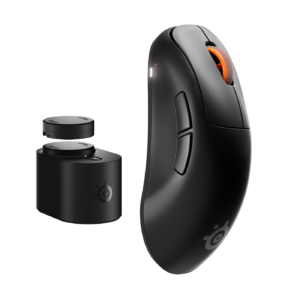
SteelSeries Aerox 3 Wireless (2022): Specs, Pros & Cons
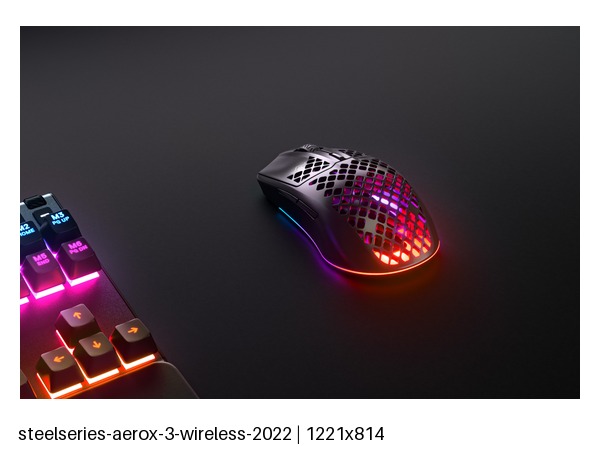
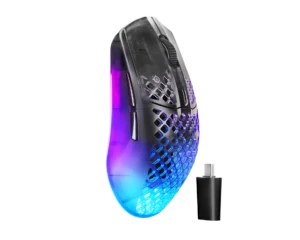
Perforated gaming mice had a moment around the turn of the decade, and most of the brands that started it have quietly moved on. Modern shells reach similar weights without drilling holes in them, which removed the main reason anyone accepted a mouse full of gaps. SteelSeries has kept the honeycomb here, so the Aerox 3 Wireless is worth judging on whether that decision still earns its place.
As an object it is a low, right-handed shape that SteelSeries rates for claw, fingertip and palm grips, with a shell light enough to move quickly without being one of the featherweight competition mice. It connects three ways (a cable, a low-latency wireless dongle and Bluetooth), which is a more useful set than the dongle-only arrangement most competitive mice ship with, because Bluetooth is what makes a gaming mouse usable with a work laptop.
The sensor sits deliberately below the flagships, and so does the polling rate. It is the trade that buys the battery life, and on a mouse aimed at long sessions it is the right way round.
What to know before buying: a honeycomb shell is a preference as much as a specification. Some people like the texture and welcome the airflow under the fingers. Others dislike the feel of gaps entirely and would rather have a solid shell at the same weight, which is now easy to find. A low shell with no thumb rest is a similar coin toss between hand sizes.
Its price sits below the flagships whose ideas it borrows, and that is where it makes sense: as a light, well-connected everyday mouse.
Category strengths
Where the SteelSeries Aerox 3 Wireless (2022) beats the median
- Much longer battery life ?200 h vs 130 h (median)
- More connection options ?
- A lighter build ?68 g vs 89 g (median)
- More supported grip styles ?
- Has RGB lighting ?
Where the SteelSeries Aerox 3 Wireless (2022) trails the median
- A lower max tracking speed ?400 IPS vs 650 IPS (median)
- A lower max sensitivity ?18,000 DPI vs 25,600 DPI (median)
- A lower max acceleration ?40 G vs 50 G (median)
How this VS Score was computed
Score 59: each known spec is measured against the median of all mice (83 products), then weighted; 50 means level with that median. In classes of six or more, a value beyond the class’s 10th–90th percentile range counts as that limit, so one extreme product cannot set the scale. 74% of the scoreable weight could be used; unknown values, features not applicable to this class and proxies (battery capacity where a rated life exists) add or remove nothing.
| Specification | This product | Cohort median | Score weight | Points moved |
|---|---|---|---|---|
| Battery life | 200 | 130 | 0.8 | +21.6 |
| Connection | 3 | 2 | 0.8 | +20.0 |
| Max tracking speed | 400 | 650 | 0.8 | −15.2 |
| Max sensitivity | 18,000 | 25,600 | 1 | −15.0 |
| Weight | 68 | 89 | 1 | +15.0 |
| USB-C charging | Yes | 68% of the class have it | 0.3 | +15.0 |
| Quick charge | Yes | 55% of the class have it | 0.3 | +15.0 |
| Grip styles | 3 | 2 | 0.4 | +10.0 |
| RGB lighting | Yes | 48% of the class have it | 0.2 | +10.0 |
| Max acceleration | 40 | 50 | 0.4 | −4.0 |
| Polling rate | 1,000 | 1,000 | 0.8 | +0.0 |
| Buttons | 6 | 6 | 0.6 | +0.0 |
| Switch lifespan | 80 | 80 | 0.2 | +0.0 |
| Wireless polling rate | 1,000 | 1,000 | 0.5 | +0.0 |
Not scored: Adjustable lift-off distance (unknown: not scored); Horizontal scrolling (unknown: not scored); Free-spin scroll wheel (unknown: not scored); Click latency (unknown: not scored); Debounce adjustment (unknown: not scored); Battery capacity (unknown: not scored); Wireless charging (unknown: not scored); Onboard memory (standard for the class (88% have it)); Software customization (standard for the class (98% have it)); Adjustable weights (unknown: not scored).
Editor’s note
The Aerox 3 Wireless has a honeycomb shell, and the specification that makes that acceptable is one most perforated mice do not carry: an IP54 rating.
Hollowing out a mouse to save weight leaves the internals exposed, and the obvious question is what happens when dust, crumbs or a spilled drink get in. IP54 means the internals are protected against dust ingress and splashing water, so this is a perforated mouse you can clean, rather than one you handle carefully and hope for.
At 68 g it is light without being extreme. SteelSeries quotes up to 200 hours of battery life over Bluetooth but up to 80 hours on the wireless dongle, its low-latency gaming mode, and the included USB-C cable fast-charges the mouse and lets it play while charging. Connection is wired, 2.4 GHz or Bluetooth.
The sensing is where it gives ground. TrueMove Air runs to 18,000 DPI with 400 IPS tracking, against 750 to 900 IPS on the flagships, which matters only at very low sensitivity with fast swipes. The switches are IP54-rated Golden Micro, good for 80 million clicks, and the feet are PTFE.
The right-handed shell is 120.6 mm long and sits low, and SteelSeries lists claw, fingertip and palm grips for it.
Buy it if you want a light wireless mouse with long battery life that tolerates a real desk. Buy a flagship sensor if you play at very low sensitivity and swipe hard.
Specifications
Quality bars show where each figure sits between the lowest and highest of the 83 mice this VS Score is measured against.
Sensor & tracking
Design & handling
Switches & latency
Connectivity
Battery
Features
Sources and verification
Where the specifications come from
- Official product pagesteelseries.com
Verification
- First published
- Specifications last checked
- Sheet completeness
- 26 of 34 specifications verified; the rest show as Unknown and are never estimated or scored
- Page type
- Product specification page — Compiled from the manufacturer’s published specifications and the cited sources; this is not a hands-on test.
- Basis
- Research-based: specifications and editorial text were compiled from the documents listed here and the manufacturer’s published data. We have not tested this unit ourselves; where independent measurements are mentioned they belong to the linked publication.
Where to buy
Prices and availability may change. Check the retailer before buying. We may earn a commission on purchases.
Price history
Mice with similar specs to the SteelSeries Aerox 3 Wireless (2022)



Ratings & reviews
No reviews yet. Be the first to share your experience.
The bottom line
The SteelSeries Aerox 3 Wireless (2022) earns a VS Score of 59, above the median of the 83 mice it is measured against (a score of 50 is level with that median).
- Who it’s for
- Someone who wants one light wireless mouse to serve both a games desk and a work laptop, and who would rather have battery life measured in weeks than the last increment of sensor speed.
- Who should look elsewhere
- Players who compete at very low sensitivity with fast, wide swipes. The tracking ceiling here is lower than the flagships'. Also wrong for anyone who dislikes the feel of a perforated shell, since solid mice now reach similar weights.
- The trade-off that matters
- A slower sensor and a lower polling rate, bought with endurance. Over long sessions that is the better half of the bargain. In a tournament it is the worse one.
- The main alternative
- Keychron M3 Mini: a solid-shell ambidextrous mouse at a comparable weight, for anyone who wants the lightness without the holes.
The VS Score is calculated from the weighted specifications above, each measured against the median of comparable mice — a shortlisting guide, not a substitute for your own priorities. See how we score.