Hitscan Hyperlight: Specs, Features, Pros & Cons
The 8K polling on the Hyperlight's product page comes with a footnote. Hitscan packs a standard receiver in the box and sells the 8K dongle as a separate item, so the mouse that arrives is an ordinary wireless mouse that can be upgraded later.
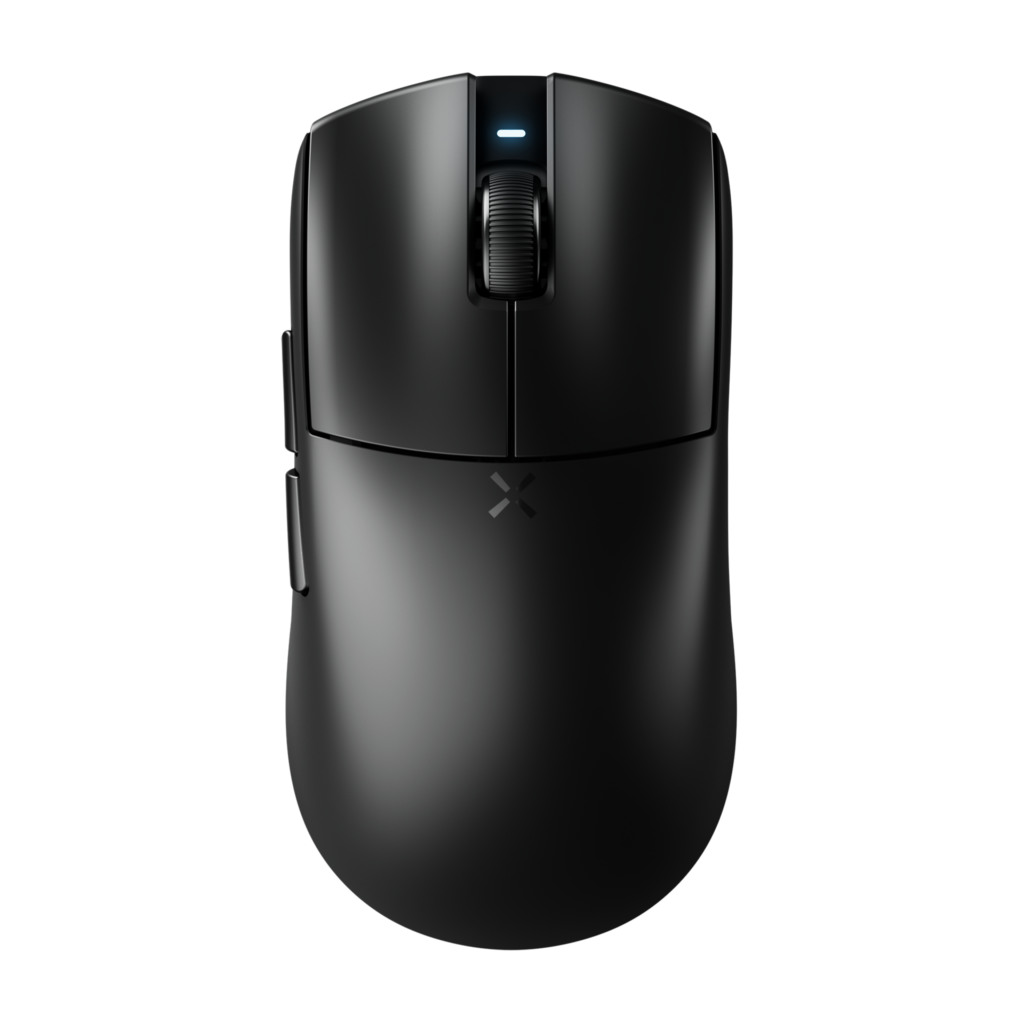
The Hyperlight is rated at 39 g, give or take a gram, and Hitscan claims it is one of the most durable builds at that weight. Its evidence is a description of the shell, so owner reports over the coming months are the evidence to watch. The shape has its hump in the middle and low main buttons, and Hitscan says it was designed around a claw grip first, with palm and fingertip grips as secondary uses. It is made in production batches, and the second batch is the one on sale now.
Inside is PixArt's PAW3395 sensor with a Nordic nRF52840 controller. PixArt has since released the PAW3950 as its newer flagship, and Pulsar's latest mice already build on it, so on paper the Hyperlight is a sensor generation behind the most expensive ultralights. The maximum DPI setting has no bearing on how anyone plays.
The main buttons use Omron optical switches, which are designed to avoid the double-click fault that worn mechanical switches develop, while the side buttons stay mechanical TTC parts. There is no Bluetooth. The DPI button sits on the underside next to the power switch, so changing sensitivity in the middle of a game means lifting the mouse, and an LED shows which of four default steps is active. Finer adjustments go through Hitscan's own utility software.
Category strengths
Where the Hitscan Hyperlight beats the median
- A much lighter build ?39 g vs 89 g (median)
- More supported grip styles ?
- A slightly higher max sensitivity ?26,000 DPI vs 25,600 DPI (median)
Where the Hitscan Hyperlight trails the median
- Much shorter battery life ?75 h vs 150 h (median)
How this VS Score was computed
Score 56: each known spec is measured against the median of all mice (81 products), then weighted; 50 means level with that median. In classes of six or more, a value beyond the class’s 10th–90th percentile range counts as that limit, so one extreme product cannot set the scale. 62% of the scoreable weight could be used; unknown values, features not applicable to this class and proxies (battery capacity where a rated life exists) add or remove nothing.
| Specification | This product | Cohort median | Score weight | Points moved |
|---|---|---|---|---|
| Weight | 39 — capped at the class’s lower range (52.5) | 89 | 1 | +35.0 |
| Battery life | 75 | 150 | 0.8 | −20.0 |
| USB-C charging | Yes | 67% of the class have it | 0.3 | +15.0 |
| Grip styles | 3 | 2 | 0.4 | +10.0 |
| Max sensitivity | 26,000 | 25,600 | 1 | +1.0 |
| Max tracking speed | 650 | 650 | 0.8 | +0.0 |
| Max acceleration | 50 | 50 | 0.4 | +0.0 |
| Polling rate | 1,000 | 1,000 | 0.8 | +0.0 |
| Connection | 2 | 2 | 0.8 | +0.0 |
| Wireless polling rate | 1,000 | 1,000 | 0.5 | +0.0 |
Not scored: Adjustable lift-off distance (unknown: not scored); Buttons (unknown: not scored); Horizontal scrolling (unknown: not scored); Free-spin scroll wheel (unknown: not scored); Click latency (unknown: not scored); Switch lifespan (unknown: not scored); Debounce adjustment (unknown: not scored); Battery capacity (capacity is a proxy; the rated battery life is scored instead); Quick charge (unknown: not scored); Wireless charging (unknown: not scored); Onboard memory (unknown: not scored); Software customization (standard for the class (97% have it)); Adjustable weights (unknown: not scored); RGB lighting (unknown: not scored).
Editor’s note
Hitscan rates the battery at up to 75 hours from a 250 mAh cell, without saying which polling rate that figure assumes or giving any runtime with the 8K dongle. Polling eight times as often keeps the radio busier, so plan on charging more often at 8K.
The shell is compact at 118 by 61 by 38 mm. That suits claw and fingertip players with small to medium hands, and Hitscan moved the sensor slightly forward of center, which puts the pivot point closer to the fingertips. A large hand in a palm grip will hang off the back of it.
The obvious rival is Pulsar's X2 CrazyLight in its medium size. Pulsar rates it at the same weight, its shell is a couple of millimeters longer and wider, and it runs PixArt's newer sensor. It also costs more at list price. The Hyperlight's case is that it gets the weight right for less money and leaves the decision about 8K to the buyer.
Spare PTFE skates come in the box, and the base takes both large and small skate shapes, so replacing worn ones later does not tie you to a single part. The USB-C charging cable doubles as an extension for the receiver, which matters because the manual asks for the mouse to stay within 20 cm of it.
For me the Hyperlight is the better buy for a claw player who will stay with the receiver in the box. Add the separate dongle and the price gap to the Pulsar narrows enough that the newer sensor deserves a second look.
Specifications
Quality bars show where each figure sits between the lowest and highest of the 81 mice this VS Score is measured against.
Sensor & tracking
Design & handling
Switches & latency
Connectivity
Battery
Features
Sources and verification
Where the specifications come from
- Official product pagehitscan.com
- Independent testingrtings.com
Verification
- First published
- Specifications last checked
- Sheet completeness
- 21 of 34 specifications verified; the rest show as Unknown and are never estimated or scored
- Page type
- Product specification page — Compiled from the manufacturer’s published specifications and the cited sources; this is not a hands-on test.
- Basis
- Research-based: specifications and editorial text were compiled from the documents listed here and the manufacturer’s published data. We have not tested this unit ourselves; where independent measurements are mentioned they belong to the linked publication.
Mice with similar specs to the Hitscan Hyperlight
Ratings & reviews
No reviews yet. Be the first to share your experience.
The bottom line
The Hitscan Hyperlight earns a VS Score of 56, above the median of the 81 mice it is measured against (a score of 50 is level with that median).
- Who it’s for
- A claw or fingertip player with small to medium hands who wants a featherweight wireless mouse and is content with the standard receiver, or happy to add the faster dongle later.
- Who should look elsewhere
- Laptop owners who want Bluetooth, and anyone who changes sensitivity often, because the DPI button is on the underside. Large hands in a palm grip should look at a bigger shell.
- The trade-off that matters
- The box holds only the standard 1,000 Hz receiver, so the 8K polling that headlines the product page costs extra.
- The main alternative
- Pulsar X2 CrazyLight: the same rated weight in a slightly larger symmetrical shell, with PixArt's newer sensor.
The VS Score is calculated from the weighted specifications above, each measured against the median of comparable mice — a shortlisting guide, not a substitute for your own priorities. See how we score.