SteelSeries Aerox 3 Wireless Gen 2: Specs, Pros & Cons
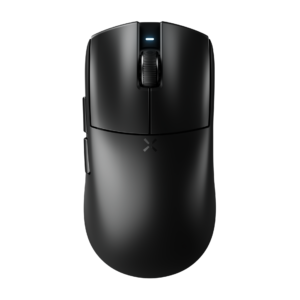
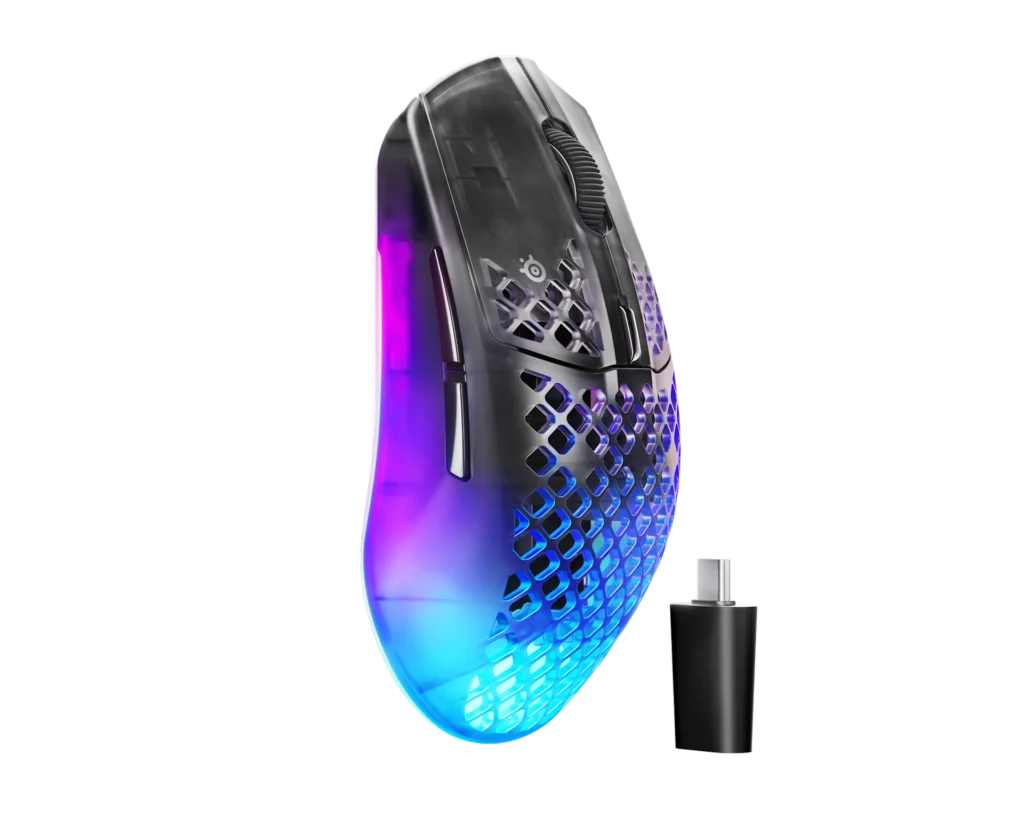
The holes are the first thing anyone notices, and they divide opinion more than any specification on this page. SteelSeries perforates the Aerox shell to cut weight, and the result reads either as purposeful engineering or as an unfinished object, depending almost entirely on the person holding it.
The Aerox 3 sits at the accessible end of the lightweight category (below the tournament flagships, above the plain budget models), and this is the wireless version of a shape SteelSeries has now iterated on for several generations. It is low, symmetrical and small, which suits claw and fingertip grips and works against anyone with large hands who rests the palm flat. The side buttons sit only on the left, so despite the symmetry it is a right-handed mouse in practice.
What makes this generation worth attention is that it stopped treating wireless as the compromise option. There is a fast low-latency link for play, Bluetooth for a work laptop and a wired mode as well, which is an unusually complete set at this price and useful if the mouse has to move between two desks.
The perforations raise a practical question beyond aesthetics: dust and crumbs get in, and cleaning is more involved than wiping down a solid shell. SteelSeries has taken the ingress problem more seriously than most, but no perforated mouse is maintenance-free.
The naming is the other thing to be careful about. Several revisions share the Aerox 3 name with materially different internals, and retail listings are not always precise about which one is in the box, which is worth confirming before you order, because the differences are not cosmetic.
Category strengths
Where the SteelSeries Aerox 3 Wireless Gen 2 beats the median
- A much higher polling rate ?4,000 Hz vs 1,000 Hz (median)
- A much higher wireless polling rate ?4,000 Hz vs 1,000 Hz (median)
- More connection options ?
- Longer battery life ?200 h vs 150 h (median)
- A lighter build ?68 g vs 89 g (median)
- Has RGB lighting ?
- A slightly higher max sensitivity ?26,000 DPI vs 25,600 DPI (median)
Where the SteelSeries Aerox 3 Wireless Gen 2 trails the median
- A lower max tracking speed ?400 IPS vs 650 IPS (median)
- A lower max acceleration ?40 G vs 50 G (median)
How this VS Score was computed
Score 62: each known spec is measured against the median of all mice (81 products), then weighted; 50 means level with that median. In classes of six or more, a value beyond the class’s 10th–90th percentile range counts as that limit, so one extreme product cannot set the scale. 75% of the scoreable weight could be used; unknown values, features not applicable to this class and proxies (battery capacity where a rated life exists) add or remove nothing.
| Specification | This product | Cohort median | Score weight | Points moved |
|---|---|---|---|---|
| Polling rate | 4,000 | 1,000 | 0.8 | +40.0 |
| Wireless polling rate | 4,000 | 1,000 | 0.5 | +25.0 |
| Connection | 3 | 2 | 0.8 | +20.0 |
| Max tracking speed | 400 | 650 | 0.8 | −15.2 |
| Weight | 68 | 89 | 1 | +15.0 |
| USB-C charging | Yes | 67% of the class have it | 0.3 | +15.0 |
| Battery life | 200 | 150 | 0.8 | +13.6 |
| RGB lighting | Yes | 46% of the class have it | 0.2 | +10.0 |
| Horizontal scrolling | No | 45% of the class have it | 0.2 | −9.6 |
| Free-spin scroll wheel | No | 34% of the class have it | 0.2 | −9.6 |
| Max acceleration | 40 | 50 | 0.4 | −4.0 |
| Max sensitivity | 26,000 | 25,600 | 1 | +1.0 |
| Buttons | 6 | 6 | 0.6 | +0.0 |
| Grip styles | 2 | 2 | 0.4 | +0.0 |
| Switch lifespan | 80 | 80 | 0.2 | +0.0 |
Not scored: Adjustable lift-off distance (unknown: not scored); Click latency (unknown: not scored); Debounce adjustment (unknown: not scored); Battery capacity (unknown: not scored); Quick charge (unknown: not scored); Wireless charging (not applicable: only 14% of this class have it); Onboard memory (standard for the class (86% have it)); Software customization (standard for the class (97% have it)); Adjustable weights (not applicable: only 2% of this class have it).
Editor’s note
The Aerox 3 Wireless Gen 2 combines a familiar low-profile shape with current wireless performance. At about 68 grams it moves easily for claw and fingertip play, and the open perforated shell is protected by an IP54-rated barrier against dust and splashes. That does not make the mouse washable, but it gives more reassurance than an exposed honeycomb design without an ingress rating.
SteelSeries' updated TrueMove Air sensor reaches 26,000 CPI, and the 2.4 GHz link polls at up to 4,000 Hz. Higher polling costs battery life and CPU time, so 1,000 Hz remains the sensible everyday setting on many systems. Bluetooth 5 covers work machines. USB-C handles charging and wired play. Stated endurance is up to 120 hours on the dongle or 200 hours on Bluetooth under favorable conditions.
The symmetrical shell is still functionally right-handed because the side buttons are only on the left. Large hands in a palm grip may find it too flat, and the perforations divide opinion on feel and cleaning. Prism RGB looks attractive through the shell but consumes power. Mechanical switches rated to 80 million clicks, PTFE feet, onboard memory, and SteelSeries GG customization round out a strong feature set.
This model is best for FPS and mixed-use players who want a light mouse with both a fast receiver link and Bluetooth. It is less suitable for true left-handed control, palm-focused large hands, or buyers who dislike holes in the shell. Make sure the product is explicitly the Gen 2 wireless version. Earlier Aerox 3 revisions have different sensor, polling, and battery specifications.
Specifications
Quality bars show where each figure sits between the lowest and highest of the 81 mice this VS Score is measured against.
Sensor & tracking
Design & handling
Switches & latency
Connectivity
Battery
Features
Sources and verification
Where the specifications come from
- Official product pagesteelseries.com
- Independent testingrtings.com
Verification
- First published
- Specifications last checked
- Sheet completeness
- 25 of 34 specifications verified; the rest show as Unknown and are never estimated or scored
- Page type
- Product specification page — Compiled from the manufacturer’s published specifications and the cited sources; this is not a hands-on test.
- Basis
- Research-based: specifications and editorial text were compiled from the documents listed here and the manufacturer’s published data. We have not tested this unit ourselves; where independent measurements are mentioned they belong to the linked publication.
Where to buy
Prices and availability may change. Check the retailer before buying. We may earn a commission on purchases.
Price history
Mice with similar specs to the SteelSeries Aerox 3 Wireless Gen 2


Ratings & reviews
No reviews yet. Be the first to share your experience.
The bottom line
The SteelSeries Aerox 3 Wireless Gen 2 earns a VS Score of 62, above the median of the 81 mice it is measured against (a score of 50 is level with that median).
- Who it’s for
- Claw and fingertip players with small to medium hands who want one light mouse for a gaming PC and a work laptop, and can live with the holes.
- Who should look elsewhere
- Palm grippers with big hands, true left-handers and anyone who wants a shell they can wipe clean in seconds should pass.
- The trade-off that matters
- The perforated shell. It is what keeps the weight down, and it is also a surface that gathers dust and needs occasional careful cleaning, splash barrier or not.
- The main alternative
- Razer DeathAdder V3 HyperSpeed: a solid, lighter right-handed shell for low weight without holes, if Bluetooth is not needed
The VS Score is calculated from the weighted specifications above, each measured against the median of comparable mice — a shortlisting guide, not a substitute for your own priorities. See how we score.