Narwal Freo 20: Specs, Price, Pros & Cons
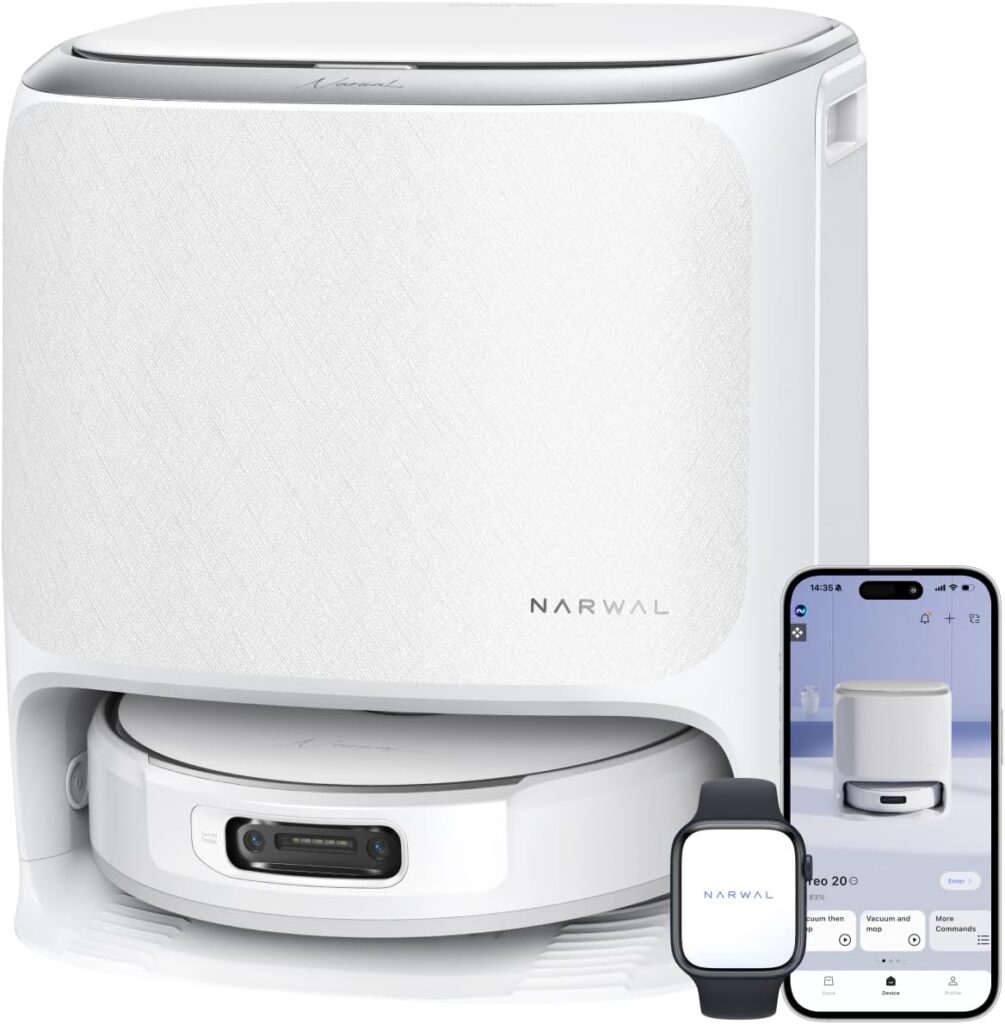
The Narwal Freo 20 keeps its dirty water apart from its clean water on the robot itself. A bank of nozzles sprays the flattened roller as it turns, and what runs off is pumped into a separate onboard tank, so the robot behaves more like a small self-rinsing wet vac than a robot dragging a damp pad.
It arrived in late August as a newcomer among roller-mop robots, launched at an introductory price that undercuts the Roborock and iRobot flagships built on the same idea. Narwal's own page gives a high suction figure, and the body stands 95 mm tall. It is also credited with a generous threshold clearance and warm drying air, which suits a home with a few raised saddles.
What Narwal leaves unsaid is long. Tank and bin volumes, mop lift and map count are published, if at all, only as marketing images, so many of its basic figures remain unconfirmed. Navigation relies on two cameras, with no laser, and even the runtime comes from a retail listing instead of the maker. Buyers used to comparing robots number by number will find little to compare.
It fits an early adopter with hard floors who likes new mechanisms and buys from a shop with a generous return window. A kitchen and hallway of tile or vinyl would show off the roller best. What it gives up is a track record: there are only a handful of owner reviews so far, and nobody outside Narwal yet knows how the roller, the nozzles or the dock hold up after a year of daily runs.
Category strengths
Where the Narwal Freo 20 beats the median
- Much stronger suction ?31,000 Pa vs 19,750 Pa (median)
- A higher threshold clearance ?30 mm vs 24 mm (median)
- A higher warm-air drying temperature ?60 °C vs 50 °C (median)
- Slightly quieter operation ?56.9 dB vs 60.1 dB (median)
- A slightly more compact design ?95 mm vs 96.8 mm (median)
Where the Narwal Freo 20 trails the median
- No edge-cleaning extension ?
- No automatic detergent dispenser ?
- A lower mop wash temperature ?60 °C vs 75 °C (median)
How this VS Score was computed
Score 53: each known spec is measured against the median of all robot vacuums (58 products), then weighted; 50 means level with that median. In classes of six or more, a value beyond the class’s 10th–90th percentile range counts as that limit, so one extreme product cannot set the scale. 37% of the scoreable weight could be used; unknown values, features not applicable to this class and proxies (battery capacity where a rated life exists) add or remove nothing.
| Specification | This product | Cohort median | Score weight | Points moved |
|---|---|---|---|---|
| Suction power | 31,000 | 19,750 | 1.2 | +33.6 |
| Mopping | Yes | 79% of the class have it | 0.6 | +30.0 |
| Dirt detection & re-mop | Yes | 79% of the class have it | 0.4 | +20.0 |
| Edge-cleaning extension | No | 79% of the class have it | 0.4 | −19.2 |
| Automatic mop removal | No | 37% of the class have it | 0.4 | −19.2 |
| Navigation | Camera (vSLAM) | LiDAR | 1 | −17.0 |
| Automatic detergent dispenser | No | 76% of the class have it | 0.3 | −14.4 |
| Threshold clearance | 30 | 24 | 0.3 | +3.9 |
| Mop wash temperature | 60 | 75 | 0.3 | −3.0 |
| Warm-air drying temperature | 60 | 50 | 0.2 | +2.0 |
| Noise level | 56.9 | 60.1 | 0.4 | +1.2 |
| Height | 95 | 96.8 | 0.5 | +0.5 |
Not scored: Mop lift (unknown: not scored); Carpet detection (unknown: not scored); Cleaning modes (unknown: not scored); Max cleaning area (unknown: not scored); Mapping (standard for the class (98% have it)); Multi-floor maps (unknown: not scored); Obstacle avoidance (standard for the class (100% have it)); No-go zones (standard for the class (100% have it)); Battery capacity (unknown: not scored); Runtime (unknown: not scored); Recharge & resume (unknown: not scored); Self-empty dock (standard for the class (91% have it)); Auto-refill mop (standard for the class (87% have it)); Mop self-cleaning (standard for the class (92% have it)); Dustbin capacity (unknown: not scored); Water tank (unknown: not scored); App control (standard for the class (100% have it)); Voice assistant (standard for the class (100% have it)); Scheduling (standard for the class (100% have it)); Zone / room cleaning (standard for the class (100% have it)); HEPA filter (unknown: not scored); Washable filter (unknown: not scored); Anti-tangle brush (standard for the class (98% have it)); Removable mop pads (standard for the class (90% have it)).
Editor’s note
Narwal's pitch for the Freo 20 is 'the world's first flattened roller mop', and behind the slogan there is a real idea: a wide, flat mopping track pressed down with a constant 12 newtons, washed continuously by sixteen spray nozzles with the dirty water pumped to a separate tank onboard. Where most robots mop with damp pads, this one is closer to dragging a small, self-rinsing wet vac across the floor. Suction is a claimed 31,000 Pa. Unlike the iRobot listings in this batch, that figure comes from Narwal's own page, so it is recorded here.
The launch price positions it aggressively, with an introductory offer from late August that undercuts the roller-mop flagships from Roborock and iRobot.
Now the caution. Narwal leaves many hard numbers out or shows them only in marketing images, so bin and tank volumes, mop lift and map count are not stated anywhere I could verify. The empty cells on this page reflect Narwal's silence. Navigation is dual-camera AI with no laser, which historically copes worse in dark rooms than LiDAR. Even the runtime comes from Amazon's listing rather than Narwal.
And this machine is new: three Amazon reviews at 3.9 stars at the time of writing. Nobody outside Narwal knows how the roller, the sixteen nozzles or the dock survive a year of daily use.
I find the engineering interesting, and the intro price is fair for the hardware. But I would buy it only with a comfortable return window, or wait a quarter for real owner reports.
Specifications
Quality bars show where each figure sits between the lowest and highest of the 58 robot vacuums this VS Score is measured against.
Cleaning
Navigation
Battery & dock
Design
Smart features
Maintenance & filtration
Sources and verification
Where the specifications come from
- Official product pageus.narwal.com
- Retailer listing (cross-check)amazon.com
Verification
- First published
- Specifications last checked
- Sheet completeness
- 26 of 39 specifications verified; the rest show as Unknown and are never estimated or scored
- Page type
- Product specification page — Compiled from the manufacturer’s published specifications and the cited sources; this is not a hands-on test.
- Basis
- Research-based: specifications and editorial text were compiled from the documents listed here and the manufacturer’s published data. We have not tested this unit ourselves; where independent measurements are mentioned they belong to the linked publication.
Where to buy
Prices and availability may change. Check the retailer before buying. We may earn a commission on purchases.
Price history
Robot Vacuums with similar specs to the Narwal Freo 20
Ratings & reviews
No reviews yet. Be the first to share your experience.
The bottom line
The Narwal Freo 20 earns a VS Score of 53 on the 37% of specifications we could compare like for like — an indication, not a ranking.
- Who it’s for
- Early adopters on hard floors who want the most interesting mopping mechanism of 2026 (a pressed, continuously washed roller track) at an aggressive launch price.
- Who should look elsewhere
- Anyone who needs proven reliability or published specifications. Runtime, tank sizes and mop lift are unstated, and there are three reviews.
- The trade-off that matters
- Novel hardware from a maker that discloses little: you trade verifiable information for a first-generation mechanism no rival offers yet.
- The main alternative
- iRobot's Roomba Max 775 is the other new roller-mop flagship: a little pricier at list, equally unproven, but backed by iRobot's service network.
The VS Score is calculated from the weighted specifications above, each measured against the median of comparable robot vacuums — a shortlisting guide, not a substitute for your own priorities. See how we score.