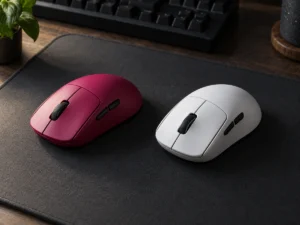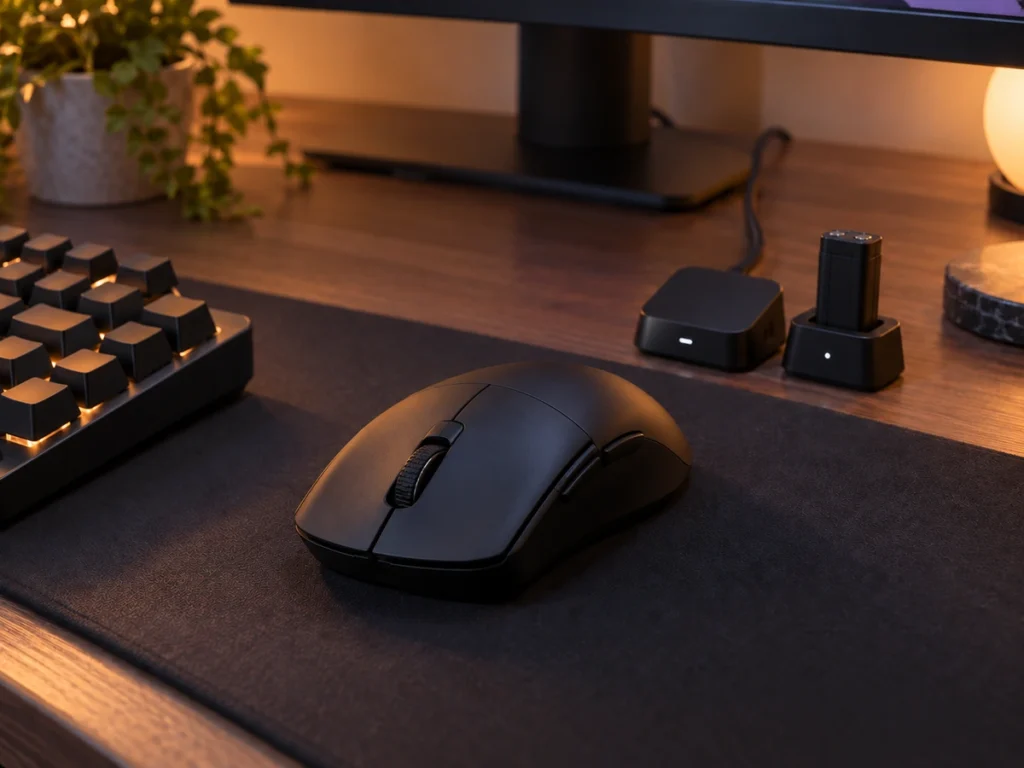
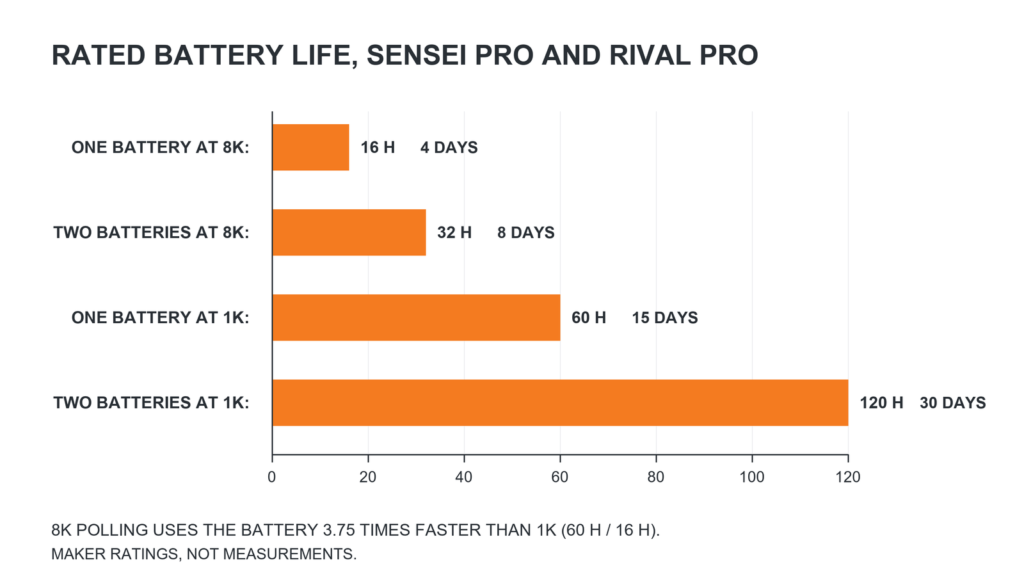
SteelSeries rates its new Sensei Pro and Rival Pro mice at up to 32 hours at 8,000 Hz polling. That figure is two batteries added together. Each of the two hot-swappable packs is rated at 16 hours at 8K, so the mouse in your hand runs half the headline figure before you swap. The four models went up for pre-order on September 29, 2026 at $179.99, €199.99 or £169.99, with shops stocking them from October 13. SteelSeries calls them the first mice to rely on Ultra-Wideband radio alone, with no 2.4 GHz link.
Sixteen hours per battery, in days
The press release and the product page give the same four numbers. At 1K, one battery is rated at 60 hours. The pair doubles both, which is where the headline comes from.
At four hours of play an evening, a single battery at 8K is flat after four days. At 1K the same pack lasts about fifteen. Divide one rating by the other and 8K polling drains the battery 3.75 times as fast, which is the price of reporting position eight times as often.
The second battery changes how that feels. You charge one pack while the other is in the mouse, so a flat battery never leaves you waiting at a cable. It does leave you with a chore every few days, and SteelSeries has not said how long a swap takes, whether the mouse stays paired during it, or what a spare pack will cost. Battery capacity is missing from both pages too.
SuperSync complicates the arithmetic. It lets the sensor report at 1K, 2K or 4K while clicks still go out at 8K. SteelSeries publishes no battery figure for those mixed settings, so the two single-battery ratings are the only points you can plan around.
What the Ultra-Wideband link adds
The Sensei Pro talks to a base station that sits on the desk and plugs into the PC by USB, on a band between 6.4 and 9.056 GHz. SteelSeries says that gives about 20 times the bandwidth of 2.4 GHz, where headsets, keyboards and Wi-Fi compete for space. It also says the mouse sends one extra packet for every eight, which it calls 9K over-polling, to keep a full 8K arriving at the PC.
Nobody outside SteelSeries has measured the link yet. The claim that rivals “fake” 8K by bundling packets comes from the product page, with no test attached.
The base station is the only receiver in the box, alongside a USB-C to USB-A cable, grip tape and a spare set of PTFE feet. A smaller Wireless Travel Dongle costs $24.99 and is sold only on SteelSeries’ own store, so a laptop bag setup adds that to the price. Neither the press release nor the product page mentions Bluetooth. Windows 10 or later is required, and on PlayStation and Xbox Series consoles SteelSeries warns that not all features may work.
The Sensei shape at 53 grams
The full-size Sensei Pro measures 125.6 by 66.5 by 38.6 mm. Its wired predecessor, the SteelSeries Sensei Ten, measures 126 by 68 by 39 mm, so the outline is within about 1.5 mm in every direction. The weight is not. The Sensei Ten weighs 92 g without its stiff rubber cable, and the Sensei Pro weighs 53 g.
For a Sensei Ten owner, that is the whole case: the same hand position, 39 g lighter and free of the cable. The Mini version, at 118 by 62.5 by 36.2 mm and 49 g, suits fingertip and aggressive claw grips. The Rival Pro and Rival Pro Mini carry the same internals in an ergonomic right-hand shape at the same weights.
Inside all four is the TrueMove 42K Pro, which SteelSeries describes as a customized PixArt 3395 rated at 42,000 DPI, 800 IPS and 70 G. A Max Performance Mode keeps the sensor at 8K and 20,000 frames per second all the time. The optical switches are rated for 100 million clicks and 0.35 ms click latency.
Against the Viper V4 Pro
The closest rival on price is the Razer Viper V4 Pro, from $159.99 at 49 g with 8K polling on Razer’s HyperSpeed receiver. Razer’s spec table rates it at up to 180 hours at 1000 Hz and up to 45 hours at 8000 Hz, against 16 hours for each Sensei Pro battery at 8K. The Viper costs $20 less in the US and comes with its receiver in the box. The Sensei Pro costs more and gives you a battery you can take out and replace yourself.
What the first tests need to show
On paper, wait for the first independent tests before paying $179.99. Two things would settle it. A latency and stability test of the Ultra-Wideband link in a room crowded with wireless gear would show whether the bandwidth claim survives. The price of a spare battery would show what the swap system costs over three or four years of use.
Until then, plan on a battery swap twice a week if you leave it at 8K, and about twice a month at 1K.